


Most workplace training fails for one reason: nobody designed it. Someone was asked to “do a course on X”, built 40 slides, added a quiz, and shipped it. Learning design is the discipline that sits in front of all of that. It decides whether training is the right answer at all, and if it is, what shape it needs to take to actually change behaviour on the job.
This guide covers what learning design is, how it differs from instructional design, the process behind it, and how we apply it across mining, health, government and transport clients in Australia.

What is learning design?
Learning design is the process of turning a performance problem into a structured learning experience that changes what people do at work. It covers the analysis, objectives, sequencing, activities, assessment and evaluation behind a program. Learning designers decide what to teach, in what order, in what format, and how to prove it worked.
The word “design” is doing real work in that definition. A designer makes deliberate, defensible choices. Content is not just gathered and dumped into a module. It is selected, ordered and shaped around what the learner needs to be able to do differently on Monday morning.
That distinction matters commercially. Content production is cheap and getting cheaper. Design is where the value sits, because design is what determines whether anything sticks.
Learning design vs instructional design vs learning experience design
These terms overlap heavily and are often used interchangeably. The differences are mostly about emphasis and setting, not capability. Here is how they actually get used in Australia.
| Learning design | Instructional design | Learning experience design (LXD) | |
|---|---|---|---|
| Primary focus | The whole learner journey, including what happens before and after the formal learning | The instruction itself: objectives, content, sequence, assessment | The felt experience of learning, including usability, emotion and motivation |
| Common setting | Corporate L&D and universities | Corporate L&D, RTOs, government | Digital product teams and eLearning studios |
| Typical job title | Learning designer, learning architect | Instructional designer | Learning experience designer |
| Strongest influence | Design thinking and adult learning theory | Systematic models such as ADDIE and Merrill | UX and service design |
| Where you see the term | Increasingly the default in Australian corporate L&D | Still dominant in job ads and accredited training | Emerging, mostly in digital-first teams |
If you want the longer treatment, we have written a full comparison of educational design, learning design and instructional design, plus a standalone explainer on what instructional design is.
Our honest take: the label matters far less than whether the person can run a needs analysis, write a measurable objective, and defend a design decision to a sceptical subject matter expert. The international competency standards for the profession, maintained by ibstpi, describe the same core skill set regardless of job title.
The learning design process: 7 steps
Good learning design follows a repeatable sequence. This is the process we use, and it maps closely to the ADDIE model.
- Analyse the performance gap. Work out what people are doing now, what they need to do instead, and whether the cause is skill, knowledge, motivation, tooling or process. A learning needs analysis is where this happens.
- Confirm learning is the right lever. If the real problem is a broken system or an unclear policy, training will not fix it. Say so early.
- Write measurable objectives. Each objective names an observable behaviour and the standard it must meet. “Understand the policy” is not an objective. “Escalate a hazard within 15 minutes using the site form” is.
- Choose the modality. Match the format to the behaviour, not to the budget line. Some things need practice with a facilitator. Some things need a 4-minute refresher on a phone.
- Build the high level design. A high level design is the blueprint: modules, sequence, duration, activities, assessment approach and interaction types. This is the document clients sign off before anyone opens Rise 360.
- Develop, pilot and refine. Build it, test it with real learners from the target audience, and fix what breaks. Pilots surface problems that reviewers never will.
- Implement and evaluate. Launch with a plan for reinforcement, then measure the impact of the program against the behaviours you named in step three.
Steps one to three are where most of the value is created, and they are the steps most often skipped. When a program lands badly, the failure almost always traces back to a fuzzy objective or a needs analysis that never happened.
The evidence base behind learning design
Learning design is not a matter of taste. There is a body of research behind the choices, and it is worth knowing what it says.
People forget fast unless you plan for it
The Ebbinghaus forgetting curve shows how sharply retention drops after a single exposure. This is why one-off training days rarely change anything, and why spaced reinforcement, microlearning and job aids are built into good designs from the start.
Most capability is built on the job
The 70:20:10 model puts the majority of workplace learning in the flow of work, with a minority coming from formal programs. A designer who ignores the 70 builds beautiful courses that never transfer.
Instruction works better in a certain order
Merrill’s first principles of instruction hold that learning improves when learners engage a real problem, activate prior knowledge, see a demonstration, apply the skill, and then integrate it into their own context. That sequence shows up in almost every design we build.
Evaluation needs levels, not vibes
The Kirkpatrick model separates reaction, learning, behaviour and results. Reaction scores are the easiest to collect and the least useful. Designing for level three and four from the outset changes what you build.
Accessibility is a design decision, not a compliance afterthought
Digital learning needs to work for people using screen readers, keyboard navigation and captions. The Web Content Accessibility Guidelines published by the W3C are the reference standard, and retrofitting them after a build is far more expensive than designing to them from the start.
How to design online learning that people finish
Here is what determines whether an online program works.
- Keep modules short and self-contained. A learner should be able to finish something useful in one sitting, on the device they actually have.
- Front-load the “why”. Adults disengage fast when relevance is unclear. Open with the situation they recognise – the WIIFM (what’s in it for me?) – not the learning objectives slide.
- Design for practice, not exposure. Scenarios, decisions and consequences beat click-to-reveal. If the learner cannot get it wrong, they are not learning.
- Write like you’re in the room with them. Short sentences, plain language, one idea per section. Speak directly to the person reading it. Add warmth, active language, and a bit of humour where it fits. Nobody finishes a module that reads like a policy document.
- Build in retrieval. Low-stakes questions spread through the program do more for retention than a single end-of-course quiz.
- Plan the reinforcement before launch. Manager conversations, job aids and follow-up nudges are part of the design, not a nice-to-have.
- Check it on a phone and with a screen reader. Both, before sign-off.
We build in Articulate Rise 360, Storyline 360, Chameleon Creator and HTML, and we choose between them based on the design, not the other way around. If you are weighing the two most common options, our Rise 360 vs Storyline 360 comparison breaks down where each one wins.

Women Up North Housing A small, stretched team supporting women escaping domestic violence needed training that respected both the sensitivity of the content and the reality of their workload. We designed a program that could be completed in short bursts without losing the depth the subject demanded. Read the Women Up North Housing case study.
What learning design looks like in high-stakes industries
The stakes change the design. In mining, rail, health and utilities, a design flaw is not an inconvenience, it is a risk control that failed.
Under the model work health and safety laws, a business must provide the information, training, instruction and supervision needed to keep workers safe. Safe Work Australia’s guidance on training and supporting your workers is explicit that the material must be understandable to the person receiving it. That is a design requirement, not a paperwork requirement. Training that technically exists but nobody can follow has not met the duty.
We used a staged practice-and-verification structure with Major Transport Infrastructure Authority’s (MTIA) railway signalling testers training, because the consequence of a partially competent tester is not a low quiz score. Similar thinking runs through our work on the Level Crossing Removal Project, Metro Trains Sydney and South32.
Where training is nationally recognised, the design also has to satisfy the 2025 Standards for Registered Training Organisations. That means mapped assessments and defensible evidence, on top of everything else the design has to do.
Who does learning design, and when to bring in help
Plenty of organisations run learning design in-house, and should. The question is where the gaps are.
A dedicated designer or partner usually earns their place when one of these is true:
- The program carries regulatory, safety or reputational risk
- The subject matter experts have the content but no way to structure it
- The audience is large, distributed or hard to reach
- Previous attempts have been built and ignored
- The organisation is mid-change and needs the learning to land in a specific window
If you have the capability and want to sharpen it, Instructional Design for Teams run through Instructional Design Australia is built for exactly that. If you need the work done, that is what our learning design and learning strategy teams do.
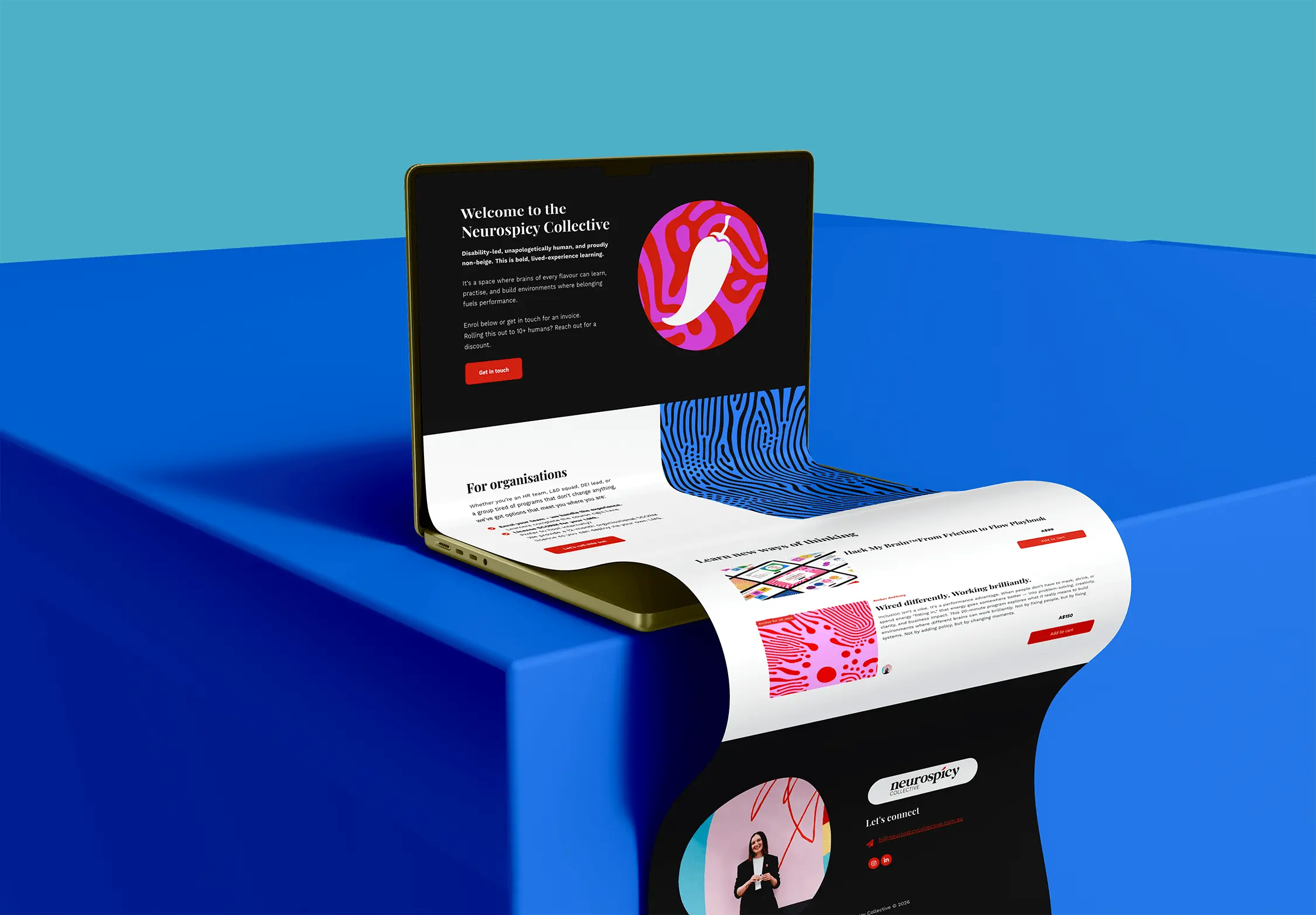
Neurospicy Collective Amber’s sell-out workshops needed a platform that matched the energy of the brand and the ambition of the business. We configured her LearnWorlds LMS from scratch and designed the learner journey around it, so the online experience felt like the workshops rather than a watered-down version of them. Read the Neurospicy Collective case study.
Five learning design mistakes we see constantly
- Starting with content. The subject matter expert sends 90 slides and the project becomes a formatting exercise. Start with the behaviour instead.
- Objectives that cannot be observed. If you cannot see whether someone did it, you cannot assess it or evaluate it.
- Choosing the format first. “We need an eLearn” is a solution looking for a problem. Not everything belongs in an eLearn.
- No plan for after launch. Without reinforcement, the forgetting curve does its work and the investment evaporates.
- Reviewing with stakeholders instead of learners. Executives catch typos. Learners catch the design flaws that matter.
FAQs
Frequently asked questions about learning design
There is no single required qualification. Many designers come from teaching, subject matter expertise, communications or L&D coordination. Employers generally look for demonstrated capability and a portfolio over a specific degree. Industry certificates and microcredentials are a common route in, particularly for career changers from teaching. We offer a Professional Certificate in Instructional Design for those wanting to become instructional designers or improve their skills, supported with coaching sessions, templates and guides.
Learning that lands, not learning for its own sake
Learning design is the difference between a program people tolerate and a program that changes how work gets done. We start with the performance problem, design backwards from the behaviour, and build only what earns its place.
If you have a capability gap and no clear plan, start with learning strategy. If you know what you need built, our learning design and eLearning teams can take it from brief to launch. Tell us what needs to change and we will tell you honestly whether training is the answer.
References
- Safe Work Australia, Training and supporting your workers to stay safe at work
- Australian Skills Quality Authority, About the 2025 Standards for RTOs
- Department of Employment and Workplace Relations, 2025 Standards for Registered Training Organisations
- W3C Web Accessibility Initiative, WCAG 2 Overview
- ibstpi, Instructional Designer Competencies
- Advanced Distributed Learning Initiative, gov

