


You can build fast. Or you can build right. Rarely both without a plan. That plan is a high level design — and skipping it is one of the most expensive decisions a learning team can make.

A High Level Design, or HLD, is where a learning solution takes shape before a single module is built. It sets direction. It removes guesswork. It gives you something solid to test, challenge, and approve.
If you skip this step, you are not saving time, you are deferring decisions. That cost shows up later, and it’s always higher than the cost of getting the design right upfront.
What is a High Level Design?
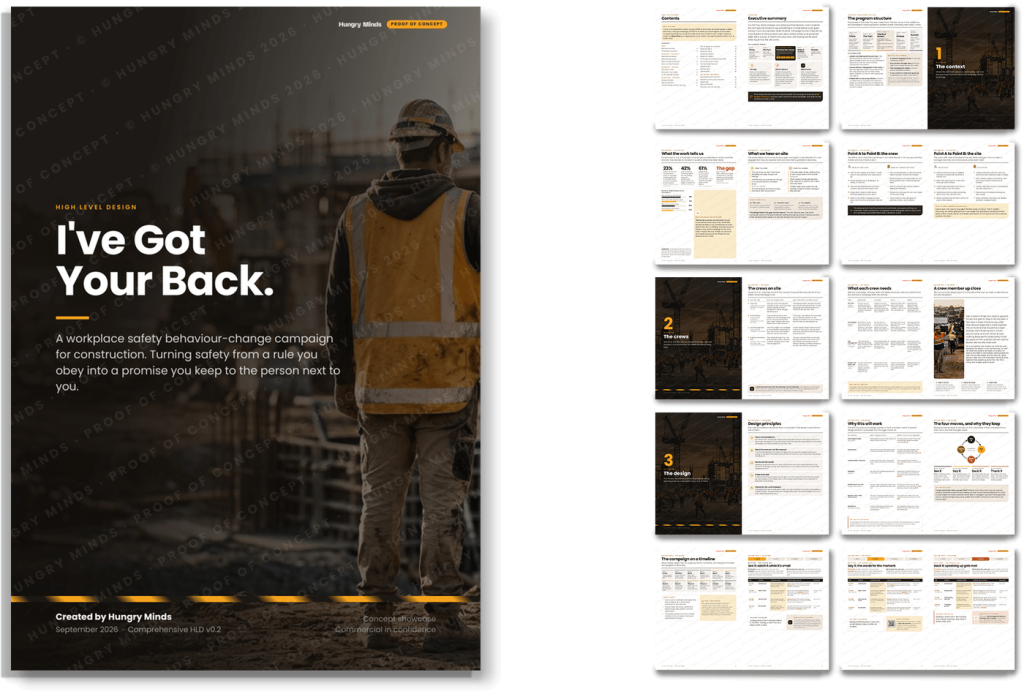
A high level design (HLD) is a structured blueprint for your learning solution — it defines what will be built, for whom, and why, before development begins.
- What problem are we solving?
- Who is this for?
- What needs to change?
- What will the learning look like?
- How will it be delivered?
- How will success be measured?
It does not build the course — it defines it.
A strong high level design typically includes the following components:
- Audience profiles and context
- Learning outcomes tied to business goals
- Content structure and flow
- Modality decisions: digital, workshop, blended
- Assessment approach
- Technology considerations
- Risks, assumptions, constraints
You end up with a clear, shared view of what will be built and why.
The learning science behind high level design
An HLD is not a project management exercise. It is a design decision grounded in how people learn.
Three areas of learning science directly shape how we approach HLDs.
Needs analysis: start with the gap, not the content
Every HLD begins with a needs analysis. This is the process of identifying the gap between where your people are now and where they need to be. Without this step, you are designing for assumptions.
Research consistently shows that training built without a proper needs analysis fails to shift behaviour or improve performance. You end up with content that feels relevant to the content owner but misses the mark for the learner.
A good needs analysis examines the business problem, the target audience, their existing capability, the environment they work in, and the barriers to performance. It asks: is this a knowledge gap, a skill gap, or something else entirely? Sometimes the answer is not training at all.
Learning outcomes: define the destination first
Once you understand the gap, you write learning outcomes. These are specific, measurable statements about what learners will be able to do after the program. They drive every design decision that follows.
We use Bloom’s Taxonomy to pitch outcomes at the right cognitive level. There is a difference between asking someone to recall a policy and asking them to apply it in a complex scenario. The taxonomy gives us six levels of cognitive complexity: remember, understand, apply, analyse, evaluate, and create. Each level demands a different type of learning experience.
If your outcomes sit at the “remember” level but your business needs people to “evaluate” and “apply,” you have a mismatch. The HLD is where we catch that early.
Cognitive load: respect how the brain works
People can only process a limited amount of new information at once. Cognitive Load Theory, developed by John Sweller, tells us that poorly structured learning overwhelms working memory and reduces retention.
This matters at the design stage. An HLD that maps content structure, sequencing, and modality is actively managing cognitive load. We decide what to chunk, what to scaffold, what to space out over time, and what to reinforce through practice.
These decisions happen in the HLD, not during development. If you leave them to the build phase, you end up with content dumps dressed up as courses.
Where HLDs sit in ADDIE
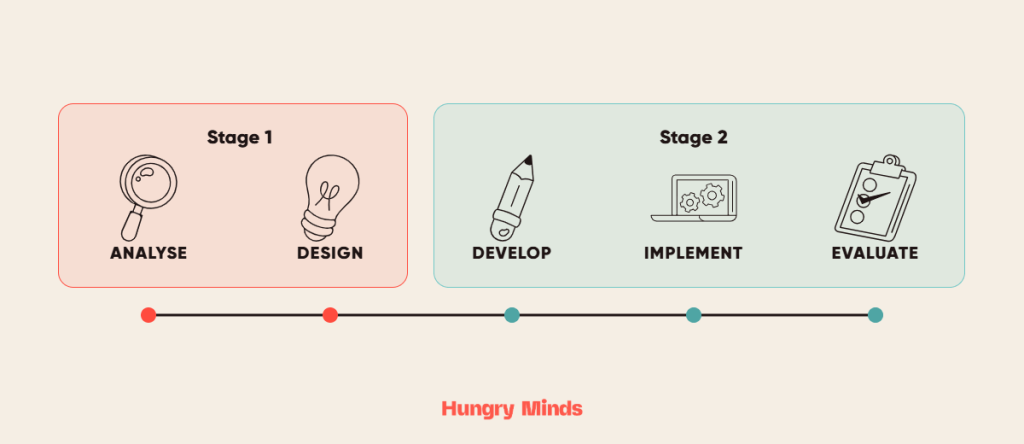
Stage 1: Analyse and Design
This is where the HLD lives. We diagnose the problem, conduct a needs analysis, define measurable outcomes, understand your audience, and shape the solution. The HLD is the output — the agreed design intent, backed by evidence and aligned to business goals.
Stage 2: Develop, Implement and Evaluate
This is where we build, launch, and measure impact — using a framework like Kirkpatrick’s four levels — then refine based on what the data tells you.
Without a solid Stage 1, Stage 2 becomes rework. You build, then fix, then rebuild. The HLD is what stops that cycle before it starts.
The architect analogy
Think about building a house.
You do not start pouring concrete on day one. You start with an architect.
They ask questions:
- How many bedrooms?
- How you live day to day?
- Where the light comes in?
- What matters to you?
They review your site. They discuss budget. They test options.
Then they produce plans and specifications. Often with renders so you can see what you are getting.
That is your HLD.
It gives you clarity before construction starts. You can walk through the design. You can challenge it. You can change it. The cost to adjust is low.
Move a wall on a plan: small effort, small cost.
Move a wall after the house is built: different story. Time. Money. Disruption.
I have lived both versions.
I designed one of my own homes. I like it. But from the dining table, you can see into a bathroom. That is what happens when you follow a process without the depth of experience behind it.
My next house was designed by an architect. No such issues.
The difference is not the process. It is the skill and experience behind it. That is the role of an experienced learning design team — we see the issues before they are built in.
Why a high level design matters for your organisation
- Clarity before commitment. You align stakeholders early. Everyone knows what’s being built and why before development begins. No surprises at review. No scope creep mid-build.
- Faster decisions. You make the hard calls once — during design — not repeatedly during development when changing course is expensive.
- Better learning outcomes. Less content, better structured, outperforms more content poorly organised. Every time. Designing for outcomes rather than volume isn’t a philosophy. It’s what the evidence says.
- Retained learning. When you plan for spaced practice, retrieval activities, and real-world application at the design stage, learners remember more and apply it sooner. These aren’t afterthoughts. They’re design decisions — and they belong in the HLD.
- Control over scope and cost. You understand what you’re committing to before you commit to it. That’s not just good project management. It’s good sense.
How clients use HLDs
Not every client comes to us with a training project already approved and funded. Some are still making the case internally. Some are responding to an RFP. Some are applying for a grant.
An HLD works in all of these situations because it shows you’ve done the thinking. It’s a credible, structured plan that stakeholders can interrogate and decision-makers can act on. Whether you’re locking scope before development, securing internal buy-in, or supporting a change management conversation, the HLD does the same thing: it turns intent into something concrete.
What makes a good HLD
Not all HLDs are equal.
A good one is:
- Grounded in real business needs
- Clear on outcomes and measures
- Informed by learning science, not guesswork
- Practical to build
- Designed for the audience, not the content owner
- Honest about constraints
A weak one is:
- Vague
- Content heavy, outcome light
- Disconnected from how people actually work
- Built on assumptions no one has tested
Our approach at Hungry Minds
We do not treat HLDs as paperwork. We treat them as decisions.
We bring:
- Experience across industries and learning contexts
- Structured methods grounded in evidence-based practice
- The ability to challenge when needed
- Clear, usable outputs — something your stakeholders can understand and your team can act on
You’ll know what you’re building. More importantly, you’ll know why.
If you are about to invest in learning, pause before you build. Get the design right first.
It is faster to adjust a plan than to fix a finished product.
And you avoid the learning equivalent of a bathroom facing the dining table.
Want to talk about a High Level Design for your next project?
Get in touch or call us on 1300 162 393.
Learn more about our learning strategy and learning design services.