

University Degree or Industry Professional Certificate? The Real Question for Future Instructional Designers
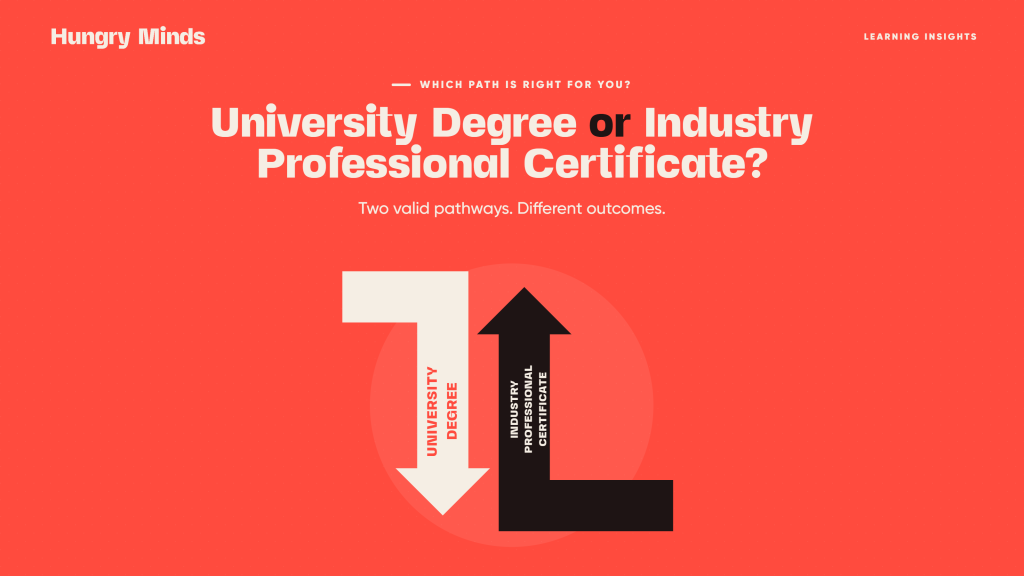
If you are thinking about becoming an instructional designer, learning designer or eLearning developer, you will quickly find two very different pathways.
One pathway is a university degree, such as Monash University’s Bachelor of Learning Design and Technology or similar university programs. These courses often run for several years, carry a significant cost and are positioned as broad academic qualifications in learning design, educational technology, creativity, psychology, artificial intelligence, simulations and related fields. Monash describes its course as a three-year full-time degree, or six years part time, with work-integrated learning and exposure to areas such as artificial intelligence, simulations, corporate training and career development. (Monash University)
The other pathway is an industry-led professional certificate, such as the Instructional Design Australia Professional Certificate in Instructional Design. This course is currently listed at $2,990, with a usual price shown as $4,496. It is a 12-week, self-paced, hybrid-online program with one-on-one coaching, practical templates and guides, an instructional design toolkit, four microcredentials and digital badges. (Hungry Minds)
On paper, both options teach “learning design”. In reality, they are built for very different purposes.
The cost difference is hard to ignore
A university degree can be a major investment.
Using Monash as one example, the Bachelor of Learning Design and Technology lists the average annual student contribution for a Commonwealth Supported Place in 2026 as $7,500. Across a three-year full-time course, that is approximately $22,500. The full-fee amount is listed at $36,700 per year. Across three years, that would be approximately $110,100 before other study-related costs. Monash also notes that fees are subject to annual change and that the Student Services and Amenities Fee may apply. (Monash University)
By comparison, the IDA Professional Certificate is currently listed at $2,990. (Hungry Minds)
That does not automatically make it better for everyone, but it changes the decision. A learner needs to ask a simple question:
Am I paying for employable capability, or am I paying for a formal academic credential?
Those are not the same thing.
What is a professional certificate?
A professional certificate is not the same thing as a university degree. It is an industry term for a course designed to build professional capability in a specific field.
That distinction matters.
A university degree is usually designed around an academic curriculum, formal assessment structures and broad theoretical coverage. A professional certificate is usually designed around practical competence: what someone needs to know, practise and produce to work effectively in a specific role or industry.
That is the case with the IDA Professional Certificate. It is not trying to imitate a university degree. It is designed by industry, for industry. The course page describes the program as helping learners apply learning theories, instructional design principles and technologies, practise with templates and guides, receive personalised coaching and earn four microcredentials that stack into the Professional Certificate. (Instructional Design Australia)
Professional credibility does not belong exclusively to universities anymore. Cisco, AWS, Google, Microsoft, and a growing list of AI companies now offer practical credentials that demonstrate real capability in specific tools, roles, and domains. These credentials do not replace every university pathway, but they show that the market is increasingly hungry for specific, practical and job-ready skills.
The IDA Professional Certificate sits squarely in that movement toward industry credentials.
Universities give you the theory. The IDA Professional Certificate gives you the skills to apply it. The how, not just the what. The doing, not just the knowing. By the time you finish, you are not just across the concepts. You are ready to use them.
Industry credentials are growing because work is changing
The rise of industry credentials is not random. It reflects a bigger shift in hiring and workforce development.
The World Economic Forum’s Future of Jobs work highlights how quickly skill requirements are changing, with employers expecting significant skill disruption through to 2030. (World Economic Forum) Jobs and Skills Australia has also noted that more than 90% of employment growth over the next decade is expected to be in jobs needing post-secondary qualifications, but only around half of that growth is expected to be in university-qualified roles. (Jobs and Skills Australia)
That point is critical.
The future is not “degree or nothing”. The future is capability, evidence, adaptability and ongoing professional learning.
For instructional design, that matters because the field moves quickly. Tools change. Client expectations change. AI is changing how content is drafted, reviewed, adapted and produced. Employers need people who can learn quickly, work with stakeholders and produce useful learning materials, not only people who can talk about learning theory.
Assessment matters: industry standards vs academic standards
One common misunderstanding about professional certificates is that they are less rigorous because they are not university degrees. That is not necessarily true.
The IDA Professional Certificate includes assessment against a rubric and a standard that must be met. The difference is that the standard is industry-defined. In other words, learners are assessed against the kinds of expectations that matter in real instructional design work: clarity, structure, application of adult learning principles, quality of learning outcomes, suitability of learning activities, visual design, practical usability and the ability to produce materials that could work in a real organisational context.
That is different from many academic standards, which may place greater weight on research, referencing, theoretical discussion, essays and critical analysis. Those skills have value, especially in university settings, but they are not always the same skills required to succeed as a working instructional designer.
In the workplace, a learning designer is rarely asked to write an academic essay about instructional design theory. They are more likely to be asked to design a module, create a storyboard, simplify complex content, work with a subject matter expert, build a participant workbook or produce a learning solution that meets a business need.
That is why an industry-defined assessment standard can be highly relevant. It tests whether a learner can apply instructional design principles in a practical way, not simply whether they can discuss those principles academically.
This reflects a broader shift in how employers think about capability. A transcript tells them someone completed subjects. A portfolio, a rubric-assessed project, and an industry credential tells them whether someone can actually do the work.
For instructional design, that distinction is critical. A strong professional certificate should not be judged by whether it imitates university assessment. It should be judged by whether it prepares someone to perform in the role.
What university degrees often provide
University learning design degrees can provide a broad introduction to theory, educational technology, psychology, research, digital learning trends and future-focused learning environments.
Monash, for example, says its course explores creativity, technology, psychology, artificial intelligence, simulations, corporate training and career development. It also says the course was designed with industry leaders and includes transferable skills such as project management, leadership, critical thinking and data-driven decision-making. (Monash University)
For some learners, that broader academic pathway will make sense. A university degree may suit people who want a formal undergraduate qualification, people entering the workforce for the first time, people who may want to work in higher education, people who enjoy academic study, theory and research or people who want a long-form university experience.
But here is the question worth asking. Does broader academic depth make someone a better instructional designer in practice?
In many real workplace settings, the answer is: not necessarily.
The uncomfortable reality about many university courses
A lot of university learning still relies heavily on readings, discussion boards, embedded content, assessments and academic tasks. Some of that content is valuable. Some of it is interesting. Some of it builds useful theoretical awareness.
But reading about learning design is not the same as doing learning design.
In the real world, instructional designers are not usually paid to discuss theory in isolation. They are paid to solve performance problems, work with subject matter experts, make complex information easier to understand, design learning experiences, write clean content, build materials, manage scope and deliver quality work on time.
A designer may understand cognitive load theory, constructivism, behaviourism, assessment theory and human-centred design. That knowledge is useful. But if they cannot turn a messy 90-page policy document into a clear 20-minute module, manage a difficult SME or create a usable storyboard by Friday, the theory does not carry the project.
That is where many academic pathways can fall short.
Knowing is not doing. And in instructional design, the doing is the job.
Some university courses are losing relevance
Universities still matter. Degrees still matter for many professions. But it is also clear that some university courses are under pressure because the labour market is changing faster than traditional course structures.
Jobs and Skills Australia’s point that future job growth will require post-secondary qualifications, while only about half of that growth will require university-level qualifications, is important. It suggests the labour market is moving toward a broader mix of qualifications, including vocational, professional, industry and skills-based pathways. (Jobs and Skills Australia)
There is also growing concern about whether universities are producing graduates who are sufficiently work-ready. Recent reporting on Jobs and Skills Australia’s position highlighted concerns that some graduates lack practical experience and employability skills, with calls for stronger collaboration between universities, TAFEs and employers. (The Australian)
This does not mean university courses have no value. It means their value depends on the field, the role, the quality of teaching, the recency of industry exposure and whether the program builds capability employers actually want.
For instructional design, that last point is crucial.
A course can cover every learning theory ever written. If it does not build the practical skills to apply them, it has not prepared anyone for the job.
Teacher experience matters
Prospective students should look carefully at who is actually teaching the course.
Some university academic staff bring strong research backgrounds, teaching credentials and theoretical expertise. That has genuine value for learners who want an academic or research-informed pathway.
But it is also fair to ask:
- When did this person last work as a commercial instructional designer?
- Have they delivered projects for corporate, government, not-for-profit or health clients?
- Have they managed real stakeholder pressure?
- Have they built actual eLearning modules, facilitator guides, participant workbooks, scenario-based assessments or blended programs?
- Have they had to balance learning science, client expectations, budget, quality and deadlines?
That is not a criticism of universities as institutions. It is a practical question about relevance. In instructional design, recency of real project experience matters.
IDA’s model is different. Its coaches are industry practitioners. They work on real projects, with real clients, real deadlines and real constraints. The Professional Certificate includes live one-on-one personalised coaching sessions with senior instructional design experts. Its listed coaches include practitioners with current instructional design, coaching, corporate learning and consulting experience. (Hungry Minds)
That gives learners something a purely academic course can struggle to provide: exposure to how instructional design actually works outside the classroom.
Less “here is what the research says.” More “here is what I did last Tuesday.”
Jobs and Skills Australia’s point that future job growth will require post-secondary qualifications, while only about half of that growth will require university-level qualifications, is important. It suggests the labour market is moving toward a broader mix of qualifications, including vocational, professional, industry and skills-based pathways. (Jobs and Skills Australia)
There is also growing concern about whether universities are producing graduates who are sufficiently work-ready. Recent reporting on Jobs and Skills Australia’s position highlighted concerns that some graduates lack practical experience and employability skills, with calls for stronger collaboration between universities, TAFEs and employers. (The Australian)
This does not mean university courses have no value. It means their value depends on the field, the role, the quality of teaching, the recency of industry exposure and whether the program builds capability employers actually want.
For instructional design, that last point is crucial.
A course can cover every learning theory ever written. If it does not build the practical skills to apply them, it has not prepared anyone for the job.
What real instructional design work requires
Hiring managers are not just reading your transcript. They are looking at what you can do.
Instructional design roles are built around applied skills. Designing end-to-end learning solutions. Applying adult learning principles. Producing digital learning. Working with SMEs. Creating engaging materials. Building capability. Developing onboarding content. Improving organisational performance.
That reflects what hiring managers often look for. They want to know:
- Can you write well?
- Can you structure content?
- Can you design for behaviour change?
- Can you work with SMEs?
- Can you use common tools?
- Can you produce materials?
- Can you take feedback?
- Can you meet deadlines?
- Can you show a portfolio of programs you built?
A university degree may help with some of these things, but it does not guarantee them. A practical, industry-led program is designed specifically around these questions. Not around what looks good in an academic curriculum. Around what gets someone hired, and what makes them good at the job once they are.
The IDA difference: learning by doing
The IDA Professional Certificate is built around one idea: you learn instructional design by doing instructional design.
Learners work through the ADDIE process. They conduct a learning needs analysis, write active learning outcomes, design for different delivery modes, apply visual design principles, practise consulting skills, and use real tools and templates..
By the time they finish, they have a portfolio piece. Something they made. Something they can show.
And that matters more than most people realise.
A transcript tells an employer what someone studied. A portfolio shows what they can produce. In instructional design, employers and clients want to see how someone thinks, writes, structures, simplifies and designs. They want evidence of capability, not evidence of study.
The coaching component takes it further. Three 60-minute one-on-one sessions with a senior instructional designer. Real feedback on real work. Support through the process. Guidance to sharpen consulting skills and close the gaps.
That is a long way from reading a chapter, posting on a discussion board, and submitting an essay.
One builds knowledge about instructional design.
The other builds an instructional designer.
Pros and cons of university learning design degrees
University degrees have strengths.
They offer formal recognition. They may provide broader theoretical grounding. They can suit learners who want a structured academic pathway. They may be useful for people wanting to work in higher education, research or roles where a degree is expected. They can also provide time to explore ideas in depth.
But the limitations are real.
They are expensive. They take years. They may include content that is interesting but not directly useful in day-to-day instructional design work. Some teaching may be delivered by academics whose current industry project experience is limited. Some courses may rely heavily on readings, embedded materials and academic assessment rather than real-world production.
For someone who wants to become an employable instructional designer quickly, that is a serious trade-off.
Pros and cons of the IDA Professional Certificate
The IDA Professional Certificate is shorter, more affordable and more directly focused on practical work. It gives learners templates, coaching, microcredentials, digital badges and a structured process they can use immediately. It is taught and supported by people who work in the industry and understand the realities of client projects.
Its strength is not that it tries to be a university degree. Its strength is that it does not.
It is built for people who want to do the work.
The main limitation is that it is not a formal university qualification. For some roles, especially in higher education or government, a degree may still help. For learners who want deep theory, academic research or a multi-year university experience, a degree may be the better fit.
But if the goal is to actually do the work, to design, build, deliver, and produce, the IDA pathway is where that happens.
Less citing theory. More applying it.
So which pathway makes more sense?
If you want theory, research, academic structure and a formal qualification, a university degree from Monash or a similar institution may make sense.
But if you want to know what it is like to work as an instructional designer in the real world, produce real materials, manage real constraints and learn from people who do the job every day, then an industry-led professional certificate is likely to be the more practical pathway.
The honest conclusion is this:
University degrees may teach you about learning design. IDA teaches you how to do learning design.
For many people entering the profession, that difference matters.
Its strength is not that it tries to be a university degree. Its strength is that it does not.
It is built for people who want to do the work.
The main limitation is that it is not a formal university qualification. For some roles, especially in higher education or government, a degree may still help. For learners who want deep theory, academic research or a multi-year university experience, a degree may be the better fit.
But if the goal is to actually do the work, to design, build, deliver, and produce, the IDA pathway is where that happens.
Less citing theory. More applying it.
Final verdict
The is not a choice between a “short course” and a “proper degree”. That framing misses the point entirely.
It is a choice is between an academic pathway and a professional practice pathway.
University degrees like Monash may suit learners who want theoretical depth, formal recognition, and a broader educational experience.
But in the instructional design job market, practical capability consistently matters more than academic credentials. Employers want people who can analyse needs, work with stakeholders, write clearly, design effectively and produce usable learning materials.
That is where the IDA Professional Certificate has a strong advantage.
It is practical. It is coached by people who do this work every day. It is assessed against real industry standards. It is around the actual job, not a curriculum designed for academic compliance. It respects learning science and also respects the commercial reality of the profession: quality matters, but so do deadlines, budgets, stakeholders and getting the work done.
For learners who want to study learning design, university may be the right call.
For learners who want to become instructional designers, the IDA Professional Certificate is built for the real world.
One teaches you about the job.
The other gets you ready for it.