

One of the most common questions we get: should we go digital or keep it in the room?
The eLearning vs face-to-face debate has been running for decades. And honestly? It is the wrong question.
Asking which format is better is like asking whether a knife or a fork is the better utensil. The answer depends entirely on what is on the plate. Both have a place. Neither works for everything.
What does matter is understanding the real differences between the two. Cost, flexibility, effectiveness, learner experience. Get that right and the format decision makes itself.
eLearning vs face-to-face learning: the key differences
eLearning and face-to-face learning are two fundamentally different approaches to delivering training. Neither is universally superior, but each has strengths that make it the right choice in specific circumstances.
eLearning delivers learning digitally, typically through interactive modules that include branching scenarios, video, and knowledge checks, accessed via a learning management system (LMS). Learners complete content in their own time, at their own pace, on a device of their choosing. Consistent delivery every single time, to one person or ten thousand, without scheduling a room, booking a facilitator, or asking anyone to travel. Built well, it is engaging, practical, and genuinely sticky.
Face-to-face learning brings people together in the room. Workshops, facilitator-led sessions, seminars, coaching. Real conversation, live practice, immediate feedback, and the kind of energy and connection that a screen simply cannot replicate. When you need people to collaborate, build trust, practise complex skills, or shift culture, this is where it happens.
Neither is better. Both are useful. The table below breaks down where each one shines.
| Factor | eLearning | Face-to-face learning |
|---|---|---|
| Delivery mode | Digital, self-paced | In-person, facilitator-led |
| Timing | Asynchronous (learner’s own time) | Synchronous (scheduled) |
| Scale | High — hundreds or thousands simultaneously | Limited by room size and facilitator availability |
| Cost per learner | Lower at scale | Higher per head (venue, travel, facilitator time) |
| Consistency | High — same content, same experience | Variable — depends heavily on facilitator quality |
| Social learning | Limited (unless designed for it) | High — peer interaction, discussion, debate |
| Skill practice | Scenario-based simulation | Live practice with real-time feedback |
| Flexibility | High — accessible anywhere, anytime | Low — fixed location and time |
| Learner accountability | Self-directed | Externally structured |
| Best for | Knowledge transfer, compliance, procedure training, refreshers, software and systems training, just-in-time learning | Attitude change, complex skill-building, team cohesion, hands-on technical/practical training, situations where energy, connection, and presence matter |
Quality in eLearning vs face-to-face: what the evidence says
The question of quality for eLearning vs face-to-face learning is one that researchers have examined in depth, and the findings are more nuanced than the debate usually acknowledges.
A significant body of research has found that well-designed eLearning can be equally effective as face-to-face instruction for knowledge acquisition and retention. The Australian Institute of Teaching and School Leadership (AITSL) and broader educational research consistently show that learning quality is determined less by delivery format and more by instructional design quality, the clarity of objectives, the engagement of activities, the relevance of content, and the opportunity to apply what has been learned.
Put simply: bad eLearning is bad. But so is bad face-to-face training. A poorly designed workshop wastes a room, a facilitator, and a full day of everyone’s time. At least a poorly designed eLearning module does not require anyone to book a flight.
What genuinely determines quality in either format:
- Clarity of learning objectives — does the training target a specific, measurable change in knowledge, skill, or behaviour?
- Relevance to the learner’s context — does it use their language, their scenarios, their industry?
- Opportunity for active engagement — are learners doing something, or just consuming?
- Feedback mechanisms — do learners know how they are performing and where they need to improve?
- Transfer support — is there something that helps learners apply what they learned back on the job?
These principles apply equally to eLearning and face-to-face learning. Format does not determine quality. Design does.
Where eLearning outperforms face-to-face
There are situations where eLearning is the clear winner. Not because digital is better, but because of what digital makes possible.
Consistency at scale
Need to train 500 people across five states with exactly the same content? eLearning wins. Every learner gets the same experience, the same scenarios, the same feedback. There is no variation in facilitator quality, no drift between sessions, no “that’s not what I was told” after the fact.
This is especially important for compliance training, where consistency is not just a quality concern, it is a legal one. Organisations subject to Australian workplace legislation need to be able to demonstrate that every employee received equivalent training. eLearning makes that straightforward.
Flexible — just-in-time access
Face-to-face training requires learners to be in a room at a fixed time. For frontline workers, remote teams, shift-based staff, and geographically dispersed organisations, that is often impractical. eLearning allows people to complete training when it fits their role, before a shift, between tasks, at a location of their choosing.
Safe Work Australia recognises accessible, timely training as a key component of effective workplace health and safety management — eLearning delivers exactly that.
Knowledge transfer and procedural learning
When the goal is to build knowledge — understanding a policy, learning a procedure, recognising a regulatory requirement — eLearning is hard to beat. Interactive scenarios, branching decisions, and knowledge checks can deliver this content efficiently, with immediate feedback and the ability to revisit material as needed.
Cost efficiency at volume
eLearning has a higher upfront development cost but a lower cost per completion at scale. Once a module is built, every additional learner costs almost nothing. For organisations with large and recurring training needs — annual compliance refreshers, onboarding programs, product knowledge updates — eLearning delivers significant long-term savings.
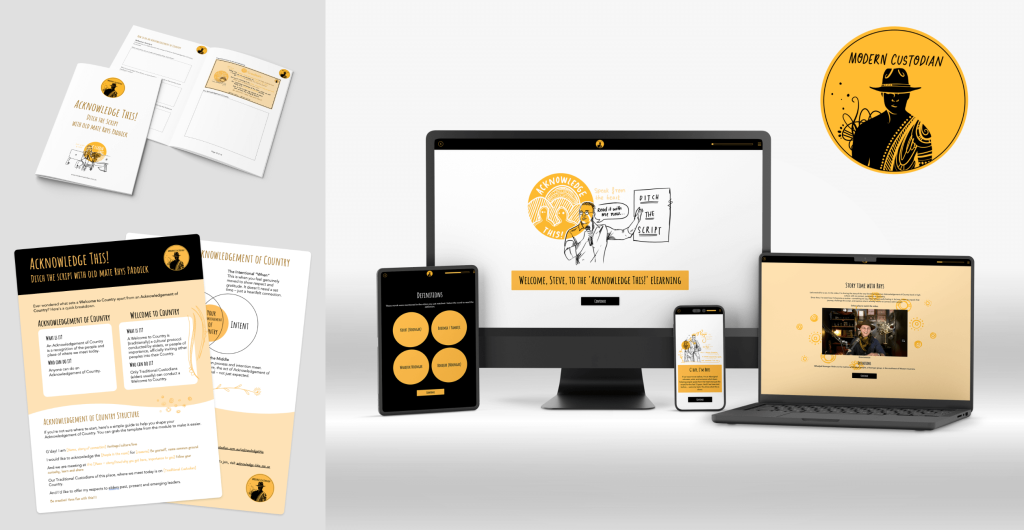
eLearning in action: Modern Custodian
Modern Custodian needed their cultural awareness and Acknowledgement of Country training to reach people across Australia. Demand was growing faster than any facilitator could keep up with. eLearning was the obvious call. The same high-quality experience, available to every learner whenever they needed it, on any device. Meaningful content, accessible to everyone.
Read more: https://hungryminds.com.au/modern-custodian/
Where face-to-face learning outperforms eLearning
There are equally clear situations where face-to-face learning is the right tool, and where eLearning, however well designed, simply cannot do the job.
Complex interpersonal skill-building
Leadership development, communication skills, conflict resolution, negotiation. These skills require human interaction to develop. A learner can watch a video about how to have a difficult conversation. They can read a scenario and choose an answer. But until they have actually done it, with another person, in real time, with the emotional stakes that involves, the skill is theoretical.
Face-to-face workshops provide the practice environment that this kind of learning requires: live role play, peer feedback, facilitated debrief, and the opportunity to try, fail, and try again in a safe setting.
Attitude and culture change
When the goal is not just to inform but to shift how people think and feel — about safety culture, about inclusion, about the organisation’s values — face-to-face learning is significantly more powerful. Discussion, storytelling, and social influence are tools that only work in a room together. You cannot click your way to genuine attitude change.
Team-based learning and cohesion
When learning is also about building relationships — new team formation, cross-functional alignment, leadership team offsites — face-to-face delivery serves dual purposes. The learning outcome and the connection outcome reinforce each other in a way that no online module can replicate.
High-risk, hands-on skills
Emergency procedures, equipment operation, first aid, practical skills that involve physical performance must be learned physically. No amount of interactive eLearning replaces the experience of performing a skill under supervision with real equipment and real feedback.
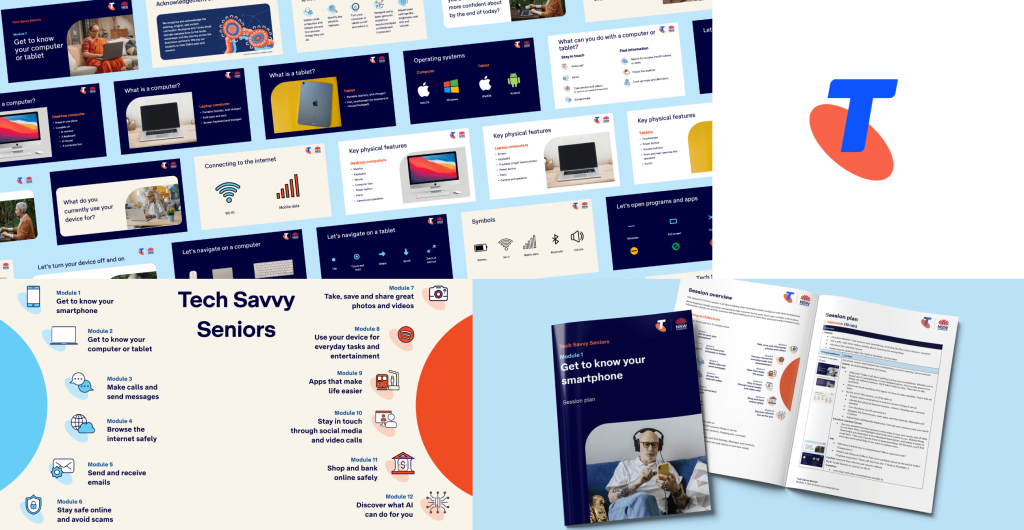
Face-to-face in action: Telstra Tech Savvy Seniors
When Telstra needed to deliver digital skills training to older Australians through community volunteer facilitators, eLearning was never the right tool. The learners needed patience, encouragement, and someone physically in the room to help them when the screen looked unfamiliar. Confidence comes from trying something, getting stuck, and having a person right there to help you figure it out.
We designed the full face-to-face program and trained the volunteer facilitators to deliver it. Warm, practical, and built around what that specific audience actually needed.
Read more: https://hungryminds.com.au/telstra-tech-savvy-seniors/
The false choice: why blended learning is usually the right answer
eLearning vs face-to-face is the wrong fight. Effective workplace learning rarely lives in one format.
The 70:20:10 model of workplace learning, widely applied across Australian organisations and supported by research from the Australian Human Resources Institute (AHRI), holds that 70% of meaningful learning happens through on-the-job experience, 20% through social interaction and peer learning, and 10% through formal training. The real question is not which format to choose. It is how to design a learning experience that uses every available tool well.
That is where blended learning comes in.
Pre-work eLearning builds foundational knowledge before a workshop. The workshop focuses entirely on application and practice. Post-workshop microlearning reinforces key concepts over the following weeks. Each format doing what it does best, in the right sequence, for the right reason.
Getting that sequence right is not guesswork. It is the result of a structured design process, one we follow on every project:

ANALYSE
The Appetiser
Identify key learning priorities to deliver everything you need — and nothing you don’t. No filler, no fluff.

DESIGN
The Recipe
Clarify scope, resources, and learning strategies with decision makers up front. No surprises in your kitchen!

DEVELOP
Made To Order
We build engaging, interactive learning experiences aligned to your goals. Co-designed, iterated and perfected.

IMPLEMENT
Presentation
Prepare the client for a seamless roll-out in face-to-face, virtual, or blended environments. Get pilot-ready and go for launch.

EVALUATE
Taste + Tweak
Review against learning outcomes — find out what to start, stop, and keep. Identify changes for lasting impact.
At Hungry Minds, “not everything belongs in an eLearn” is not just a tagline, it is how we approach every project. Before we recommend a format, we conduct a learning needs analysis to understand the objective, the audience, the context, and the constraints. Sometimes that leads to eLearning. Sometimes it leads to face-to-face. Most often, it points to a blended program that uses each format where each format earns its place.
How to decide: eLearning vs face-to-face learning
Use this as a practical guide when deciding which delivery format, or combination of formats, is right for your training need.
Choose eLearning when:
- You need to reach a large, geographically dispersed audience
- Consistency across every learner is a legal or regulatory requirement
- The content is primarily knowledge-based or procedural
- Learners need flexible, self-paced access
- Budget per learner needs to stay low at scale
- The topic is stable and unlikely to require frequent updates
Choose face-to-face when:
- The skill requires live practice with another person
- The goal is attitude, behaviour, or culture change
- Social learning and peer interaction are part of the outcome
- The audience is small and co-located
- Facilitated discussion, debate, or coaching is central to the design
- Relationship-building is part of the learning objective
Choose blended when:
- The program has both knowledge and skill components
- Learners are dispersed but still need some shared experience
- You need eLearning’s scale with face-to-face’s depth
- Transfer and on-the-job application need active support
- The most honest answer to “which format?” is “both, at different stages”
FAQs: eLearning vs face-to-face learning
Not sure which format is right for your team?
The eLearning vs face-to-face decision is really a question about what your people need to be able to do differently, and which combination of formats will get them there most effectively.
That is exactly what our learning design process is built to figure out. We start with the problem, not the format. And we design programs that use eLearning, face-to-face, and blended approaches where each does its best work.
If you are designing a new training program and are not sure where to start, we are happy to think it through with you.
Contact us | Explore our eLearning services | See how we approach learning design
Hungry Minds is a learning design studio with national reach across Australia. We design eLearning, face-to-face, and blended learning programs that fit your people, your goals, and your context.