
What are Merrill’s first principles of instruction, and why do they work?
David Merrill’s instructional design principles, known as Merrill’s First Principles of Instruction, give learning designers a practical, evidence-based framework for building training that actually works. Merrill identified five core principles shared across effective instructional theories: problem-centred learning, activation, demonstration, application, and integration. Apply them well, and you get learning that sticks. Ignore them, and you get another forgettable PowerPoint nobody asked for.
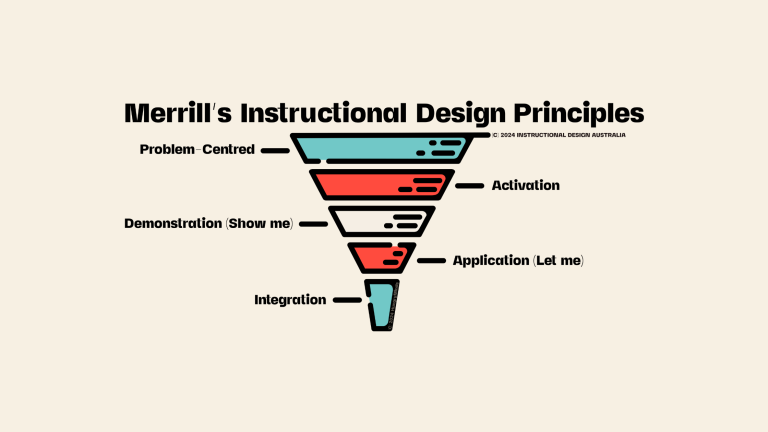
Problem-Centered Learning:
Problem-centred learning sits at the heart of Merrill’s framework. Learners engage with real-world problems from the outset, not abstract theory. The approach unfolds in three stages: show the whole task, engage learners at progressively deeper levels of the problem, then gradually increase complexity. Learning by doing, not learning by watching.

Activation:
Activation means connecting new content to what learners already know. Before introducing new concepts, good instructional design draws on existing knowledge, creating a mental hook for the new material to attach to. It’s the difference between learning that lands and learning that disappears.

Demonstration (Show me):
Show, don’t just tell. Merrill’s demonstration principle means providing worked examples, guided walkthroughs, and multiple perspectives, not just a definition. When learners see a concept modelled in context, they’re far more likely to apply it correctly. Think scenarios, case studies, and annotated examples over slides full of text.

Application (Let me):
Application is where learners move from knowing to doing. Merrill’s principle calls for structured practice opportunities, scenarios, simulations, and real tasks, that build from supported practice toward independent performance. The focus is skill development. You’re helping learners get it right, with feedback along the way.

Integration:
Integration is where learning sticks. This is about ownership, not practice. Learners reflect, adapt, and use their new skills in their real work. They connect it to what they already do, show others, and embed it into daily habits. This is what bakes learning into the culture. Without integration, even well-designed programs fade fast.

Merrill’s instructional design principles aren’t just theory, they’re a practical checklist for building learning that actually moves the needle. Whether you’re designing eLearning, blended programs, or face-to-face sessions, these five principles help you structure every experience for maximum impact. No filler, no fluff, just learning that sticks.

How Merrill’s principles connect to real instructional design practice
Merrill’s first principles of instruction sit alongside other evidence-based frameworks Hungry Minds uses in its work, including Kolb’s Learning Cycle, the Kirkpatrick Evaluation Model, and the 70:20:10 Model. Together, they form a research-grounded approach to designing learning that isn’t just engaging, it drives real behaviour change.
Designing a new workplace learning program? These principles work as a practical checklist at every stage of your design process, from strategy through to evaluation.
FAQS
Merrill’s principles of instructional design identify five conditions that promote effective learning. According to David Merrill’s research, learning is most effective when:
- Learning is problem-centred and learners are engaged in solving real-world.
- Existing knowledge is activated as a foundation for new knowledge.
- New knowledge is demonstrated to the learner.
- New knowledge is applied by the learner.
- New knowledge is integrated into the learner’s world.
When developing your next program, keep Merrill’s five instructional design principles top of mind to ensure your instruction is efficient and effective. Apply Merrill’s principles by:
- Using problem-based learning to engage learners in real-world problems.
- Activating existing knowledge before introducing new content to help them link and meld the ‘old’ with the ‘new’.
- Incorporating multiple demonstrations of the concepts where possible to provide context and deepen learners’ understanding of its application.
- Ensuring that opportunities are included for learners to apply their new insights and practice skills, such as scenarios and simulations.
Helping learners to integrate their new understanding and skills into their own lives through embedding activities to support learning transfer.
Merrill’s five principles of instructional design, also known as Merrill’s First Principles of Instruction, are:
- Problem-centred
- Activation
- Demonstration
- Application
- Integration
Advantage: A clear and concise model for the creation of a learning solution.
Disadvantage: Design-focused only – it does not incorporate how to identify learning needs or to evaluate the program for improvement.
The goal of Merrill’s principles of instruction is to provide instructional designers with a research-grounded framework for creating effective, efficient learning experiences, ones that promote real skill application and behaviour change, not just knowledge retention.
Merrill’s first principles of instruction focus on what good learning design looks like, the core conditions that make instruction effective. ADDIE (Analyse, Design, Develop, Implement, Evaluate) is a process model, it describes how to develop a learning program. The two frameworks complement each other: use ADDIE to structure your process, and Merrill’s principles to guide your design decisions within it.

References
Merrill, M. D. (2002). First principles of instructional design. Educ. Technol., Res. Dev. 50: 43–59.
Bayat, S. (2012). Effects of problem-based learning approach on cognitive variables of university students. Elsevier.
Mossuto, M., (2009). Problem-based learning: Student engagement, learning and contextualised problem-solving.
Radford University (n.d.). Problem Solving, Critical Thinking, and Analytical Reasoning Skills Sought by Employers. Retrieved from https://www.radford.edu/content/cobe/innovation-analytics/analytics/career-prep/report-e.html
Mayer, R.E. (2001). Multimedia learning. London: Cambridge University Press.
Merrill, M.D., Tennyson, R.D. & Posey, L.O. (1992). Teaching concepts: An instructional design guide (2nd Ed.). Englewood Cliffs, NJ: Educational Technology Publications.