

Let’s talk about one of the simplest, most underrated learning tools in the room. Your own notes.
Not the slide deck. Not the facilitator guide. Yours.
Because when it comes to learning that actually sticks, writing your own notes punches well above its weight.
Why handwritten notes still win
There’s a reason this keeps showing up in learning science.
A landmark study by Mueller and Oppenheimer at Princeton University found that people who took handwritten notes performed better on conceptual questions than those who typed notes. Why? Because handwriting forces you to process, not just record. You summarise. You decide what matters. You think.
That’s the point.
Typing often turns into transcription. Writing turns into learning.
There’s a well-established finding in learning science, known as the “generation effect” (Slamecka & Graf, 1978). People remember information better when they produce it themselves rather than just read it. In study after study, participants who generated answers outperformed those who simply reviewed them. More effort in encoding leads to stronger recall later.
Then there’s research from the University of Tokyo in 2021. Participants who wrote notes by hand showed stronger brain activity in areas linked to memory and language. They also remembered information more accurately than those using digital devices.
Three different studies. Same message.
If you want learning to stick, get people writing.
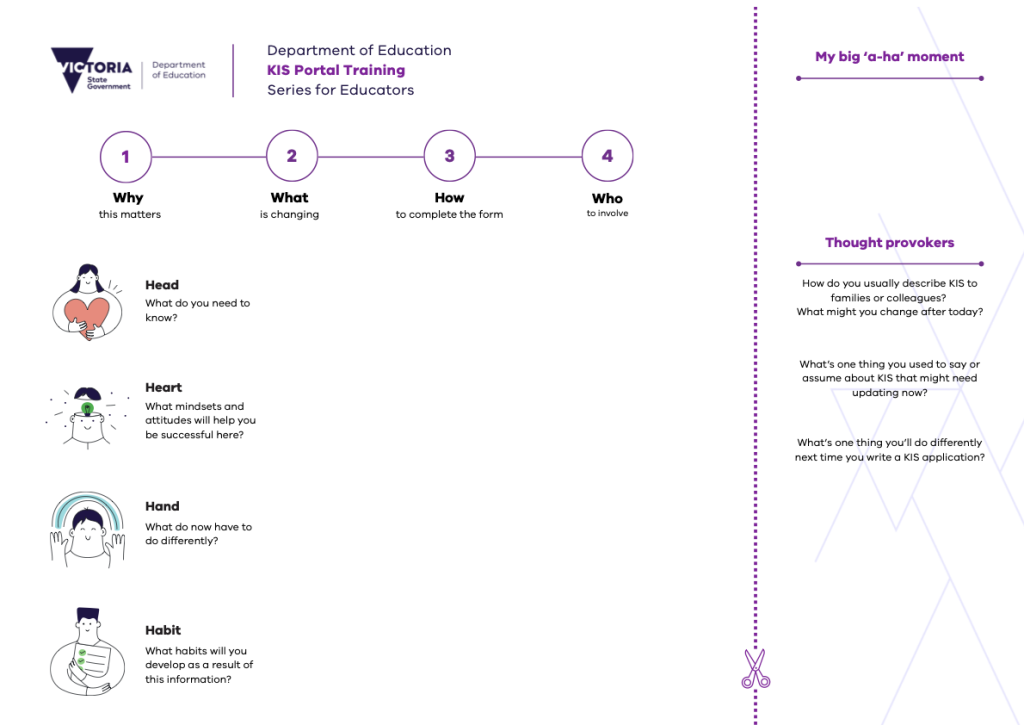
In this program, we used learning canvases to structure learning across head, heart, hand, and habit, prompting reflection, insight, and practical application.
What’s actually happening in the brain
This is where learning science earns its keep.
When you take your own notes, you’re doing more than capturing content. You’re activating multiple cognitive processes at once:
- Encoding. You translate information into your own words.
- Elaboration. You connect new ideas to what you already know.
- Retrieval pathways. You build stronger cues for recall later.
- Cognitive effort. You slow down just enough to think.
That combination matters.
Passive learning fades fast. Ebbinghaus showed us that years ago with the Forgetting Curve. Without effort and reinforcement, most information disappears quickly.
Active processing changes that curve. Writing your own notes is one of the easiest ways to make that happen.
Why this matters in training and development
Here’s the uncomfortable truth.
A lot of training still treats learners like storage devices. Content goes in. Tick the box. Move on.
But people don’t learn by watching. They learn by doing something with what they hear.
When learners take their own notes, a few things shift:
- They stay engaged for longer
- They filter what matters
- They personalise the content
- They create a usable resource for later
That last one gets overlooked.
Good notes become job aids. They travel back to the workplace. They support real decisions, not just workshop recall.
That’s where training starts to move the needle.
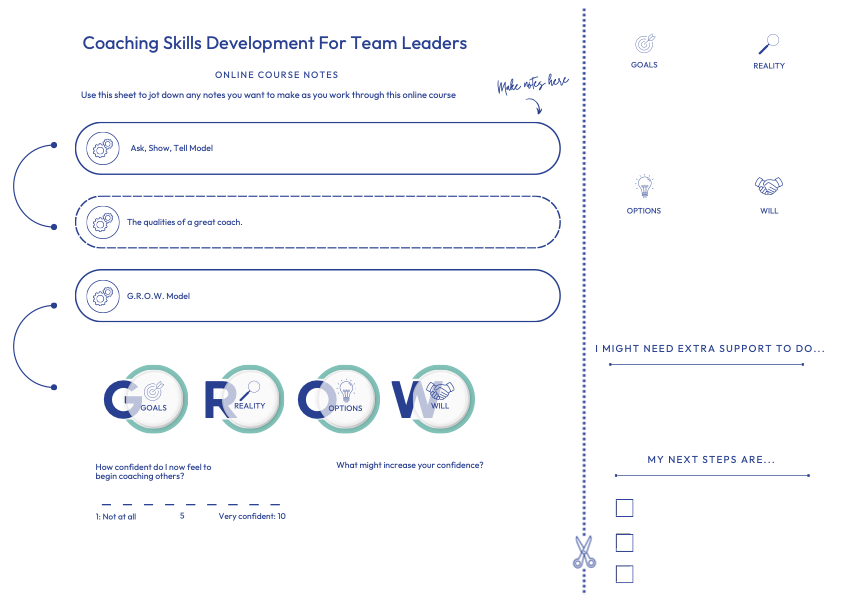
This coaching skills program for team leaders incorporates learning canvases to guide structured note-taking, build coaching confidence, and support application of the GROW model through reflection and action planning.
Where Hungry Minds leans in
We’re all for great design. But we’re not here to do the thinking for the learner.
At Hungry Minds, we deliberately leave space for people to think, write, and reflect.
That shows up in how we design materials:
- Learning canvases that guide thinking, not just display content
- Reflection journals that prompt learners to process ideas in their own words
- Workbooks with generous white space, so learners can capture what matters to them
Because packed pages don’t equal better learning. They just remove the need to think.
We also design reflective practice questions that do more than check understanding. They push learners to apply, question, and connect ideas to their own context.
That’s where depth comes from.
And yes, it’s grounded in learning science.
Reflection, active recall, and personal meaning-making all strengthen retention and transfer. We build these in on purpose.
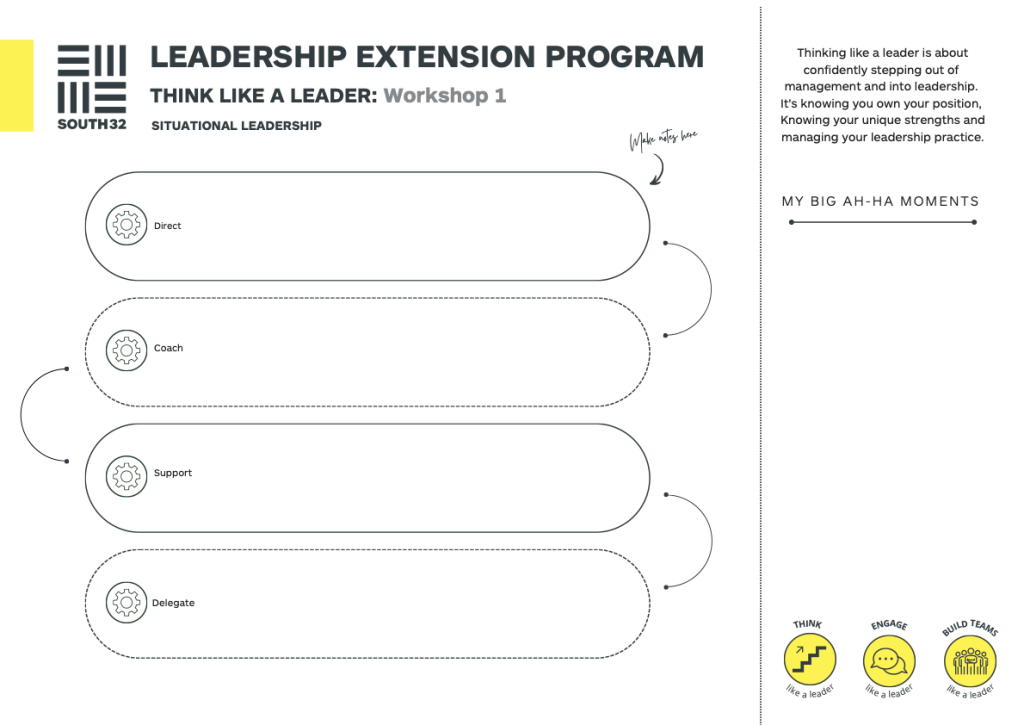
South32’s leadership program includes a participant placemat to capture key insights, support peer discussion, and translate leadership concepts into personalised actions and next steps.
The practical takeaway
If you’re running training, designing learning, or sitting in a session yourself, this is low effort, high impact.
Encourage people to write their own notes. Then make it easier for them to do it well.
Here’s how:
- Build in pauses. Give people time to think and write
- Ask better questions. “What does this mean for you?” beats “Any questions?”
- Provide structure. Simple prompts guide better notes
- Leave space. Physically and mentally
- Reinforce it. Ask learners to revisit and use their notes later
One final thought
Learning doesn’t stick because the slides looked good.
It sticks because the learner did something with the content.
Writing your own notes is one of the simplest ways to make that happen.
And in a world full of noise, that’s a habit worth keeping.
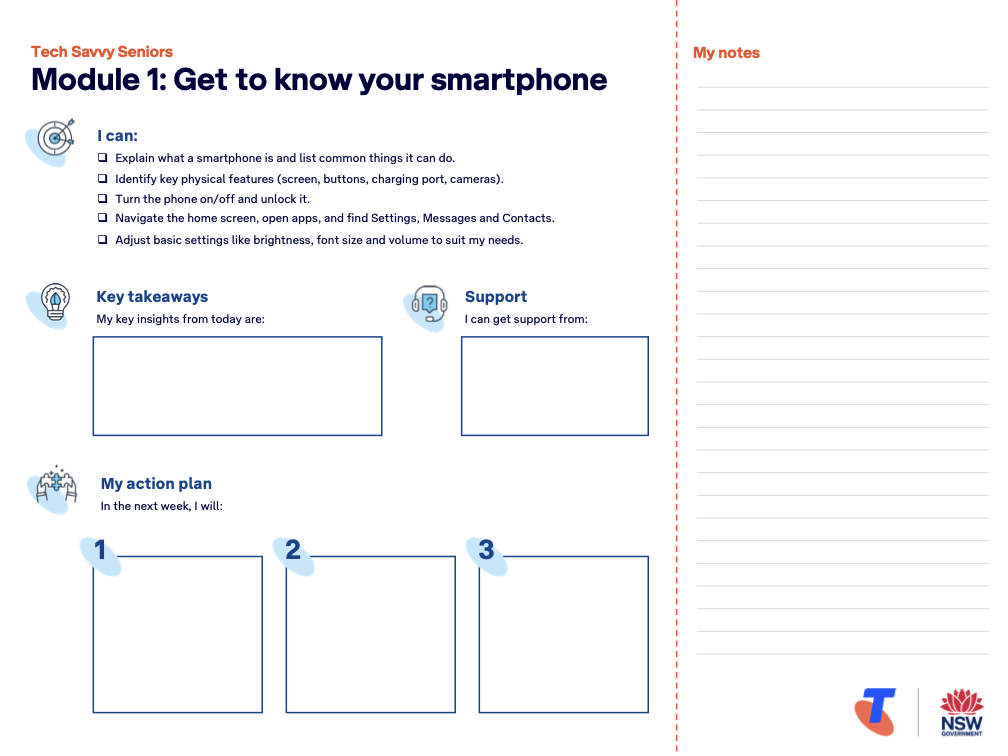
Telstra’s Tech Savvy Seniors program incorporates learning canvases to support reflection, capture key insights, and help learners apply new skills through structured note-taking and action planning.
Hungry for more?
Related blog articles:
- The Kirkpatrick Model: Measuring What Matters in Learning, From Reaction to Results
- Has Your Learning Program Hit Its Objectives?
- Engagement Metrics: What to Measure in eLearning and Why It Matters
- Learning Objectives: Define the Destination, Guide the Journey
- Bloom’s Taxonomy: A Guide for Creating Effective Learning Outcomes
References
Mueller PA, Oppenheimer DM. The pen is mightier than the keyboard: advantages of longhand over laptop note taking. Psychol Sci. 2014 Jun;25(6):1159-68. doi: 10.1177/0956797614524581. Epub 2014 Apr 23. Erratum in: Psychol Sci. 2018 Sep;29(9):1565-1568. doi: 10.1177/0956797618781773. PMID: 24760141.
Slamecka NJ, Graf P. The generation effect: Delineation of a phenomenon. Journal of Experimental Psychology: Human Learning and Memory. 1978.
Keita Umejima, Takuya Ibaraki, Takahiro Yamazaki, and Kuniyoshi L. Sakai, “Paper Notebooks vs. Mobile Devices: Brain Activation Differences During Memory Retrieval,” Frontiers in Behavioral Neuroscience: March 19, 2021, doi:10.3389/fnbeh.2021.634158.