
Two thirds of knowledge workers say they do not have enough time to do their job. Only 1% of the working week is available for training and development.
And yet, most training still asks people to block out half a day and sit through a 45-minute module covering everything at once. Then wonders why nobody remembers anything two weeks later.
Microlearning is the antidote.
Short, focused, and built around how people actually learn, microlearning delivers one idea, one skill, or one behaviour at a time. The right content at the right moment, in a format people can fit into their day.
It is not a trend. It is a response to reality. Your people are busy, mobile, and used to sourcing just-in-time information when they need it. Effective learning design needs to meet them there.
Here is what microlearning is, why it works, and what good looks like in practice.

What is microlearning?
Microlearning is a learning design approach that delivers content in short, focused bursts, typically between 3 and 10 minutes, each targeting a single, clearly defined learning objective.
Rather than attempting to cover an entire topic in one sitting, microlearning breaks knowledge and skills into bite-sized units that learners can engage with quickly, in context, and at the point of need. This mirrors how people naturally seek information — a short video, a quick scenario, a focused job aid — rather than sitting through a lengthy formal training session.
And here is the thing: forgetting is not a character flaw. It is biology.
The Ebbinghaus Forgetting Curve shows that people forget up to 70% of new information within 24 hours without reinforcement. Microlearning is a direct response to that. Spaced, repeatable bursts of content build retention over time, combating the forgetting curve rather than ignoring it.
This is not short eLearning with a different name. It is a deliberate instructional design strategy, grounded in cognitive science, built around how people actually learn and remember things.
The benefits of microlearning
The benefits of microlearning are well-supported by research and consistently validated in real workplace settings. Here is what organisations using microlearning typically report:
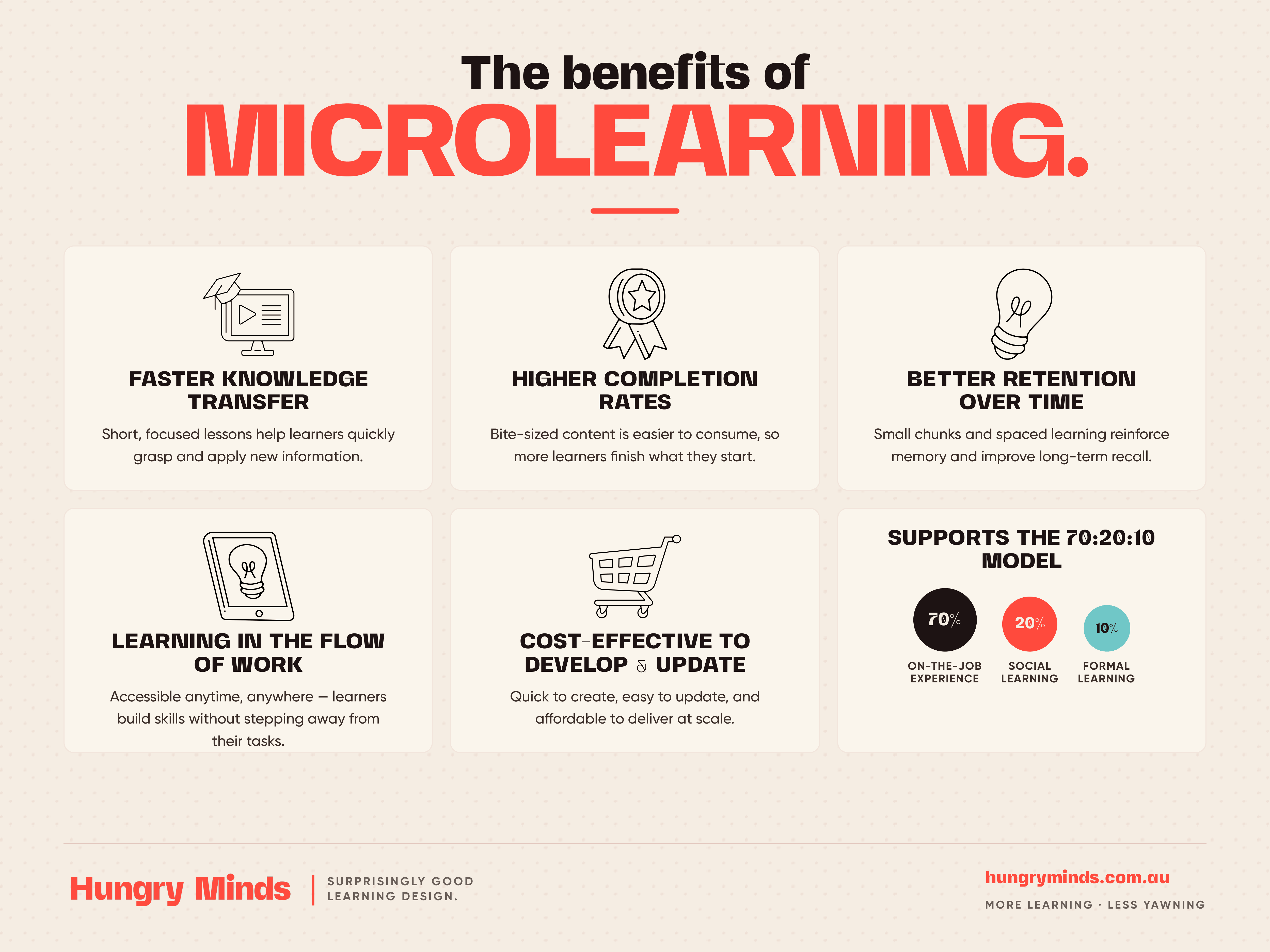
Faster knowledge transfer
Short modules with a single objective are easier to complete and easier to absorb. Learners spend less time navigating irrelevant content and more time engaging with what matters for their role.
Higher completion rates
Microlearning modules require significantly less cognitive load than full-length courses. When content feels manageable, learners are more likely to start, and finish. That is a meaningful advantage in high-volume compliance environments where course abandonment is common.
Better retention over time
Spaced repetition — delivering the same content across multiple short interactions over time — is one of the most evidence-backed strategies in learning science. Microlearning is naturally suited to a spaced delivery model, which means your people actually remember what they learned.
Learning in the flow of work
Microlearning fits into a learner’s day without demanding they step away from it. A 5-minute module on a mobile device between tasks is far more realistic than asking someone to block out an hour for a training session. This “just-in-time” access is particularly valuable for frontline, remote, and shift-based workers.
Cost-effective to develop and update
Shorter modules are faster to build, easier to revise, and simpler to maintain. When a policy changes or a procedure is updated, you update one targeted module, not an entire course. This makes microlearning solutions an operationally smart choice for organisations with evolving compliance requirements.
Supports the 70:20:10 model
The 70:20:10 model of workplace learning, developed by McCall, Lombardo, and Eichinger and widely applied in Australian organisations, holds that 70% of learning happens through on-the-job experience, 20% through social interaction, and only 10% through formal training. Microlearning is designed to reach learners in that 70% zone — in the moment, on the job, when they need it.
Microlearning examples: what does it look like in practice?
Microlearning is a format-agnostic strategy — the “micro” refers to the learning design, not a specific media type. These are some of the most common and effective microlearning examples used in Australian workplace training.
Scenario-based eLearning modules
A 5-minute interactive module presents a realistic workplace situation — a difficult conversation, a safety decision, an ethical dilemma — and asks the learner to make a choice. Immediate feedback explains why the choice worked or where it fell short. This is one of the most effective microlearning examples for building decision-making skills.
Short explainer videos
A 2–4 minute video explains a single process, concept, or procedure. These work well for onboarding, system walkthroughs, and product knowledge — content that benefits from visual demonstration rather than text.
Job aids and quick reference guides
Not all microlearning is digital. A well-designed one-page job aid — a checklist, a decision tree, a step-by-step procedure card — functions as a microlearning resource when it is designed around a single, high-frequency task.
Knowledge checks and retrieval practice
A short, 3-question quiz reinforces a concept after a formal training event, spacing the retrieval over days or weeks to combat forgetting. These microlearning modules work particularly well as follow-up to compliance training, inductions, and product launches.
Podcast and audio learning
A 5-minute podcast episode covering a leadership principle, a regulatory update, or a team learning topic. Audio microlearning is increasingly popular for roles where screen time is limited — trades, healthcare, field operations.
Animated explainer modules
Short animations that break down complex processes, regulatory frameworks, technical systems, scientific concepts into simple, visual sequences. Effective where the audience is diverse or where language accessibility matters.
Compliance microlearning: solving one of training’s hardest problems
Compliance training has a reputation problem. It is seen as a box-ticking exercise, something people click through as fast as possible to get the completion certificate. The content is forgotten almost immediately, which means the behaviour it was supposed to change never changes.
Compliance microlearning addresses this directly.
Instead of one annual 45-minute compliance course, organisations can deliver a series of short, targeted microlearning modules — rolled out at regular intervals across the year, each covering a discrete compliance topic. This spaced, repeated approach to compliance training is not only more engaging, it is more likely to produce the behavioural outcomes the compliance training is legally and ethically required to deliver.
In Australia, compliance training requirements are set by legislation including the Work Health and Safety Act 2011, the Privacy Act 1988, and anti-discrimination and equal opportunity legislation across states and territories. For organisations in regulated industries, compliance microlearning offers a way to meet these obligations while genuinely shifting how people think, not just what they can recite under audit.
Common compliance microlearning topics include:
- Work health and safety (WHS), including hazard identification, incident reporting, and psychosocial harm
- Workplace bullying and harassment prevention
- Sexual harassment, including the new positive duty under Australian law
- Privacy Act obligations and data handling
- Code of conduct and ethical decision-making
AI microlearning: what is changing and what it means for you
AI microlearning refers to the use of artificial intelligence in the design, delivery, or personalisation of microlearning content. It is an area that is developing quickly and is worth understanding clearly, because the hype often outpaces the substance.
At its most useful, AI microlearning enables:
- Personalised learning pathways. AI can analyse a learner’s performance data and serve the next microlearning module based on what they have and have not yet mastered, rather than delivering the same sequence to everyone regardless of their starting point.
- Faster content development. AI-assisted authoring tools can reduce the time it takes to draft scripts, generate scenarios, and create first-pass content — freeing instructional designers to focus on quality, context, and learner experience.
- Adaptive difficulty. AI-powered microlearning platforms can adjust the complexity of a knowledge check in real time based on how a learner is performing, providing more challenge where confidence is high and more support where gaps exist.
- What AI microlearning cannot replace is the instructional design expertise that makes a module effective in the first place. Understanding your learners, diagnosing the real capability gap, choosing the right format, and designing feedback that changes behaviour — these are human skills. AI is a production accelerator, not a learning designer.
At Hungry Minds, we use AI tools where they genuinely improve quality or reduce turnaround time — and not where they would compromise the rigour and contextual relevance that make microlearning solutions actually land.
Microlearning solutions: what to look for
Not all microlearning is created equal. A 5-minute module that is poorly designed is still a 5-minute module nobody learns from. When evaluating microlearning solutions, whether building in-house or engaging a development partner, here is what actually matters.
Single objective per module
Each microlearning module should be built around one clearly defined learning objective. If you cannot state what the learner will be able to do differently at the end of the module, the design needs to go back to the drawing board.
Designed for the moment of need
Effective microlearning is built for a specific context — a specific role, a specific task, a specific decision point. Think less “block out Tuesday afternoon for training” and more “I need this right now.” A two-minute refresher before a performance review. A quick scenario the moment a new system goes live. The answer to a compliance question without having to dig through a 40-slide module to find it. Learning at their fingertips, right when it counts.
Active, not passive
Microlearning modules should ask learners to do something — make a decision, answer a question, apply a concept to a scenario. Passive consumption (reading text, watching video without interaction) reduces retention. Active engagement builds it.
Fits into a broader learning architecture
Microlearning works best as part of a blended learning strategy — supporting, reinforcing, or extending formal learning rather than attempting to replace it entirely. As part of a broader program, microlearning moves the needle. As a standalone silver bullet, it rarely does.
Technically accessible
Microlearning should work on the devices your learners actually use. For frontline and field-based workers, that often means mobile-first design, offline capability, and load times that do not frustrate. For desk-based workers, SCORM-compliant delivery into your existing LMS is typically the simplest path.
How Hungry Minds builds microlearning modules
We build microlearning modules in Articulate Rise, Articulate Storyline, and Chameleon Creator, choosing the tool based on what the content and learner context actually require — not what is easiest for us to produce.
Every microlearning module we develop starts with the same question: what does the learner need to do differently, and what is getting in the way?
That question drives the instructional design. It determines the format, the scenario, the feedback, and the measure of success. It is why our microlearning solutions are built on learning design principles grounded in adult learning science, not templated from a generic library.
Our process follows the ADDIE framework:

Analyse
The Appetiser
Identify key learning priorities to deliver everything you need — and nothing you don’t. No filler, no fluff.

Design
The Recipe
Clarify scope, resources, and learning strategies with decision makers up front. No surprises in your kitchen!

Develop
Made to order
We build engaging, interactive learning experiences aligned to your goals. Co-designed, iterated and perfected.

Implement
Presentation
Prepare the client for a seamless roll-out in face-to-face, virtual, or blended environments. Get pilot-ready and go for launch.

Evaluate
Taste + tweak
Review against learning outcomes — find out what to start, stop, and keep. Identify changes for lasting impact.
We also build custom eLearning development programs where microlearning sits alongside longer-form modules, facilitator-led sessions, and on-the-job reinforcement — because the best learning programs use microlearning as one tool in a broader toolkit, not as the whole toolkit.
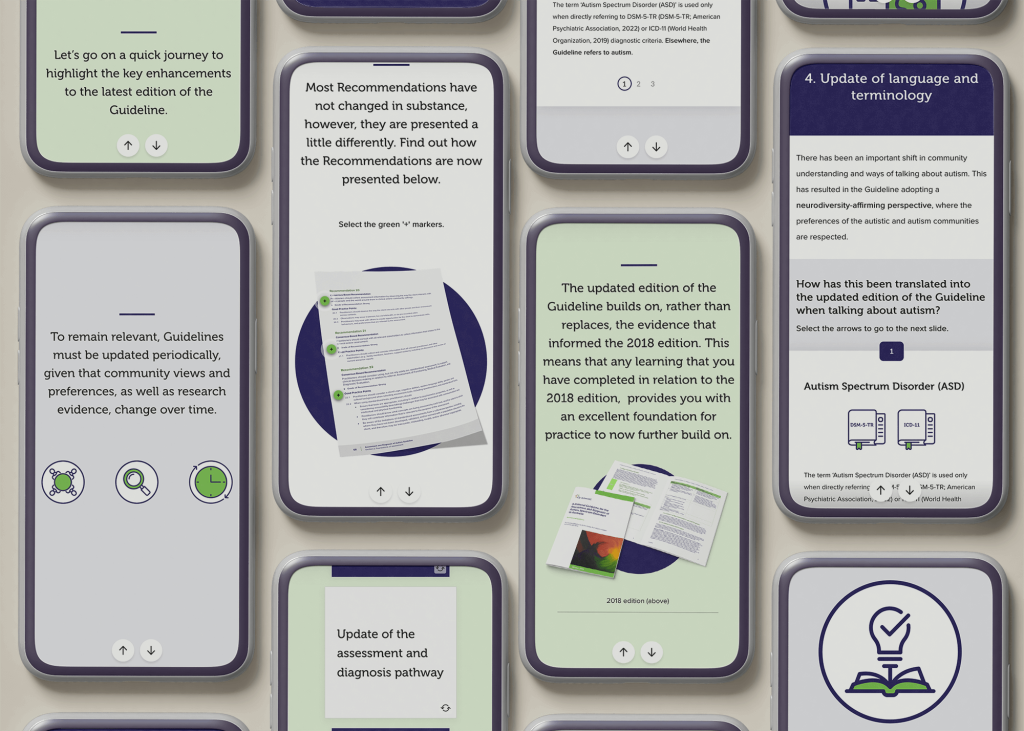
A great example of microlearning in practice is our work with Autism CRC. Rather than one long course, we built a series of focused microcredential modules that educators and healthcare professionals could work through at their own pace, returning to specific topics when they were relevant to their practice. Complex content, made accessible. One bite at a time.
Microlearning vs traditional eLearning: a quick comparison
| Category | Microlearning | Traditional eLearning |
|---|---|---|
| Length | 3–10 minutes | 20–60+ minutes |
| Objectives | Single, focused | Multiple |
| Delivery | Just-in-time, in the flow of work | Scheduled, formal |
| Development time | Faster | Longer |
| Best for | Reinforcement, performance support, compliance refreshers | Deep skill-building, induction, accredited training |
| Retention | High (spaced repetition) | Variable (depends on spacing and reinforcement) |
| Mobile suitability | High | Variable |
Neither format is universally superior. The right choice depends on the learning objective, the audience, the context, and what the organisation is trying to change. Often, the most effective programs use both.
FAQs
Ready to build microlearning that actually sticks?
Microlearning done well is not just short — it is precise, purposeful, and designed to change something. If your people are clicking through compliance courses and forgetting everything by Friday, or if your onboarding is too long and too passive to land, microlearning might be exactly what your training program needs.
We build microlearning modules and custom eLearning solutions for Australian organisations across mining, healthcare, government, and beyond. No filler, no fluff, just learning that sticks.
Contact us | Explore our eLearning services | See how we approach learning design
Hungry Minds is a learning design studio with national reach. We build microlearning solutions, custom eLearning, and blended learning programs for Australian organisations.