


Snapshot







About the organisation
Amy Nicholas is a nationally recognised specialist in vicarious trauma mitigation. Through her consultancy, she works with organisations across government, non-government and corporate sectors to review and strengthen systems of work in trauma-exposed environments. Her focus is practical and duty-led: helping organisations manage exposure to potentially traumatic content as a foreseeable workplace hazard meet recently strengthened psychosocial WHS obligations.
In 2023, Amy was awarded a prestigious Winston Churchill Fellowship to investigate international best practice in mitigating vicarious trauma. Her Fellowship report, Mitigating Vicarious Trauma: Adopting an Occupational Safety Approach, is grounded in structured consultations with international experts across trauma psychology, operational leadership, law enforcement, digital forensics and frontline service contexts, translating global practice into practical guidance for organisations.
Amy is a keynote speaker and facilitator, known for reframing vicarious trauma as an occupational risk that can be reduced through thoughtful work design and leadership practice.
Her work centres on a simple shift in perspective:
From asking, “How do we make people more resilient?”
To asking, “How do we make trauma-exposed work safer?”
The need
In Amy’s consultancy work, she was working with organisations across Australia to review their systems, processes and work design to better mitigate the risks associated with exposure to potentially traumatic events, materials and content.
Across these engagements, one pattern became clear.
Many organisations were already inducting new staff using generic “vicarious trauma” eLearning modules. The intent was positive. The content, however, often was not aligned with contemporary practice.
The available programs were frequently:
- Outdated
- Heavily focused on symptoms and potential harm
- Framed around individual resilience and self-care
- Light on practical, work-based risk mitigation strategies
At the same time, organisations were seeking to strengthen their approach to psychosocial risk management. Leaders were asking:
- How do we prepare trauma-exposed workers to understand the risk and adopt safe work practices from day one?
- How can we support workers to feel confident and capable, rather than apprehensive about harm?
- How do we equip managers and operational leaders to recognise trauma exposure as a foreseeable psychosocial hazard and actively manage it?
- How do we move beyond awareness training toward practical, day-to-day safe work practices?
- How do we align induction training with contemporary WHS obligations and broader psychosocial risk frameworks?
There was a clear gap between:
- Regulatory expectations
- Organisational intent
- And the training tools available to support implementation
The eLearning modules were developed to bridge that gap. Rather than centring on vulnerability or resilience alone, they focus on:
- Risk awareness
- Practical safe work practices
- WHS-oriented capability-building at both frontline and leadership levels
The aim was not to create another wellbeing program. It was to provide a scalable, induction-ready resource that reflects contemporary WHS thinking and supports safer work design in trauma-exposed environments.
The learning solution
We partnered with Amy to transform her Churchill Fellowship research into a scalable, system-focused eLearning program grounded in occupational safety principles and underpinned by strong learning design.
The result is a thoughtfully structured experience that translates complex research into clear, engaging, and practical workplace action.
The program was designed in two versions:
Mitigating Vicarious Trauma: An Introduction
Designed for employees. Focused on awareness, early warning signs, trauma mobility, and safe engagement with trauma-exposed work.
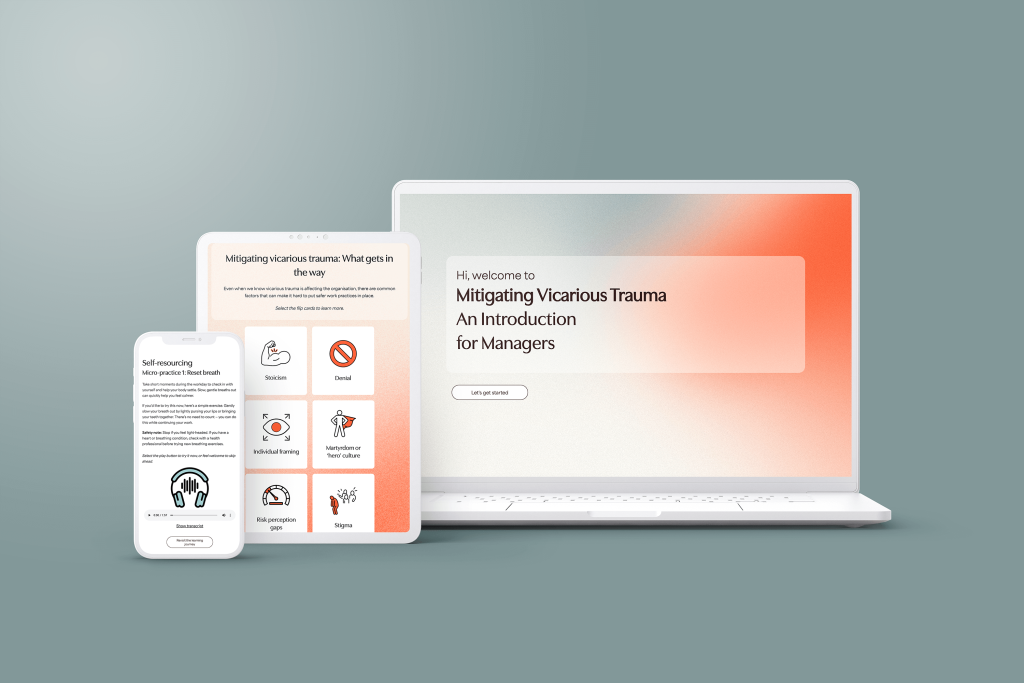
Mitigating Vicarious Trauma: An Introduction for Managers
Designed for employers and managers. Includes additional content on WHS obligations, system-level controls, and leadership responsibility in managing psychosocial risk.
Both experiences include:
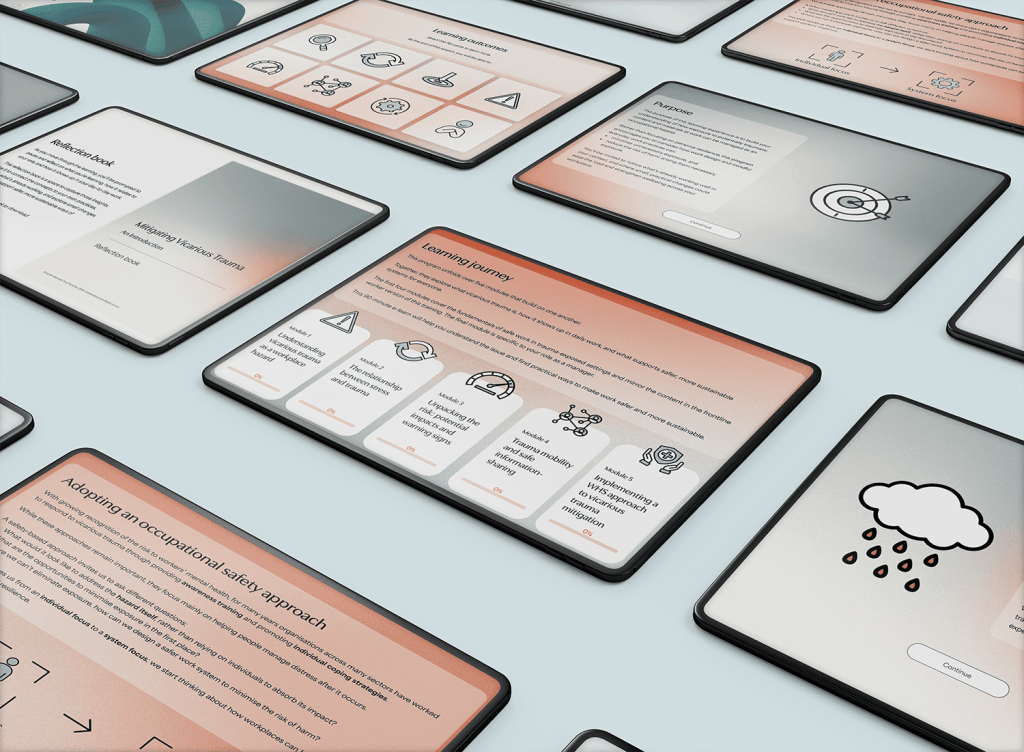
- Animated explainers
- Scenario-based storytelling illustrating uncontrolled vs managed exposure
- Interactive activities
- System-mapping visuals
- Reflection prompts
Vicarious trauma is an occupational hazard.
With the right controls in place, that risk can be identified early and managed in ways that protect both people and purpose.
We set up and configured Amy’s LearnWorlds LMS, preparing the platform for commercial rollout. The result is a professional, ready-to-scale digital learning product that extends Amy’s reach beyond keynotes and workshops.
The outcome
This project transformed rigorous research into an engaging, interactive experience that makes trauma mitigation practical, accessible, and ready for real-world application.
Amy now has:
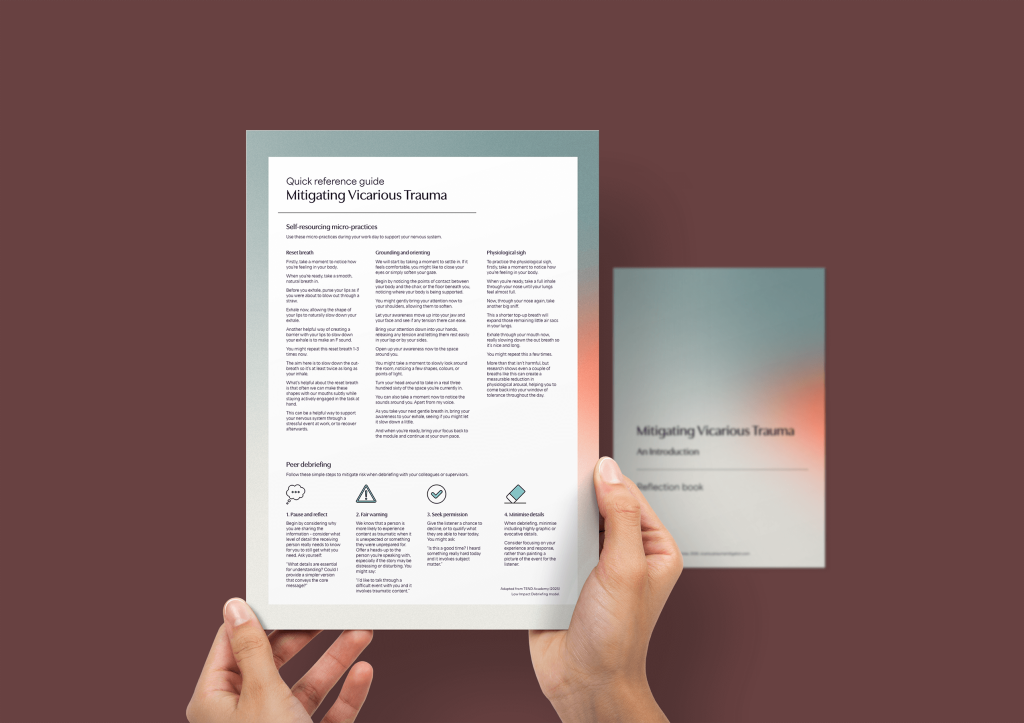
- A commercially deployable digital course aligned with WHS psychosocial risk regulations
- A structured way to support both frontline staff and executive leaders
- A platform (LearnWorlds) ready for enrolments, licensing, and organisational rollout
- A learning asset that reinforces her position as a national thought leader in vicarious trauma mitigation
More importantly, organisations now have practical guidance to move from awareness to action.
They’re not just learning about vicarious trauma — they’re learning how to design safer systems of work.
And in a regulatory landscape where employers are required to proactively manage psychosocial hazards, this program provides a clear, evidence-based pathway forward.
Build a safer, more sustainable workplace
You can purchase the Mitigating Vicarious Trauma programs here.
For enterprise licensing, tailored rollout, or invoicing enquiries, contact Amy directly at:
[email protected]