

What is a learning campaign?
A learning campaign is a planned run of small learning touchpoints, spread over weeks, all aimed at one behaviour you want to change.
It works the way a marketing campaign works. One message, repeated in different forms and different places, until it sticks. Name the behaviour, map the moments between here and there, then give every moment a job.
How much of it is digital depends on where your people work. A crew on site gets posters at the gate, a talk at the pre-start and a card in the pocket. A team on laptops gets a challenge in Viva Engage and a nudge inside the app they’ve got open. We pick the mix around your people, never around a platform.
Nearly every campaign we build has a course at the centre of it. The course teaches the thing and gives you the completion record. The campaign is what gets it used.
Why does a campaign beat a one-day workshop?
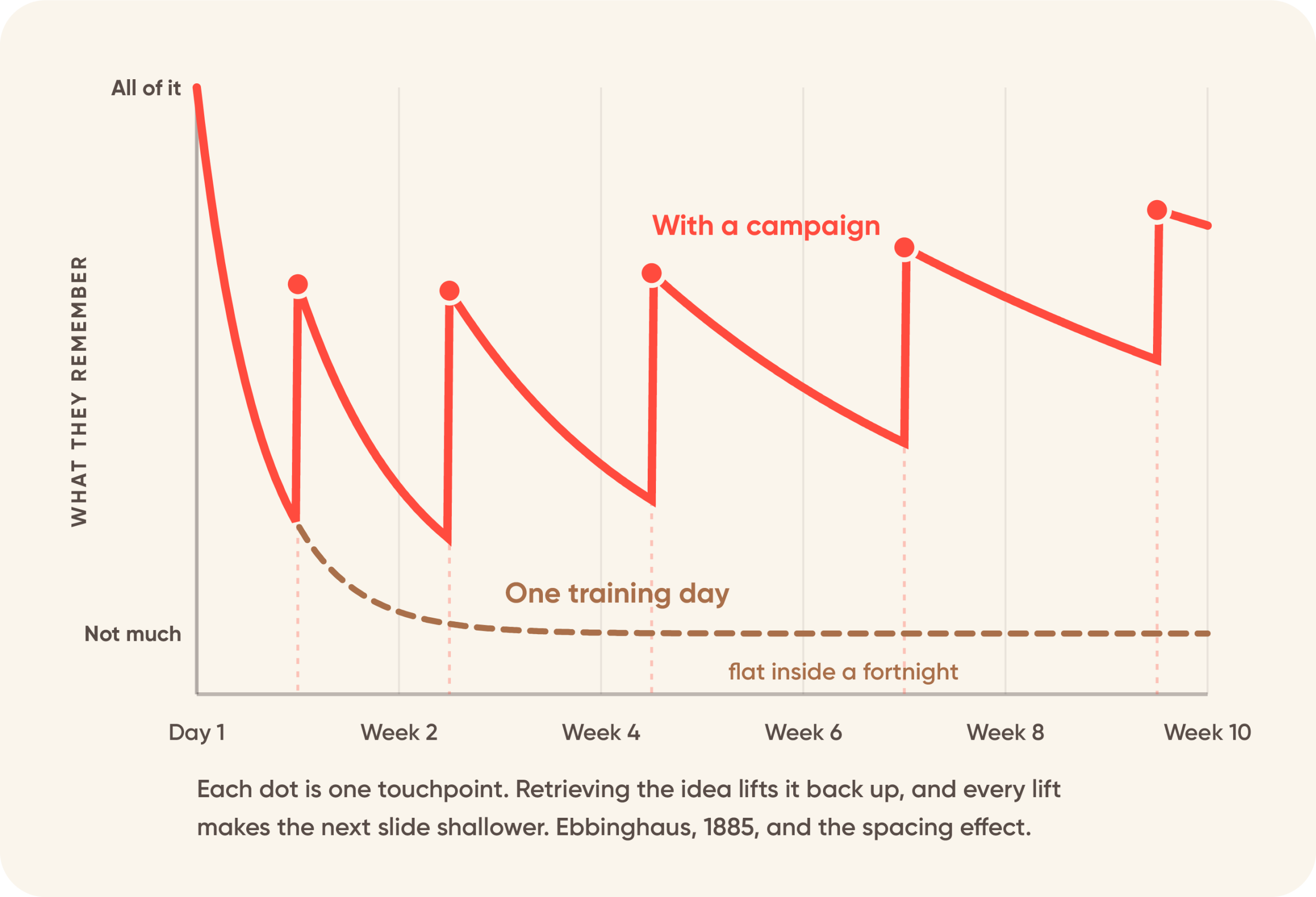
Ebbinghaus mapped the forgetting curve in 1885 and nobody’s knocked it over since. Teach something once and most of it’s gone inside a week. The one-day workshop is the shape that forgets fastest.
Your content isn’t the problem. You paid for the room, the trainer and a day of everyone’s time, and the thinking in it was good. The shape threw it away.
Spread the same content over ten weeks and it keeps working. Same spend, far better odds, and people are still using it when they’re back on the tools.
Every campaign runs the same
five beats.
What goes inside each beat is chosen to best suit the change you’re targeting, your people, and your budget.

Set it up
Before it starts
People hear what’s coming and why it lands on them. Leaders get the words to introduce it, so the first anyone hears of it comes from a human, not a calendar invite.

Land it
The moment
The piece that carries the big idea. A workshop, a film, a module, a story people repeat in the carpark. It’s the bit everybody remembers, and it’s where most programs stop.

Practise it
In the work
A real task, a hard conversation, or a call with no clean answer. Done once with somebody watching, then done solo. Capability gets built out here, on the job.

Nudge it
Across the weeks
Short prompts, spaced on purpose. A line on the wall where the decision gets made, or a question a leader asks at the pre-start. Two minutes each, one job each.

Prove it
At the end
Somebody does the thing in front of a person who can judge it, and somebody says well done out loud. You walk away with a number that stands up in front of the board.
What’s in a learning campaign?
We choose the right ingredients to meet your goal, your crew and your budget. Here's the menu.

On a screen

On the wall

In the leader's hands

In a pocket

In the inbox and the feed
Proof it landed
Six design decisions, and the
research behind each one.
These are the calls we make on every campaign. If we can’t name the job a touchpoint does and the reason it’s there, it doesn’t make the plan.
Why it works
Meet an idea twice with a gap in between and it moves into long-term memory. Cepeda’s review found the effect holds across every subject and age group. So we take the content you’ve got and spread it over weeks. Same content, same spend, far better odds.
Why it works
Being asked to recall something is what locks it in. Roediger and Karpicke put retrieval head to head with re-reading and retrieval won in a canter. So every touchpoint asks for something back, even if it’s one question.
Why it works
Working memory holds about four things, and a busy shift fills every slot. That’s Sweller’s cognitive load research. So each touchpoint gets one job. Two focused minutes lands, and forty minutes covering everything gets skimmed.
Why it works
Context is a cue and the brain leans on it hard. A line on the wall right where the call gets made does work no module can do from a desk. So does a nudge inside the app they’ve already got open.
Why it works
Judgement and culture get built between people. So we write the prompts, then send everyone off to have the chat. The screen starts it and gets out of the way.
Why it works
A completion report tells you a file got opened. So we build in a moment where somebody does the job in front of a person who can judge it. Then we ask their leader again a month on.
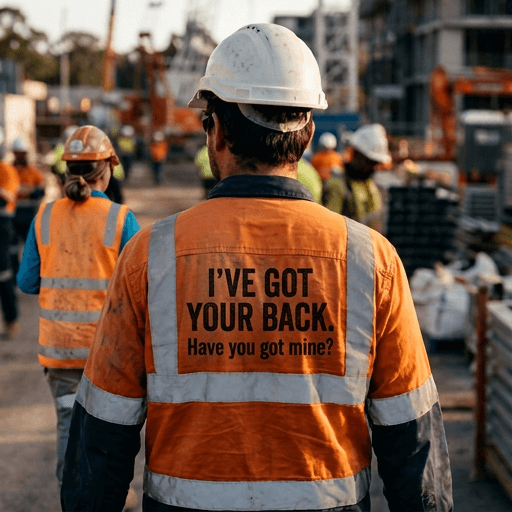
I’ve Got Your Back.
We built this one top to bottom to prove the shape works. One behaviour: speak up about the grey-area moment. The sling that doesn’t look seated right, the handrail that gives a bit, the mate who’s flat today.
Four moves carry the whole thing: See it. Say it. Back it. Thank it.
- The leader toolbox is the engine.On site the message travels through leaders or it doesn’t travel. So we wrote four ten-minute talks that drop into the pre-start, every word on the card, ready to run cold.
- Two interactions do the asking.Being asked beats being told. Make the Pact takes thirty seconds: promise to have someone’s back, and name them. Spot the Moment hands you four grey-area calls and shows how each one plays out.
- A weekly game keeps it alive.Every caption is somebody spotting the thing and saying it, so the practice lands without anyone calling it training. A staged photo goes on the board and the best gag gets read out at the pre-start.
- Guerrilla pieces catch people in between.Context is a cue, so each piece sits where the decision gets made. The message rides the back of every hi-vis and takes the washroom mirror. A sticker goes up top on the hard hat, and posters hold the gate and the ramp.
Neurospicy Collective.
One expert, in a hundred rooms at once.
Amber Anthony’s neurodiversity sessions worked because Amber was in the room, and that capped how many people she could reach. We built a course that teaches what she teaches, then wrapped a campaign around it so the message keeps working when she isn’t there.
Three posters reinforce the program’s key taglines, so the lines people remember stay in front of them.


The tip sheet does two jobs.
It goes on the wall as a poster, and it works as a job aid. Ten micro moments, three check-in questions and the communication swaps, all on one page.
So when somebody wants to put the core messages into practice, the how is right there in front of them. No module to reopen and no folder to go hunting through.
What does a learning campaign cost?
It depends what you pick, so we never open with a price. We open with a concept you can approve on paper.
First we work out what needs to change, what’s getting in the way, and what will land with this particular audience. The outcome is a high level design that pitches the concept back to you. The behaviour, the five beats, the plan touchpoint by touchpoint, and what each piece is there to do. You approve all of it before we build a thing.
See a real high level designYour leaders get toolbox talks and team huddles. The site gets posters, stickers and guerrilla placements. People carry coaching cards, buddy check-in guides, pocket guides and lanyard cards. Then come the games and competitions, on paper and on screen, plus apps, videos, podcasts and AI imagery. A comms plan runs alongside it with newsletters, emails, Viva Engage posts and challenges. We cost every line so you can see what you’re buying.
Filmed content, custom illustration or photography, and simulations of your live systems. More than one audience or language, LMS configuration, and anything needing a licence we buy on your behalf.
Two ways we price it.
Quote stage one, then shop for stage two.
We quote the analyse and design work up front, then hand you a costed shopping list for build, rollout and evaluation. Best when you know the problem and you’re not sure yet what you want built.
Quote the lot.
We price the whole program, then work out where your budget does the most good while we’re designing it. Best when you’ve got a number and a date to hit.
Either way, we pitch the concepts before a single thing gets built.

Questions, answered.
The things people ask us most. Got something else? We're happy to chat.
Ask a questionAll the ingredients for deliciously effective learning.
From a single program to a full learning strategy; we'll find the right mix.