


Snapshot






About the client
St John of God Health Care is one of Australia’s largest not-for-profit Catholic health care providers, delivering compassionate, mission-driven care across hospitals, disability services, community wellbeing programs and home care services throughout Australia, New Zealand and the Asia-Pacific region. Established in 1895 by the Sisters of St John of God, the organisation employs more than 15,000 caregivers and is committed to improving health outcomes through connected, high-quality and person-centred care.
Link to website homepage: St John of God Health Care
The Need
St John of God Health Care engaged Hungry Minds to redesign and modernise its Adult and Paediatric Advanced Life Support (ALS/PALS) training experience. The organisation was relying heavily on externally delivered accredited training pathways, which created significant administrative overhead, ongoing costs, and limitations in flexibility across hospital sites.
While existing training achieved technical competency, SJGHC identified a need for more contextualised, confidence-building learning that better reflected real clinical environments, supported team-based responses, and reduced repetitive theory for experienced clinicians.
The organisation wanted a future-focused solution that could:
- Strengthen collaboration across nursing and medical teams.
- Build internal capability
- Support both new and refresher learners
- Improve learner confidence under pressure
- Introduce more flexible online pre-learning
The learning solution
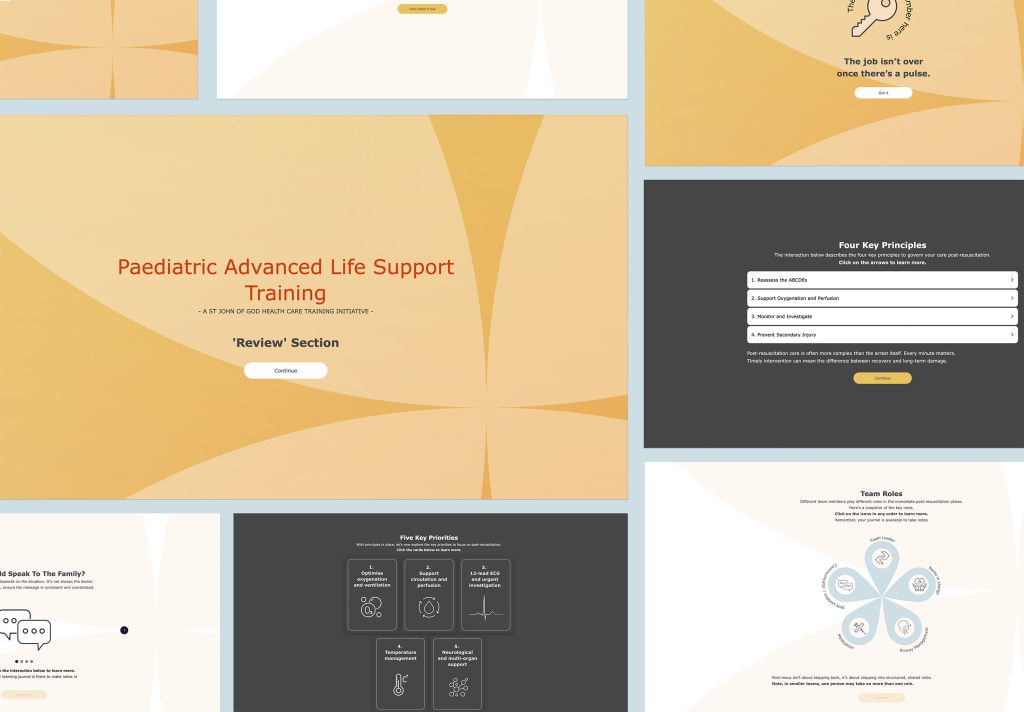
Hungry Minds partnered closely with clinical SMEs and education teams across SJGHC to co-design a blended Advanced Life Support learning experience for both Adult and Paediatric care settings.
The solution combined:
- Interactive online pre-learning
- Scenario-led workshop experiences
- Reflection activities
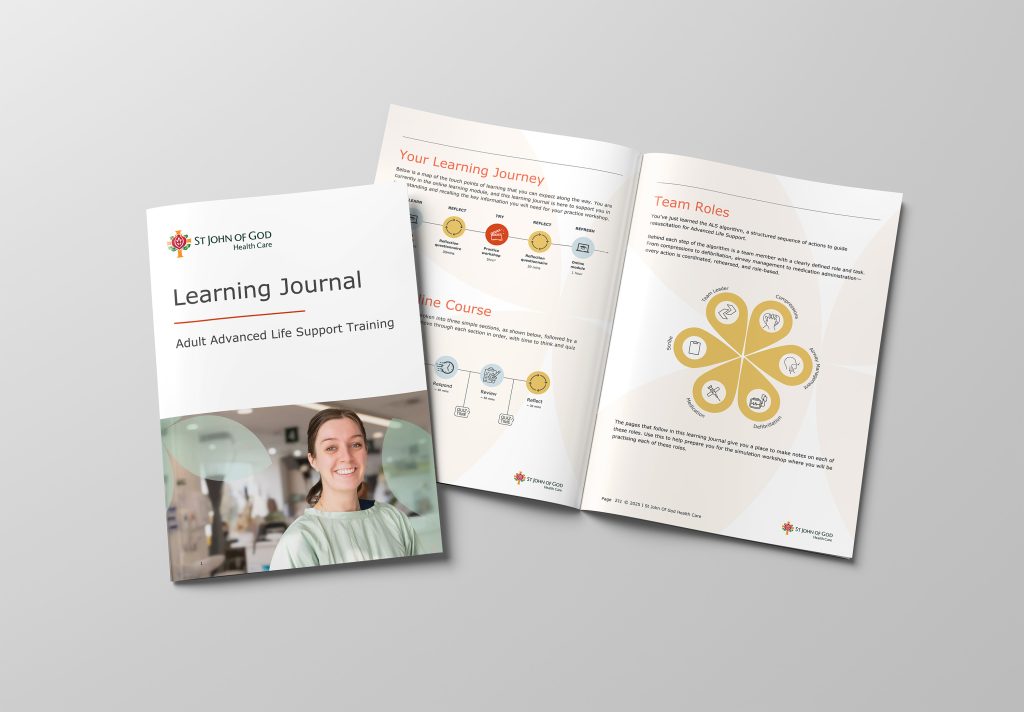
- Downloadable learning journals
- Competency reinforcement activities
- Clinically aligned assessment pathways.
The online learning was structured into four connected stages:
- Recognise
- Respond
- Review
- Reflect
This structure supported learners to progressively build confidence in recognising deterioration, responding in emergency situations, applying ALS algorithms, communicating effectively under pressure, and reflecting on team-based care.
The learning experience incorporated:
- Realistic clinical scenarios
- Interactive decision-making
- ABCDE assessment frameworks
- ISBAR communication practice
- Rhythm recognition
- Paediatric and adult resuscitation algorithms
- Reflection checkpoints
- Role-based escalation activities.
To support different learner needs, the design intentionally balanced structured foundational learning with streamlined, relevant refreshers for experienced staff. The program also prioritised flexibility for shift workers through modular online delivery and practical, high-impact learning interactions.
Importantly, the training was designed not just to teach protocols, but to strengthen calm decision-making, communication, leadership and team confidence in high-pressure clinical environments.
The Outcome
The result was a modern, scalable ALS/PALS learning ecosystem tailored specifically to the SJGHC clinical environment and organisational values.
The new approach reduced dependency on external providers while creating a more engaging and clinically relevant learning experience for caregivers across multiple hospital sites. The blended design also established a strong foundation for consistent delivery, future internal capability building, and ongoing refinement of simulation-based learning practices.
By combining flexible online pre-learning with collaborative, team-based practical experiences, the solution helped shift training away from “tick-box compliance” and toward confident, coordinated clinical readiness.