


Your facilitators are good at their job. Train the trainer makes sure they are great at delivering yours.
Your facilitators know how to work a room.
They can read an audience, manage energy, keep things moving when the tech gives up, and bring people back from a post-lunch slump. That skill is real and it matters.
But none of it automatically tells them why your program was designed the way it was. Why that activity runs 20 minutes and not 10. What the debrief question after the role play is actually designed to surface. How this session connects to what learners did last week and what they will be asked to do next month.
That is the gap train the trainer closes.
Facilitators deliver better programs when they genuinely understand what they are delivering, why it was built that way, and who they are delivering it to.
What is the train the trainer model?
Train the trainer is a structured process that prepares facilitators to deliver a learning program with confidence, consistency, and ownership.
Not just content knowledge. Ownership.
A facilitator who has been through a good train the trainer program does not just follow the guide. They understand the thinking behind it. They know what each activity is trying to achieve, what the debrief questions are designed to draw out, and how the program connects to the organisation’s broader goals. They can flex in the moment without losing the thread, because they understand what the thread is.
A good train the trainer program is a learning experience in its own right. It is not a walkthrough. It is not a briefing call the week before launch. It is a deliberate, designed process that gives facilitators everything they need to walk into a room feeling genuinely ready.
Here is what that looks like.
What a good train the trainer program covers
A strong train the trainer program covers six key areas, from project background and audience insight to hands-on practice and delivery day logistics.
Every train the trainer program looks a little different depending on the program, the facilitators, and the context. But the core does not change.
Project background: the full story, not just the overview
Facilitators need to understand why this program exists before they can deliver it well.
What problem was it built to solve? What gap in knowledge, behaviour, or capability prompted it? What business goal or strategic priority is it connected to? What has been tried before, and what did learners and leaders think of it?
This context is not background noise. It is the foundation every facilitation decision rests on.
A facilitator who understands why a program was built can meet learners where they are. When someone pushes back on the relevance, questions why they have been asked to attend, or challenges whether this applies to their role, the facilitator who knows the organisational story behind the program can respond with confidence and credibility. The one who only knows the content has to wing it.
The train the trainer session should also cover what else is happening in the organisation right now. A restructure. A new system rollout. A change in leadership. A tough quarter. These things walk into the room with your learners whether you name them or not. Facilitators who are briefed on the broader context can acknowledge reality without being derailed by it.
The end-to-end learning journey
Most programs sit inside a broader learning architecture. Facilitators need to understand where their session fits within it.
What did learners do before they walked in? Pre-work, eLearning modules, a previous workshop, a manager conversation? What comes after? On-the-job application tasks, follow-up activities, a 30-day check-in?
Facilitators who understand the full learning journey can connect the dots for learners throughout the session. They reference what came before. They set up what comes next. They help learners see the session as part of something purposeful, not a standalone event disconnected from everything else.
This section of train the trainer should also be clear about the facilitator’s specific role within the program. Are they the sole delivery lead? Part of a co-facilitation team? Is there a subject matter expert joining for certain sections? A producer managing the tech? Clear role clarity prevents confusion and gaps on delivery day.
“When facilitators understand the full learning journey, the session feels completely different. They are not just delivering content for a day. They are playing a specific role in a longer process of capability building. That shift in perspective changes how they frame activities, how they set up debriefs, and how they connect everything back to what learners will actually do when they leave the room.”
Senior Learning Designer Olivia
Know your audience
This is not a quick rundown of job titles and team sizes.
A good train the trainer session gives facilitators a genuine, honest picture of who will be in the room. Their roles, yes. But also their experience levels, their day-to-day pressures, how they typically engage with training, what they already know about this topic, and what misconceptions they are likely to bring with them.
Age and learning preferences matter here too. A room of early-career team members who grew up with digital learning has different expectations and different needs than a room of experienced operators who have sat through decades of compliance tick-boxes. Understanding that going in changes how a facilitator opens the session, how they pitch the language, how much they rely on discussion versus instruction.
Then there are the barriers. And this is the bit that gets skipped most often.
Learners do not arrive as blank slates. They arrive with scepticism about whether this applies to them. Past experiences of bad training. Workload pressure and a growing inbox. Opinions about whether their manager should be in the room with them. A team culture that does not particularly value formal learning. A change process that has everyone unsettled.
A facilitator who has not been briefed on those barriers will be surprised by them on delivery day. A facilitator who has talked them through in train the trainer is prepared. They have anticipated the pushback. They have language ready. They have a plan for the moment the room gets resistant, because they know it might.
That preparation is not about scripting responses. It is about not being caught off guard by something entirely predictable.
“The most important question I ask in any train the trainer session is: what mindset will this group bring with them, and what mindset do we need them to walk out with? Those two things are often very different. When facilitators understand that gap going in, they can close it. When they do not, they spend the day wondering why the room feels harder than expected.”
Senior Learning Designer Olivia
Walking through the facilitator guide, section by section
A TTT session is not the time to hand over the guide and say good luck.
It is the time to walk through it properly. To explain the thinking behind each section, not just the instructions. To highlight the moments that matter most. To name the things that look simple on paper but require real skill in the room.
This is where the facilitator guide earns its keep, and where the train the trainer session earns its place in the project plan. We cover exactly what the guide should contain in the next section. But in train the trainer, the job is to bring it to life.
Facilitators should leave that walkthrough understanding:
- Why each activity was designed the way it was, and what it is there to achieve
- How to deliver the purpose statement for each activity in their own words, not read off the page
- What each debrief question is designed to draw out, and how to hold that conversation when it goes somewhere unexpected
- How every activity connects back to a specific learning outcome and to learners’ real work
- Where the flex is in the session, and where it is not
- What good looks like at each stage, and what to watch for if things are drifting
A good facilitator guide calls all of this out. A good train the trainer makes sure facilitators actually get it.
Getting in the room: experiencing and delivering the hero activities
At some point in every train the trainer session, the guide has to close and the facilitators have to have a go.
The most valuable time in any train the trainer is spent on the hero activities. These are the moments the whole program is built around. The activities that carry the most learning weight, require the most facilitation skill, or are most likely to go somewhere unexpected. Not every activity needs a full practice run. The heroes do.
Facilitators start on the learner side. They complete the activity, engage with the purpose statement, and sit with the debrief questions as participants. This is not a reading exercise. It is how they develop genuine feel for what the experience is like from the other side of the room. They notice where the energy lifts. They feel where the thinking gets hard. They experience the aha moment themselves, which means they know exactly what they are working toward when they are the ones running the debrief.
Then they flip. They take the facilitator role and have a go at delivering. They run the activity with peers, ask the debrief questions out loud, and get honest, specific feedback before they are in front of a live group.
That practice is where confidence is actually built. Not from reading the guide. From having done it.
There is a real difference between a facilitator who has read the debrief questions and one who has asked them, heard the silence that follows, and learned how to sit in it without rushing to fill the gap. A train the trainer is where that skill gets built.
Space for the questions nobody has asked yet
A good train the trainer session creates explicit space for facilitators to ask every question they have.
Including the uncomfortable ones. What if a learner challenges the whole premise of the program? What if someone is clearly disengaged and making it known? What if a conversation goes somewhere emotionally charged? What if the most senior person in the room pushes back?
Anticipating those moments in advance is part of what makes a facilitator feel genuinely ready. Not just technically prepared. Actually ready.
Logistics, set-up, and delivery day planning
No surprises on delivery day.
Room set-up, materials, technology, timing, handouts, co-facilitator roles, what to do if attendance is lower than expected. All of it covered and confirmed before anyone walks out of the train the trainer.
The last thing a facilitator should be thinking about on delivery day is whether the workbooks got printed.
What a good facilitator guide must include
Train the trainer is only as good as the material it is built on.
That means the facilitator guide has to contain more than activity instructions. A lot more.
Most facilitator guides are running sheets with a logo on them. Step one. Step two. Slide 12. Activity: 20 minutes. Move on. Useful for sequencing. Not useful for understanding.
A genuinely useful facilitator guide is a long-term reference document. It is what facilitators read before the first cohort, reach for before the fifth, hand to a new team member six months later, and consult when someone asks why the program was built a particular way. It needs to stand on its own.
A genuinely useful facilitator guide includes more than activity instructions, here is what it needs to contain:
- A purpose statement for every activity: why learners are doing it, what skill it develops, and how it connects to the learning outcomes and their real work. Not for the facilitator to read aloud. For them to understand and deliver in their own words.
- Designed debrief questions: specific, intentional questions written from the learning outcomes, with notes on what each one is designed to draw out. Not “discuss with the group.” Not a vague invitation to chat. Questions with intent.
- Learning outcome links throughout: every activity and every debrief question mapped back to a specific learning outcome, so the guide always makes clear what each part of the program is trying to achieve.
- Workplace and organisational context: the on-the-job application for each activity. How does this connect to what learners actually do at work? What does good look like in practice? This is what helps facilitators make the learning feel relevant rather than theoretical.
- Facilitation tips and what to watch for: what does it look like when an activity is landing well? What are the common sticking points? What should a facilitator do if the group finishes early, or if one question opens a conversation that could run for an hour?
The train the trainer session brings all of this to life. But it has to be in the guide first.
“The facilitator guide is not a script. It is a thinking tool. When a facilitator can see how each activity connects to a specific outcome, understands the audience they are working with, knows the barriers the room might bring, and has strong debrief questions to work with, they can bring the program to life in a way no script ever could. All of that has to be designed in. It does not happen by accident.”
Senior Learning Designer Olivia
Train the trainer in action: Telstra Tech Savvy Seniors
Train the trainer is not just for professional L&D teams. The stakes are even higher when your facilitators are volunteers.
Hungry Minds designed and ran train the trainer sessions for Telstra’s Tech Savvy Seniors program, an initiative helping older Australians build confidence and skills with digital technology.
The facilitators were community volunteers. Many had never run a structured learning session before. That made the train the trainer session one of the most important parts of the whole project.
We started with the program background: what Tech Savvy Seniors was built to achieve, and why confidence, not completion, was the measure of success. That framing alone changed how volunteers thought about their role.
Then we got into the audience. Older learners arrive with real barriers: fear of breaking the device, embarrassment about asking basic questions, and real scepticism about whether they can learn this stuff at all. Volunteers who understood those barriers could name them early and work with them
We covered the learning architecture, the modular structure, the built-in flexibility, and why the program was deliberately designed to flex. The guide gives facilitators explicit permission to slow down, revisit, and adapt. That only works if they know it is there, and how to use it.
We walked through the facilitator guide section by section, including the session structure, facilitation tips, and how to use the learning canvas as a live tool used throughout the session to capture notes, track progress, and anchor the final reflection.
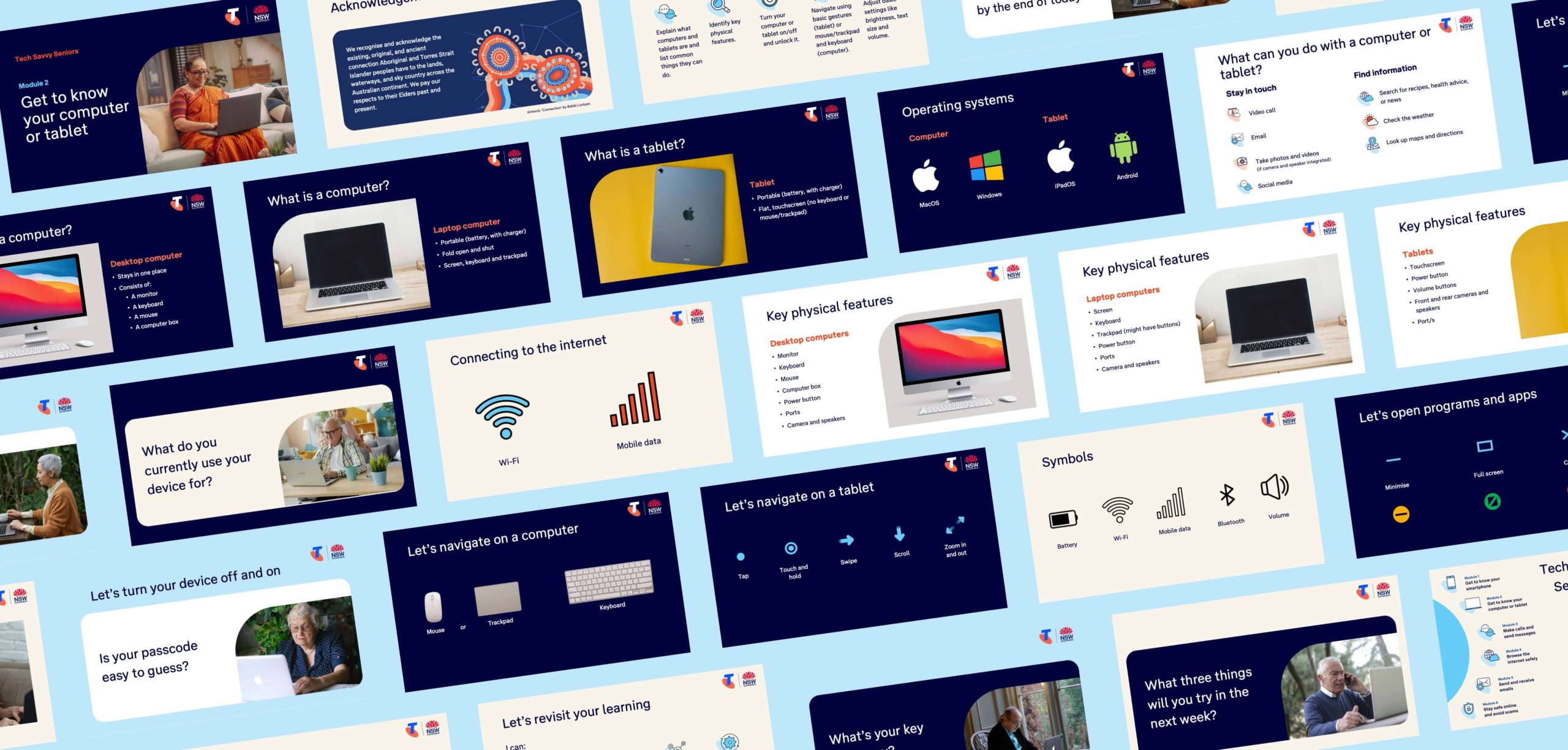
Read more: https://hungryminds.com.au/work/telstra-tech-savvy-seniors/
“Train the trainer is about giving good facilitators everything they need to deliver your program at its best. The guide does the groundwork. Train the trainer makes sure it sticks.”
Michael Peart, Managing Partner, Hungry Minds
When should a train the trainer happen in a project?
Train the trainer belongs in the project plan from the start, not bolted on at the end.
In the ADDIE model, facilitation preparation sits in the Implement phase. But the groundwork starts in Analyse and Design, when you identify who your facilitators are, what experience they bring, and what they will need to feel genuinely ready. That thinking shapes the facilitator guide and the train the trainer program together.
Build them in parallel and everything connects. Leave both to the last few weeks and you are doing triage.
“One of the first questions I ask on any project is: who is delivering this, and what do they need to feel genuinely ready? An experienced L&D team needs a completely different kind of preparation than frontline managers running a program for the first time. Getting that clear early means the facilitator guide, the train the trainer program, and the delivery all pull in the same direction.”
Senior Learning Designer Olivia
Want to build this capability in-house?
If your team regularly builds or delivers learning programs, the Professional Certificate in Instructional Design gives you the skills, frameworks, and templates to do it well.
Practical. Industry-designed. Built around the same ADDIE process we use with every client. Needs analysis, program design, facilitation preparation, delivery, evaluation.
Learn more: https://hungryminds.com.au/online-course-design/
The short version
Train the trainer is not a safety net for programs that need rescuing.
It is the structured handover that gives great facilitators everything they need to deliver your program the way it was designed.
Brief them on the context. Walk them through the guide. Get them into the room as learners before they are in the room as facilitators. Give them time to practise, ask the uncomfortable questions, and build genuine confidence before delivery day.
Your facilitators are good at their job.
Give them what they need to be great at delivering yours.