

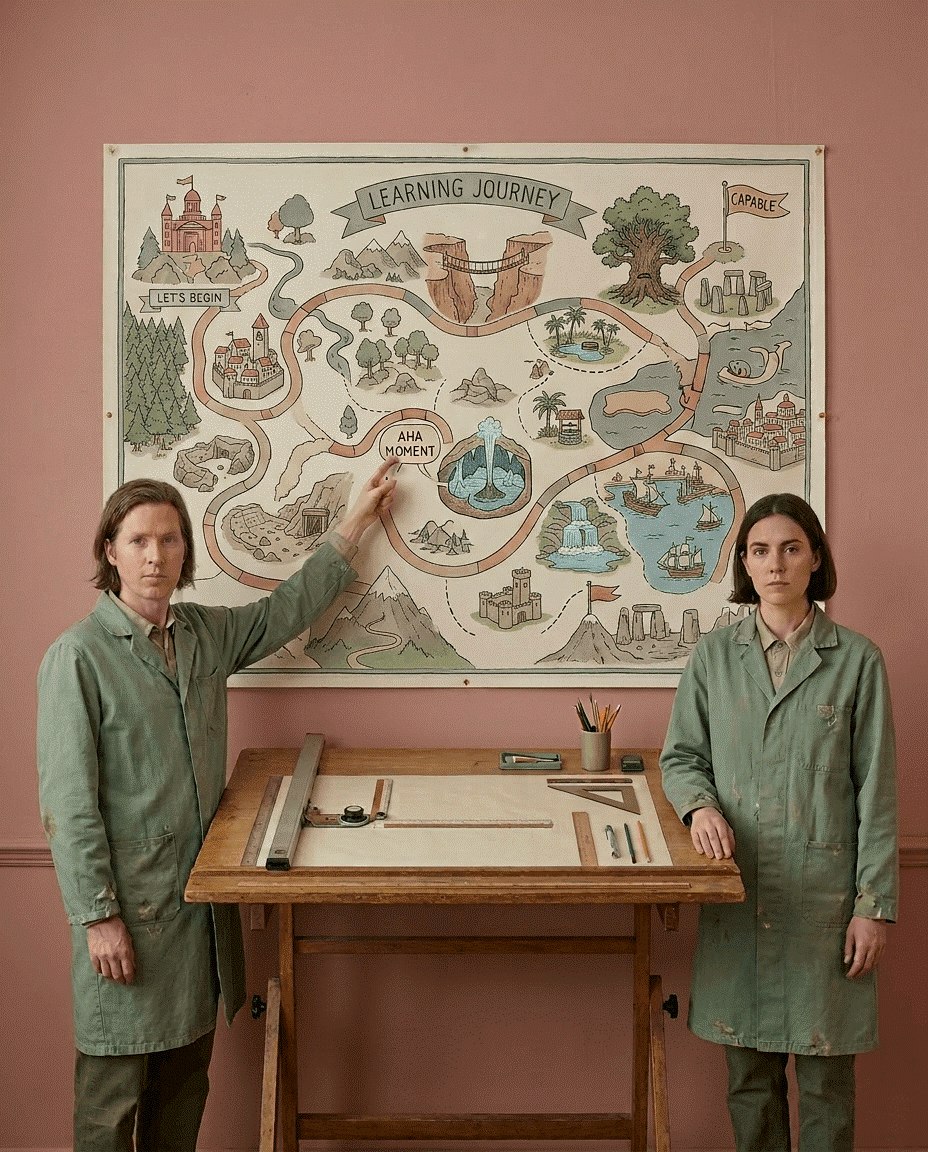
A one-day workshop is an event. A learning journey is a plan. The difference shows up about three weeks later, when you find out whether anything changed.
Most Australian organisations already know that single-hit training does not shift behaviour. The harder question is what to build instead, how long it should run, and whether you need a platform to hold it together. This guide answers all three, using five learning journeys we have actually built.
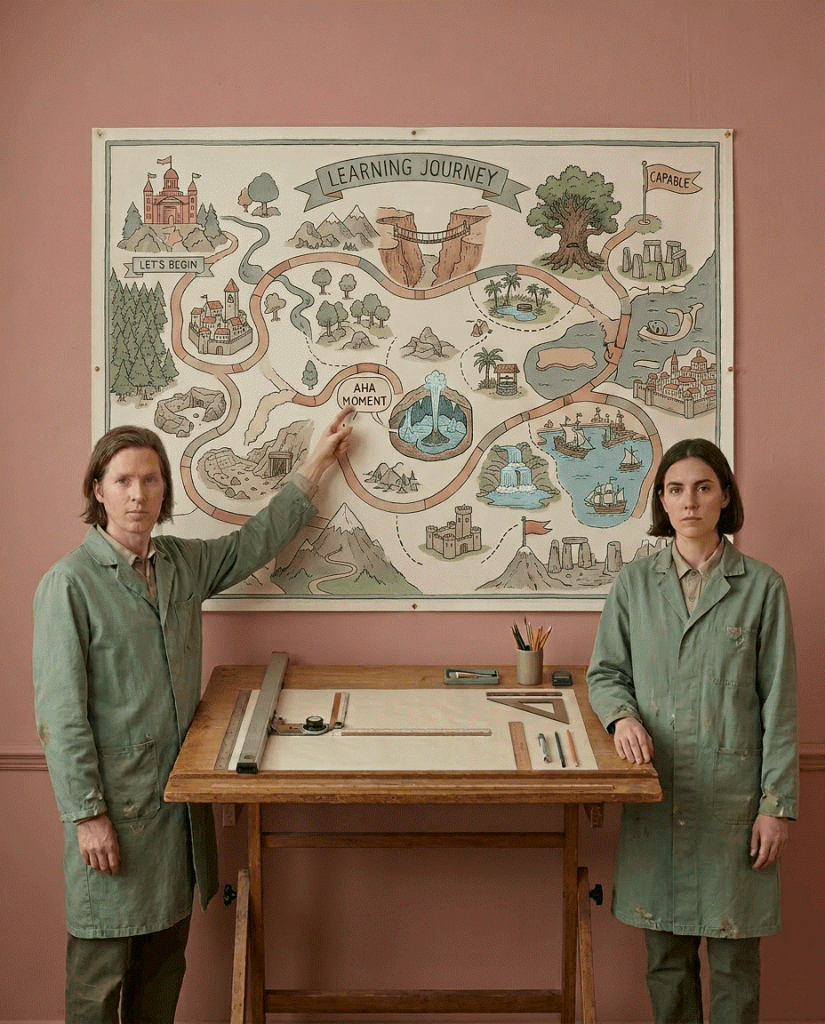
What is a learning journey?
A learning journey is a sequence of connected learning experiences spread over time, designed to build one capability. Instead of a single event, it includes multiple touchpoints like pre-work, formal learning, on-the-job practice, manager support and reinforcement across weeks or months. The structure exists because behaviour change needs repetition, not a one-off event.
It is designed for one cohort, one capability, one deliberate path from where they are to where they need to be.
The Australian Public Service Commission makes a version of this point in its Learning Quality Framework, noting that formal workshops and eLearning alone no longer provide the responsiveness organisations need. Its Learning and Development Strategy frames capability as something built through work, people and resources, not just courses. That is a learning journey, described in policy language.
Learning journey vs a traditional training course
| Traditional course | Learning journey | |
|---|---|---|
| Duration | One session or a fixed block | Weeks to months, with gaps by design |
| Structure | Content delivered once | Content, practice, reinforcement, revisited |
| Manager role | Approves the leave request | Briefed, involved, has conversation prompts |
| Where learning happens | In the room or in the module | In the room, on the job, in the team |
| Assessment | Quiz or attendance at the end | Applied task, observed practice, spaced checks |
| Measure of success | Completion rate | Behaviour change, then business outcome |
| Failure mode | Everyone attends, nothing changes | Momentum stalls between phases |
Both have their place. A 20-minute policy update does not need a journey. Anything involving judgement, habit or skill under pressure almost certainly does.
Why learning journeys work: the evidence
The case for spreading learning over time is one of the better-established findings in learning research, which is worth knowing when you are defending a longer program to a sceptical budget holder.
- Spacing beats cramming. Reviews of the spacing effect consistently find that separating study sessions in time improves performance on later tests compared with massing the same material together. A 2025 meta-analytic review of distributed practice in classroom settings, led from the University of Melbourne, found the effect holds up in applied environments, not just in the laboratory. The ERIC review of spacing across different forms of learning reaches the same conclusion across a range of learning types.
- Retrieval beats re-reading. A systematic review of distributed and retrieval practice in health professions education found that of 63 experiments, 43 showed significant benefits over control and comparison conditions. Getting people to recall something is more useful than showing it to them again.
- Forgetting is the default. The Ebbinghaus forgetting curve explains why a single exposure decays fast. A journey structure is essentially a forgetting-curve countermeasure with a project plan attached.
- Most capability is built at work. The 70:20:10 model puts the bulk of workplace learning outside formal programs. Journeys are the practical way to design for the 70 rather than pretending it does not exist.
Put simply: the gaps in a learning journey are not scheduling compromises. The gaps are the intervention.
What a learning journey contains
Most effective journeys have the same seven components, in some form.
- A trigger and a diagnostic. Something that establishes relevance and tells the learner where they currently sit.
- Pre-work. Short, light, and genuinely used in the next phase. If it can be skipped without consequence, it will be.
- A core learning event. Facilitated, virtual or self-paced. The part organisations traditionally think of as “the training”.
- Structured on-the-job application. A defined task in the learner’s actual role, with a deadline.
- Manager involvement. Prompts, briefing notes, a conversation guide. The highest-leverage and most frequently skipped component.
- Spaced reinforcement. Microlearning, retrieval questions, job aids, peer discussion. Small, repeated, low friction.
- Assessment and evaluation. Evidence the behaviour happened, then evidence it made a difference. Our guide to measuring learning impact covers how to set this up before launch rather than after.
Five learning journey examples from our own work
These are real programs we designed and built, not hypotheticals. Each one solves a different journey problem.
Example 1: Sentis, a 12-week safety leadership journey
Sentis builds safety cultures using workplace psychology, and their goal is safety citizenship rather than compliance. They needed a safety leadership program that worked for a dispersed workforce, where getting everyone into the same room repeatedly was not an option.
We designed a 12-week learning journey built on a weekly rhythm, organised into four blocks.
| Block | Weeks | Focus |
|---|---|---|
| Deconstructing the organisational context | 1 to 3 | Safety culture, and what a positive safety vision looks like |
| Embracing the psychology of change | 4 to 6 | How change works in the brain, and how to talk about it |
| Starting a movement | 7 to 9 | Building the case, securing commitment, mapping the transformation |
| Leading for success | 10 to 12 | Growing advocates, unlocking team capability, sustaining effort |
The weekly pattern is what makes it a journey rather than a course:
- Self-directed material in the LMS, including subject matter expert videos, readings and case studies
- One live online session each week for discussion, peer coaching and facilitated activities
- Deeper independent work through the week, reflecting and practising the new skill
- A dedicated community hub running continuously for discussion, debate and coaching support
That community hub is the part most programs leave out. It is what carries the cohort through the gaps between sessions.
Sentis needed safety leadership development that reached a dispersed workforce without losing the depth that culture change requires. We built a 12-week journey combining self-directed LMS content, weekly live sessions, peer coaching and a persistent community hub. Read the Sentis case study.
Use this shape when: the capability is behavioural, the cohort is spread across sites, and you need momentum over months rather than a single hit.
Example 2: St John of God Health Care, a blended clinical journey
St John of God Health Care employs more than 15,000 caregivers. They were relying heavily on externally delivered Advanced Life Support training, which was expensive, administratively heavy and inflexible across hospital sites. It produced technical competency but not confidence.
We co-designed a blended Adult and Paediatric Advanced Life Support journey with their clinical subject matter experts. The online component runs through four connected stages: Recognise, Respond, Review and Reflect.
| Phase | What happens |
|---|---|
| Online pre-learning | Self-paced modules across the four stages, built in Chameleon Creator, with realistic clinical scenarios and interactive decision-making |
| Reflection activities | Reflection checkpoints and questionnaires, plus downloadable learning journals |
| Face-to-face simulation workshop | Team-based simulation using rapid cycle deliberate practice, role rotation and coaching feedback |
| Competency assessment | Observation and competency tools, participant role checklists, clinically aligned assessment pathways |
| Annual refresher | Streamlined refreshers for experienced clinicians rather than a full re-run |
| Community of practice | Ongoing peer support between formal touchpoints |
Two design decisions matter here. Experienced clinicians get a shortened path rather than sitting through foundational theory again, and the modular online delivery works around shift patterns. Both are journey design choices, not content choices.
St John of God Health Care A four-month project replacing external ALS and PALS training with an internal blended journey across multiple hospitals, from small regional sites to large tertiary centres. The client’s aim was for participants to leave “reassured, confident and competent”, and the program is now running nationally. Read the St John of God Health Care case study.
Use this shape when: the skill is physical or clinical, the stakes are high, and you need documented competence as well as confidence.
Example 3: The MacKillop Institute, adding pre-learning to a workshop
Sometimes you do not need to build a journey from scratch. You need to turn an existing workshop into one.
The MacKillop Institute delivers evidence-based training on child safety, trauma-informed practice and workplace culture change. Their Power to Kids program existed only as a face-to-face workshop, which capped both reach and depth.
We built an eLearn series that sits in front of the workshop as pre-learning. The audience is busy professionals working with children and young people, so the design brief was bite-sized and engaging rather than comprehensive.
The effect on the journey is significant. Participants arrive with shared foundations, so facilitated time goes to practice and discussion instead of content delivery. The same workshop does more work.
Use this shape when: you already have a good facilitated program and want more from the room without adding days to it.
Example 4: South32 and MLC Life Insurance, leadership journeys
Leadership is behaviour, and behaviour needs reps. This is the clearest case for a journey over a course.
With South32 the work was about turning capable managers into confident, connected leaders, with an approach built on coaching, support and high performance. With MLC Life Insurance it was a mindset shift, helping leaders guide their teams differently.
Both share a structural feature worth copying. The cohort does real work on the program, bringing live challenges from their own teams into each phase rather than working through case studies about someone else. Our leadership learning design work is built around this.
Use this shape when: the goal is judgement and habit rather than knowledge, and you can hold a cohort together for three to six months.
Example 5: Taking a face-to-face program digital
Several of our journeys start with the same problem: a program that works brilliantly in a room, and cannot scale.
- Autism CRC inclusionED needed face-to-face lessons transformed for digital delivery
- Neurospicy Collective needed Amber Anthony’s sell-out neurodiversity workshops turned into a scalable product, delivered through LearnWorlds
- Consent Labs needed trauma-informed consent education that could reach university learners nationwide
- Gender Equity Works needed two versions of the same content, one for employers and one for workers, for Unions Tasmania
Neurospicy Collective Amber’s workshops needed a platform that matched the energy of the brand and the ambition of the business. We configured her LearnWorlds LMS from scratch and designed the learner journey around it, so the online experience felt like the workshops rather than a diluted version of them. Read the Neurospicy Collective case study.
The trap to avoid: converting a one-day workshop into a one-hour module and calling it done. The room was doing work the module cannot do. A journey replaces that work with sequencing, practice and peer contact.
Use this shape when: demand exceeds your facilitators, or geography is the constraint.
More journey examples across our work
Different problems, different journey shapes. All of these are live case studies.
| Journey problem | Client example | What it looks like |
|---|---|---|
| Sensitive content that needs emotional safety first | Mitigating Vicarious Trauma, The Shark Cage, Challenge DV, Women Up North Housing | Learner-controlled pacing, framing before content, organisational follow-through |
| Consolidating scattered knowledge | Horizon Power, Mineral Technologies, Perth Airport | Capture, structure, then sequence for the people who need it |
| Safety and emergency response | Total Fire Service, EnergyAustralia, SMCT equipment safety | Core learning plus practical verification where the risk is physical |
| Building the client’s own capability | VACCHO and Balit Durn Durn Centre, CHIA Vic | Design systems, templates and guides the team owns and runs |
| Train the trainer at scale | Training the trainers, CHIA Vic | Build the capability of the people who will deliver it onward |
| Vocational to job-ready | Qualify Group, ACLS, Youth Disability Advocacy Network (YDAN) | Scenario-based practice bridging classroom and workplace |
| Co-design with practitioners | Kids Research Institute, Mitigating Vicarious Trauma, YDAN | Build with the audience, not just for them |
| Microcredentialled pathways | Microcredentials for Autism CRC | Stackable recognition across a longer path |
Journey patterns for common scenarios
We do not have a published case study for every scenario, so treat the following as starting shapes drawn from common practice. Adjust the timing to your context.
Onboarding and induction, around 12 weeks
Pre-boarding content, then day-one legal and safety essentials only, then role fundamentals across weeks two to four, structured buddy check-ins to week eight, an applied task and manager review at week eight, culture and strategy once there is context to attach it to, and capability confirmed at week 12. Front-load only what is legally or physically necessary. See our onboarding and inductions work.
Systems rollout, around eight weeks across go-live
Awareness from leaders four weeks out, role-based training one to two weeks out covering only the tasks that person performs, sandbox practice the week before, job aids and floor support at launch, then targeted help in weeks two to four based on what the helpdesk data shows is failing, and advanced use from week five. Most of the value sits after go-live, which is exactly where budgets get cut.
Compliance on an annual cycle
A scenario-based diagnostic rather than a knowledge quiz, targeted content covering only the gaps it found, monthly supervisor-led reinforcement tied to real incidents, practical verification where the risk is physical, and a re-diagnostic at 12 months rather than a re-run of the same module. Under the model work health and safety laws, a business must provide information, training, instruction and supervision that workers can act on. Safe Work Australia’s guidance on training and supporting your workers is clear that the test is effectiveness, not delivery. This thinking sits behind our compliance training work.
How to design a learning journey: eight steps
- Name the behaviour change. Not the topic. What will people do differently, and who will notice?
- Run a needs analysis. A learning needs analysis tells you what is actually missing. Skip it and you will build content for a problem you have not diagnosed.
- Map the current experience. What do these people already get, from whom, and when? Journeys often fail because they ignore what already exists.
- Set the spine. Choose three to six phases and the gaps between them. Gaps of one to three weeks work for most workplace content.
- Assign each phase a job. One phase, one purpose. If two phases do the same thing, cut one.
- Design the manager layer separately. Write the briefing, the prompts and the timing as their own deliverable. Do not assume managers will improvise it.
- Build the high level design. Phases, durations, modalities, activities, assessment and platform requirements in one signed-off document.
- Decide how you will know. Define the evidence for each phase and the business measure for the whole journey, before you build anything.
Five reasons learning journeys fail
- No manager layer. The single most common cause. Learners return to a manager who has no idea what they were doing.
- Phase two never lands. Someone had to send it, and that someone got busy. Automate the sequence or it will not survive contact with a normal month.
- Too long for the content. A six-month journey for something that needed three weeks trains people to ignore you.
- No forcing function. If nothing happens when a phase is skipped, the journey is a suggestion.
- Measured on completion. Completion tells you people clicked. It says nothing about whether the behaviour changed.
FAQs
Frequently asked questions about learning journeys
A learning journey map, or a learning architecture, is the planning document that lays out each phase, its timing, its purpose, the modality, the activities and the evidence collected. It is the artefact stakeholders sign off before anything is built, and it doubles as the project plan.
Not necessarily. What you need is a place where the journey is mapped out, so everyone can see what’s coming and when.
A lot of the time, that’s a one-pager: a single printed page laying out every touchpoint and experience along the way. Simple, but it does the job. Anyone can pick it up, pin it above their desk, or tuck it in a folder, and know exactly where they are in the journey — no login required.
A learning management system (LMS) works best when the journey runs mostly online: scheduled content release, automated nudges, a mix of activity types, and visibility for managers.
Learning that keeps going after the session ends
A learning journey is not a longer course. It is a different design decision, built around the fact that people forget, practice matters and managers set the weather.
If you are working out what your people need to be able to do and over what timeframe, that starts with learning strategy. If you know the shape and need it built and configured properly, our learning design and eLearning teams handle the whole path from brief to launch. Tell us what needs to change and we will map the journey that gets you there.
References
- Australian Public Service Commission, Highly Capable, Future-Ready: APS Learning and Development Strategy
- Australian Public Service Commission, APS Learning Quality Framework
- Safe Work Australia, Training and supporting your workers to stay safe at work
- Mawson, R. D. and Kang, S. H. K. (2025), The distributed practice effect on classroom learning: a meta-analytic review of applied research, National Library of Medicine
- Trumble, E. et al. (2024), Systematic review of distributed practice and retrieval practice in health professions education, National Library of Medicine
- Using spacing to enhance diverse forms of learning, Education Resources Information Center (ERIC), US Department of Education
- Advanced Distributed Learning Initiative, Total Learning Architecture service definitions
- W3C Web Accessibility Initiative, WCAG 2 Overview