


Snapshot







Client
Macular Disease Foundation Australia (MDFA) is the national peak body for the macular disease community. It works to reduce the impact of macular disease through prevention and early detection, practical support, advocacy and research.
MDFA also offers free, evidence-based continuing professional development (CPD) for healthcare professionals. Its courses help clinicians recognise macular disease, support their patients and improve health outcomes.
The need
MDFA wanted its growing suite of CPD courses to stay current as clinical terminology, treatments, its own brand and its support services evolved.
It also saw the chance to extend proven course content to more professional groups, without rebuilding every module from scratch.
The audiences included pharmacists, optometrists, orthoptists, ophthalmic nurses, nurses and diabetes educators. Each of them plays a part in early identification, referral, patient education and ongoing support.
The learning solution
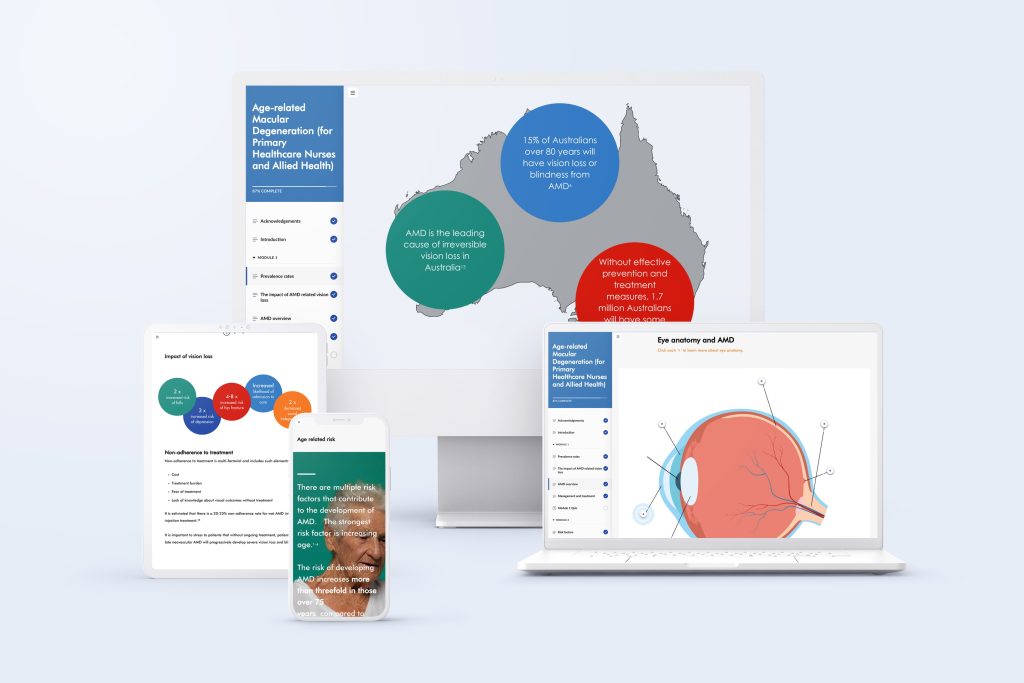
Across three connected projects, we refreshed MDFA’s existing Articulate Rise 360 modules and built new versions for new professional audiences. Each new version started from a module that MDFA had already reviewed and approved.
The refresh brought in MDFA’s new branding, revised clinical terminology and treatment information, and updated quizzes and references. It also added new content introducing Eye Connect and other patient support pathways.
How we designed it
- Adapt what already works. Established modules on age-related macular degeneration (AMD) and diabetes-related eye conditions became the base for the orthoptist and nurse versions. We kept the core learning and changed the language, examples and assessments for each professional group.
- Reviewed by MDFA’s own experts. MDFA’s subject matter experts commented directly in Review 360, and we actioned each round of updates. Their quick, clear feedback kept decisions moving across many modules and audiences at once.
- Show the condition from the inside. Six short, looping videos show everyday tasks through the eyes of someone with AMD or a diabetes-related eye condition. Learners watch someone reading, finding a product in a supermarket and navigating a street. They see straight away how changes to central vision affect daily life.
- Referral and support in the content. A Collaborative Eyecare Pathway diagram shows how general practitioners, nurses, Aboriginal Health Workers and aged care workers refer patients on to optometrists and ophthalmologists. New Eye Connect content then introduces MDFA’s patient support program, which provides care beyond the clinic setting.
What we built
- Refreshed CPD modules in Articulate Rise 360, with MDFA’s new branding, current clinical terminology and treatment information, and updated quizzes and references.
- New audience-specific versions of the AMD and diabetes-related eye conditions courses for orthoptists and nurses.
- Eye Connect content that introduces MDFA’s patient support program and its other support pathways.
- Six vision-simulation videos, designed with our specialist videographers for the modules and for MDFA’s community presentations. See more of our training video work.
- SCORM packages supplied for each module once MDFA had approved it.

The outcome
MDFA now has a current, consistent suite of professional education that is easier to maintain as clinical information and services change.
Its existing modules have been relaunched. Proven content now reaches a broader range of healthcare professionals through the newly adapted courses.
The updated learning supports MDFA’s CPD offer and connects clinical education with timely referral and patient support through Eye Connect. The six videos work in both eLearning and live presentations.
The work builds on a long partnership with MDFA. Its responsive, knowledgeable team made complex clinical updates straightforward and kept a large body of work moving from draft to approval.