


Snapshot







Client
The Department of Primary Industries and Regional Development (DPIRD) is a Western Australian Government department. It supports the state’s agriculture, fisheries and regional development sectors.
DPIRD’s people work across the state, from biosecurity and sustainable fisheries to research and regional economic growth. Every day they deal with farmers, fishers, researchers and businesses in regional communities.
Handling personal information with respect is central to the trust the department has built with all of them.
The need
The Privacy and Responsible Information Sharing Act 2024 (WA) brought the Western Australian public sector under a formal privacy framework for the first time. The framework includes 11 Information Privacy Principles.
DPIRD’s privacy project team saw the chance to get ahead of the change. It wanted staff to understand clearly what the new obligations mean in their everyday work.
The team asked for a short, engaging module that would build confidence with personal information across the department, timed for Privacy Awareness Week. With a tight window, it needed a partner who could move quickly and still deliver quality.
The learning solution
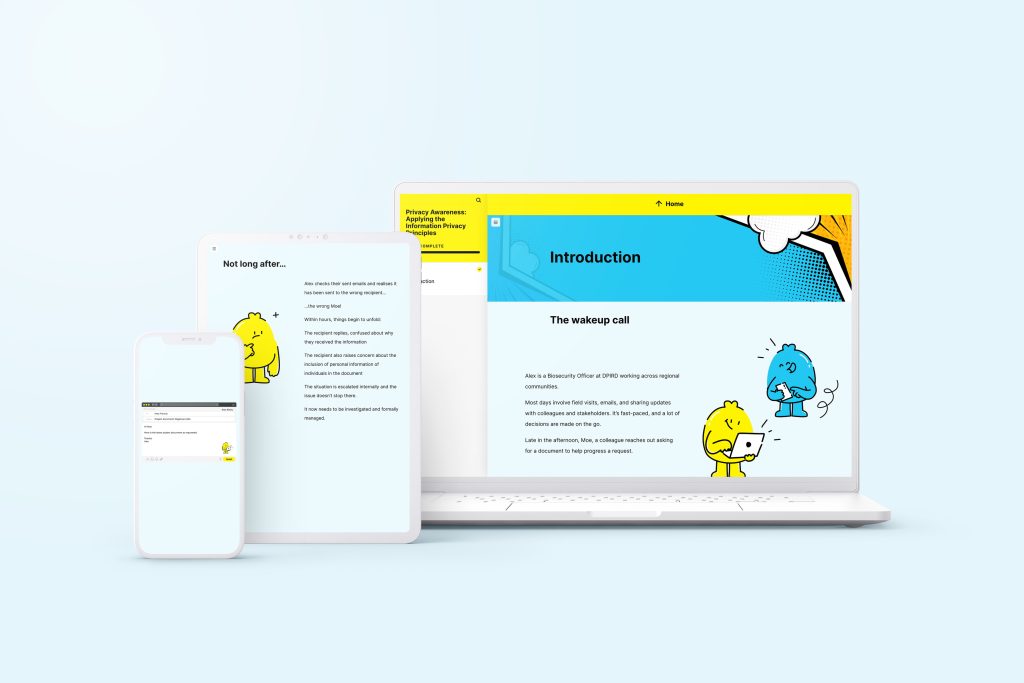
We designed and built Privacy Awareness: Applying the Information Privacy Principles. It is a 30-minute, self-paced compliance module in Articulate Rise 360, handed over as a SCORM package for DPIRD’s LMS.
People rarely change how they work after reading a policy. They learn from context, consequences and decisions, so the module is story-led and built on case studies.
The module skips a clause-by-clause tour of the legislation. It follows the everyday moments where privacy can go wrong, shows what happens next and gives staff clear steps to get it right.
The learning design draws on scenario-based and problem-based learning. It also uses Merrill’s First Principles of Instruction, which put real-world problems at the centre of learning.
How we designed it
- Grounded in DPIRD’s own context. We built from DPIRD’s privacy policies, training materials and examples of real incidents and common risks. In one scenario, a biosecurity officer called Alex sends a project document full of personal details to the wrong Moe.
- Consequences as well as rules. Each scenario shows the impact of a poor privacy decision on people and on the department. That makes the Information Privacy Principles concrete for staff.
- Learners make the call. Interactive decision points ask staff what they would do in a realistic situation, then show them the outcome. This builds the judgement they need on the job.
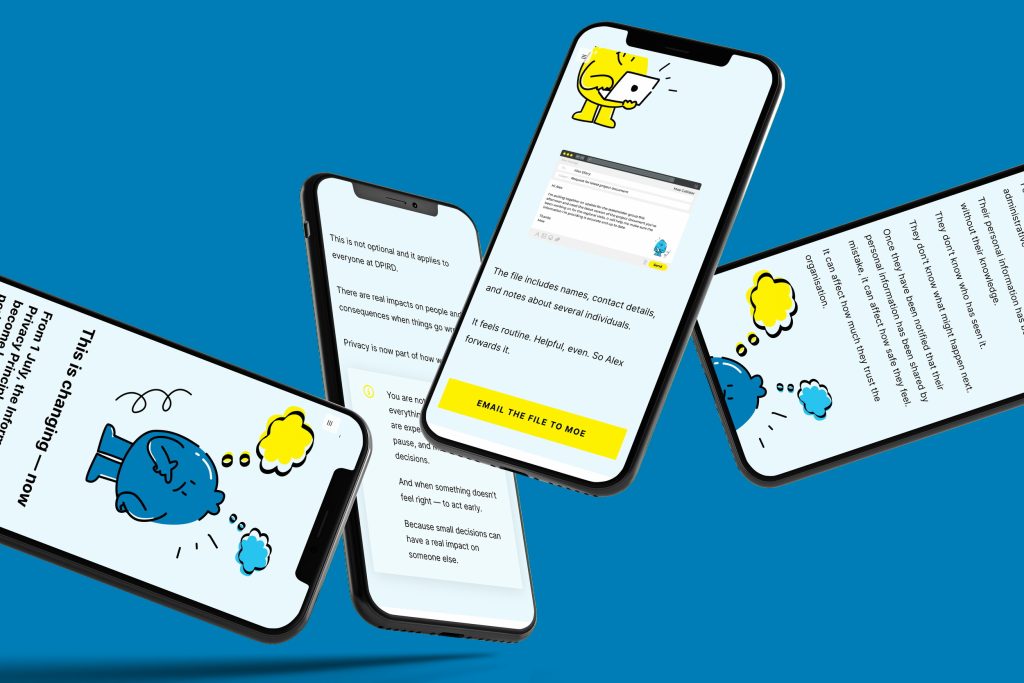
- Visual storytelling for legal ideas. Illustrated characters and short narrative scenes turn legal concepts into plain, memorable messages.
- Reinforcement along the way. Knowledge checks throughout the module ask learners to retrieve and apply key points as they go, which supports retention.
- Fast, structured co-design. An already scheduled meeting became the kick-off and discovery session, and feedback cycles ran at 24 to 48 hours. DPIRD reviewed the storyboard and concept design before the build, then alpha, beta and final versions.
- Accessible from the start. The module was designed and built to WCAG standards, so every staff member can take part.
What we built
- A 30-minute Articulate Rise 360 module, short enough to finish in one sitting. It works on desktop, tablet and mobile for staff in offices, regional centres and the field.
- Real-world scenarios and case studies drawn from DPIRD’s own incidents and common risks.
- Interactive decision points and knowledge checks that turn privacy principles into practical judgement.
- DPIRD-branded visual design, so the module matches the department’s other resources.
- AI voiceover narration, which adds an audio layer for different learning preferences and allows fast turnaround on script changes.
- A SCORM package ready for DPIRD’s LMS, so the department can roll out the module and track completions through its own systems.
The outcome
DPIRD now has a concise, engaging privacy module that turns new legislative obligations into practical, everyday behaviours.
We delivered it in four weeks from kick-off to SCORM package. The department had a ready-to-launch resource to support staff as the new privacy provisions took effect.
The module gives DPIRD one consistent privacy message for a workforce spread across Western Australia.