


Snapshot





Client
LifeFlight is a leading aeromedical, emergency rescue and retrieval medicine organisation. It serves communities across Australia in their greatest moments of need.
LifeFlight began as a grassroots regional helicopter service. Through LifeFlight Medical Services, it is now one of Australia’s largest employers of pre-hospital emergency care doctors. Its First Minutes Matter program teaches everyday people what to do in a medical emergency before help arrives.
The need
Bystanders are often first on the scene of a medical emergency, on a road, on a farm, at home or at work. First Minutes Matter gives them the confidence to act safely until professional help arrives.
LifeFlight wanted to reimagine the program as a scalable digital learning experience, building on face-to-face materials with strong clinical credibility and practical guidance.
LifeFlight recognised that a digital program needed a clear learning architecture that feels simple and accessible to people with little or no medical knowledge. That includes regional and high-risk communities, where emergency services may take longer to arrive.
The learning solution
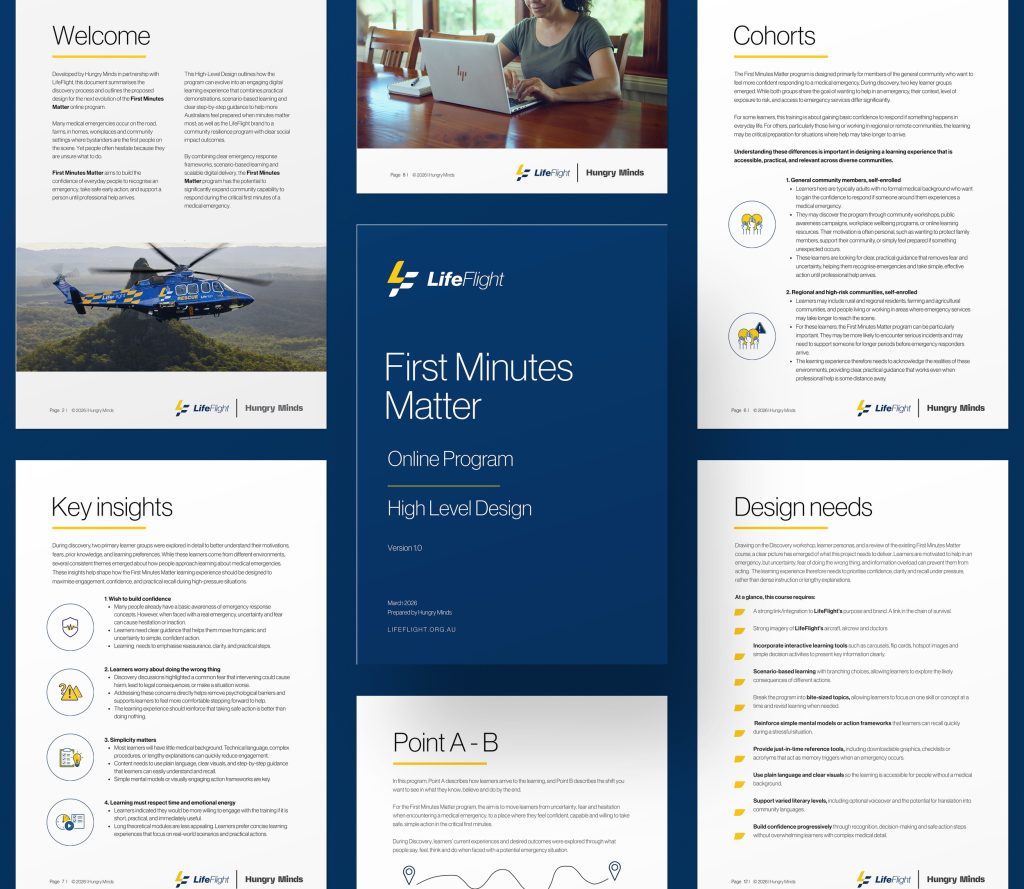
Our engagement was the design stage. We wrote a High Level Design for the next evolution of the First Minutes Matter online program. It drew on a discovery workshop with LifeFlight’s team and a review of the existing course material.
The design turns LifeFlight’s clinical expertise into a scenario-led learning model that LifeFlight can take to funders and build from.
How we designed it
- Two cohorts share one goal. The discovery workshop built personas for two groups: general community members, and people in regional and high-risk communities. It also surfaced what makes people hesitate, such as fear of doing the wrong thing and information overload.
- Learners move from Point A to Point B. We mapped each learner’s shift from anxious, uncertain and hesitant to confident, capable and willing to act. Every module is designed against that change in confidence and behaviour.
- One flow runs through every module. Recognition, Action and Readiness is the same three-stage flow in every module, so learners build one repeatable mental model they can recall under pressure.
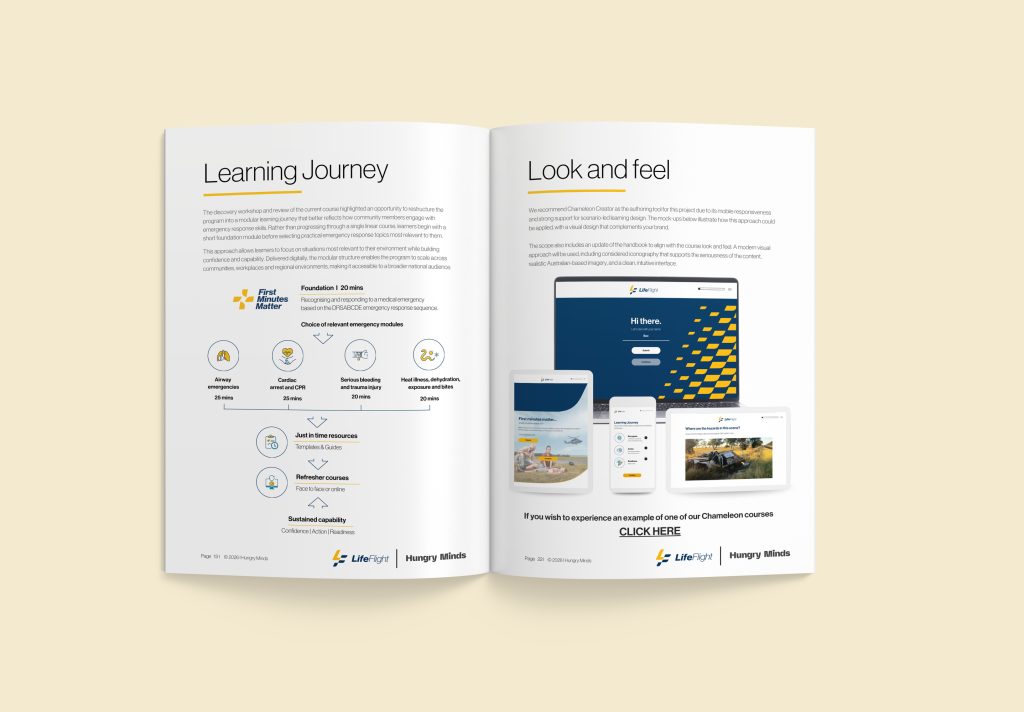
- A short foundation comes first. A Foundation module teaches the DRSABCDE emergency response sequence, then learners choose the follow-on modules that suit their own environment or workplace.
- Assessment happens inside the scenarios. Learners make decisions at realistic points in each scenario instead of sitting a final test, so their practice mirrors a real emergency.
- Video follows a set pattern. The design reuses LifeFlight’s paramedic demonstration footage where it adds value. New story-driven video follows one pattern: a person, a moment, a simple action and an outcome.
- Accessibility is built in from the start. Plain language, optional voice-over, translation readiness and support for varied literacy levels help the program reach a broad community audience.
- The recommended tools suit the job. We recommended Chameleon Creator for its mobile responsiveness and scenario branching, and Xcelerate as the learning management system for tracking and certification.
What we built
- A discovery and learner insight summary. It covers personas, fears and the learner journey, so each design decision traces back to what LifeFlight’s community and experts said.
- A modular learning journey. A Foundation module leads into four modules on airway emergencies, cardiac arrest and CPR, serious bleeding and trauma, and heat illness, exposure and bites.
- A video strategy that pairs LifeFlight’s paramedic footage with new story-driven content, keeping production efficient and the voice authentic.
- An assessment and recognition model with scenario decision points, quick knowledge checks, module badges, a completion certificate and visual progress tracking.
- Look-and-feel mock-ups showing how the online course would work in Chameleon Creator, in LifeFlight’s brand.
- A staged investment plan with a ten-sprint project timeline in three funding-ready clusters.
The outcome
LifeFlight now has a funder-ready High Level Design. It sets out a clear roadmap for turning First Minutes Matter into a scalable national eLearning program.
The design presents the program as a community resilience initiative as well as first aid education. It extends LifeFlight’s life-saving mission by giving everyday people the confidence to act in the first minutes.
LifeFlight can seek funding one cluster at a time or for the full program. The design also recommends an annual content update, so the program stays current with best practice.
Find out more about LifeFlight’s work in communities at LifeFlight.