

Snapshot






Client
The Fair Co. is a for-purpose, certified social enterprise and People+Planet First verified consulting firm. It was established by the Victorian Government to help organisations bring the Social Procurement Framework to life, and is now independent. It works with business and government on social procurement and the social dimension of ESG. That runs from strategy and tender preparation through to supplier connections, skills and employment programs. Its vision is a world where everyone gets the opportunity to thrive through meaningful work, and its line is Good Business. Made Better.
The need
The Fair Co. advises employers on inclusive employment for a living. What it wanted was a program of its own, so that advice could be delivered at scale rather than one conversation at a time. Two constraints came from the client, and both were the right calls. The program had to work face to face and self-paced from the same design, because clients buy differently. And it had to modularise, so a client wanting only modules two and three could have exactly that. Neither is how inclusion training is usually packaged.
The learning solution
Three modules were designed and built: Workplace Inclusion Fundamentals, Bias and Belonging, and Inclusive Leadership and Workplace Culture. Each exists twice over, as a facilitated workshop and as a self-paced eLearn, from one design. The Fair Co. rebranded partway through the build, so every artefact was carried into the new identity as it landed, and the program shipped whole under one look.
How we designed it
- One design, two modalities, not one adapted into the other. Each module was designed from the start to be delivered either way. The workshop is built for what a room can do together, and the eLearn for what one person can do alone. A client can run the room, send the link, or do both.
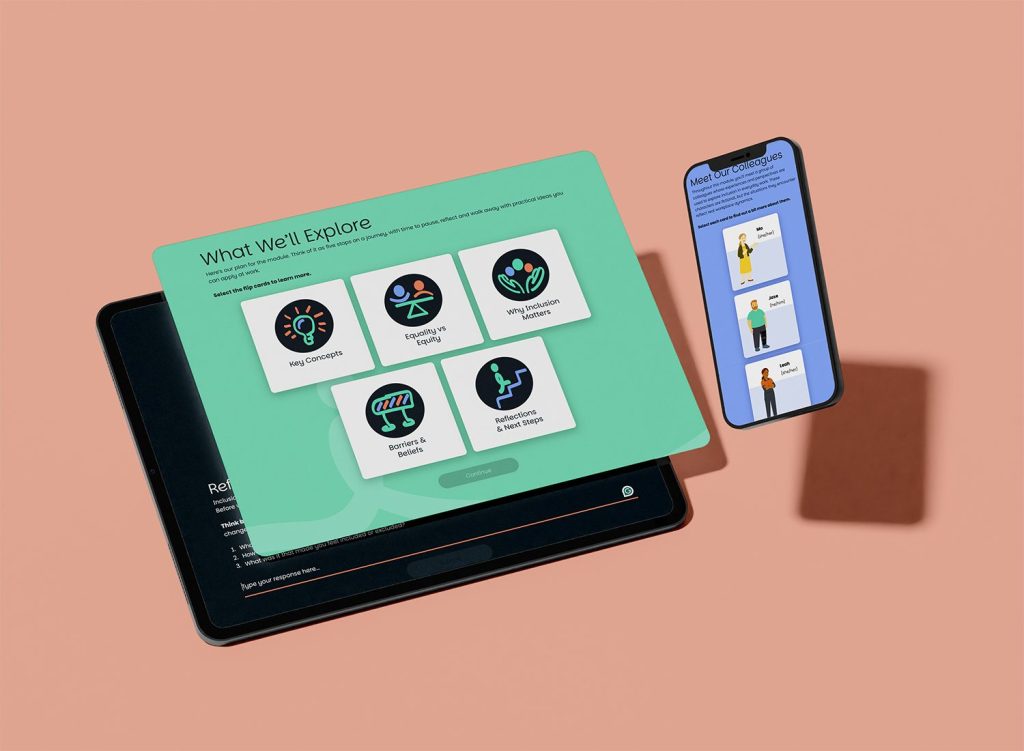
- Modules that stand alone, and say so on screen. The client asked for pick and mix, so the eLearn makes the choice visible rather than burying it in a course description. Three circles on the landing page, a YOU ARE HERE pin on the one you are in, and ALSO AVAILABLE on the other two. The copy says you may complete one, two or all three, and nothing assumes you have done the others.
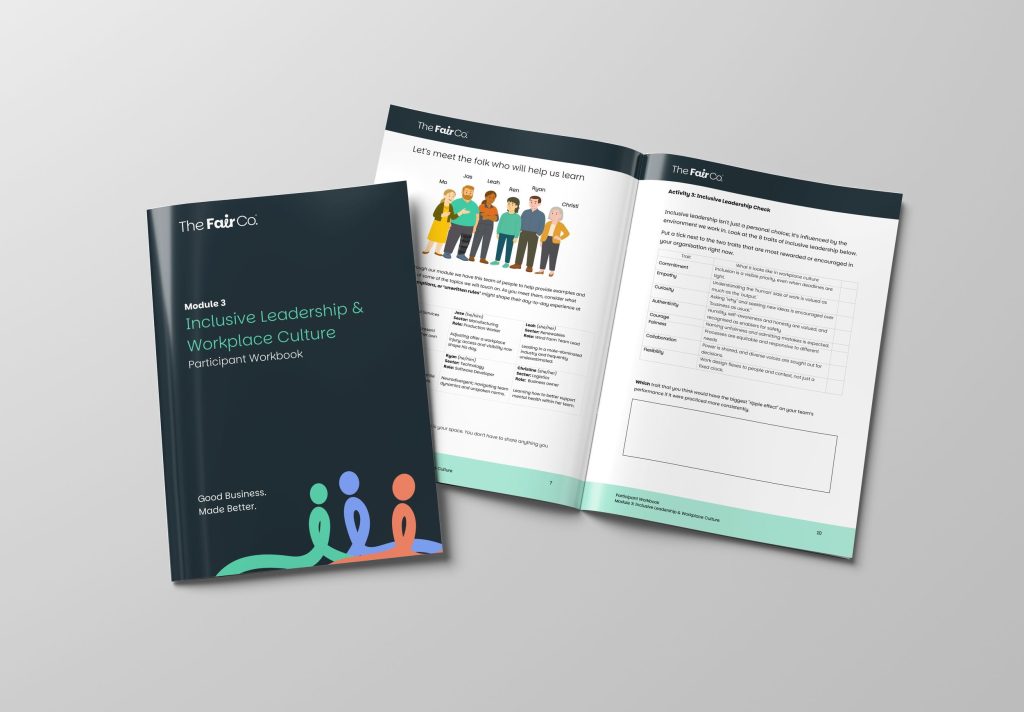
- One cast of six, in every artefact. Mo, Jase, Leah, Ren, Ryan and Christine are fictional colleagues, and each carries pronouns, a sector, a role and one specific situation. One is asked to speak for a culture while her own needs go unmet, one is adjusting after a workplace injury, and one leads in a male-dominated industry. The others navigate unspoken norms as a neurodivergent clinician, balance care responsibilities, and support a team member’s mental health. They appear in the eLearn as Meet Our Colleagues and in the workbook as Let’s meet the folk who will help us learn. A participant who does both meets the same six people twice, so the scenarios stay recognisable whoever is in the room.
- Every tool has a name. The Curiosity Compass sorts closed leadership from curious leadership. The Inclusive Leadership Check runs eight traits against what each looks like in a workplace culture. Trust Builders and Trust Breakers, the Inclusive Design Audit, and Equity in Action scenario sorting do the same job. A named tool leaves the room in someone’s head. A worksheet stays on the table.
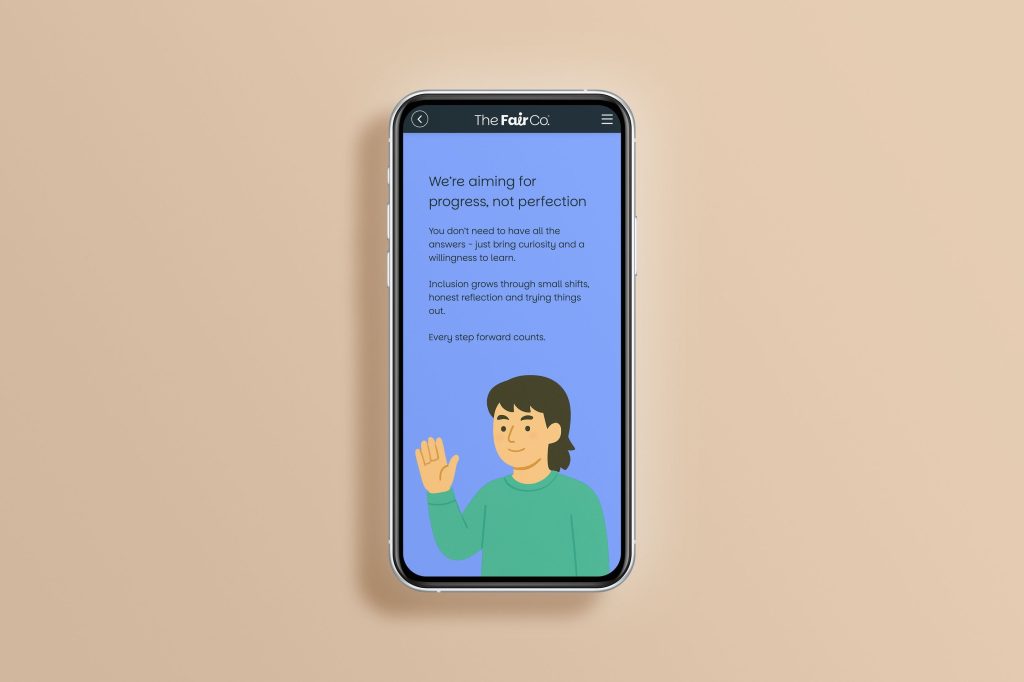
- Permission to be imperfect, up front. Every module opens on the same two ideas before any content. We are aiming for progress, not perfection. And here is what this is and isn’t: it is not a test. On this subject the fear of saying the wrong thing is what stops people participating, so removing it is the first instructional move rather than a footnote.
- Supports and a glossary come first. Each eLearn front-loads a glossary and a downloadable Support Guide. A plain note says some topics may bring up strong feelings, and that it is fine to pause. An Acknowledgement of Country opens every module.
- The client keeps everything. Editable Word source for every guide, workbook and deck, the workbooks in both print and fillable form, and an LMS support pack. Full IP sits with The Fair Co., which is the point when the program is a product they will sell and update themselves.
What we built
- Three eLearns in Chameleon Creator. Exported as SCORM 1.2: Workplace Inclusion Fundamentals, Bias and Belonging, and Inclusive Leadership and Workplace Culture.
- Three facilitator guides. Around 45 pages each, one per module, written so a facilitator can run the session from the guide alone.
- Three participant workbooks. Each in a print version and a fillable version, so a remote cohort and a room full of people get the same artefact.
- Three slide decks.
- Handouts. Meet Our Colleagues, a Planning Toolkit and a Supports guide.
- LMS setup, training and support pack. The client can load and run the modules themselves in their LMS.
The outcome
The Fair Co. now owns a workplace inclusion program rather than a set of slides. It can run module two as a workshop for one client. It can sell module three as an eLearn to another, and deliver the full series to a third, without redesigning anything. The pick and mix the client asked for is real, because each module was built to stand on its own.
Because the source files and the IP sit with them, the next version does not need us. The program is theirs to sell, extend and keep current.
The Fair Co. offers workplace inclusion services alongside its social procurement and ESG work. Good Business. Made Better. Find them at thefairco.com.au.