


Quick answer
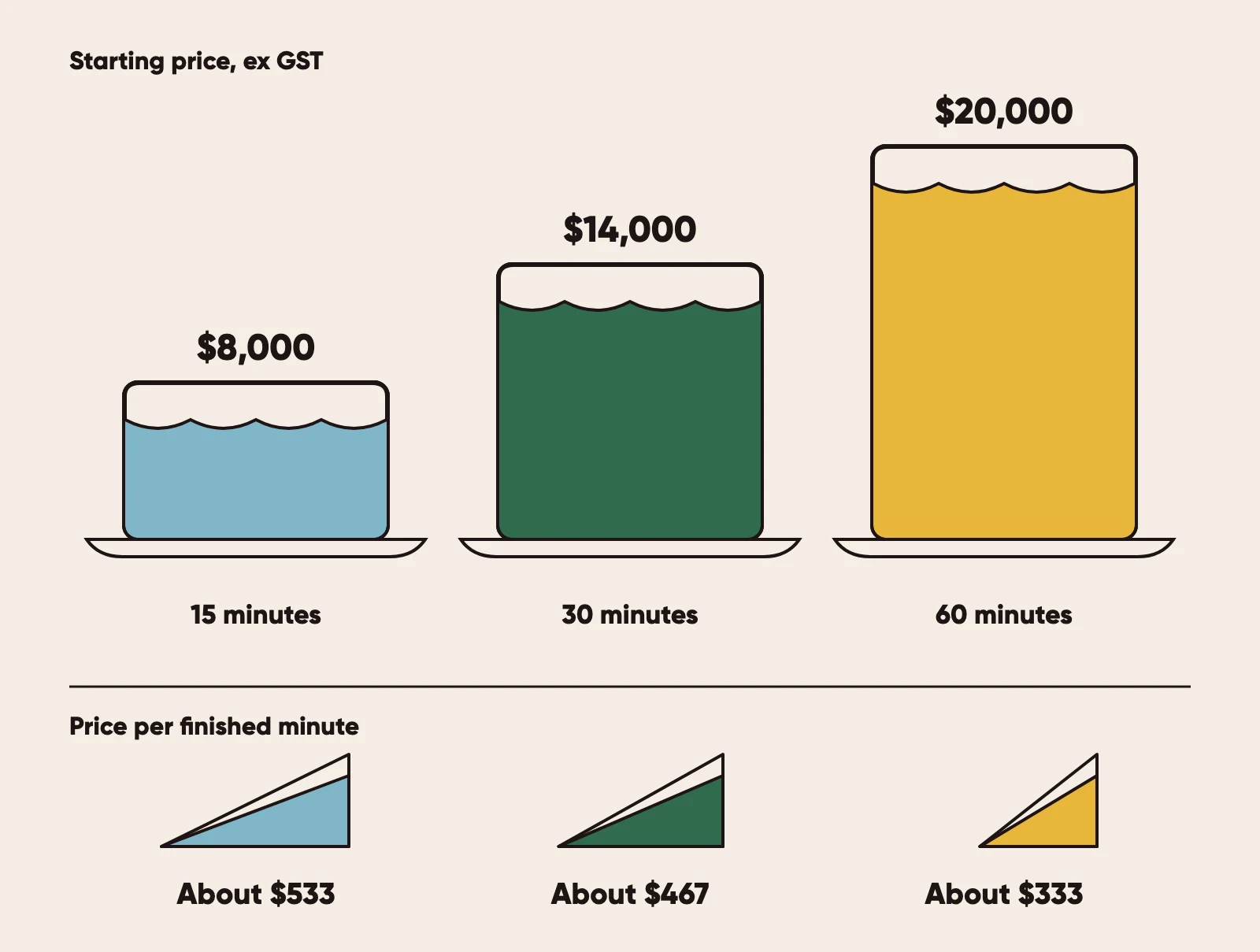
eLearning development cost in Australia depends mostly on three things: how ready your content is, the extras you add and the course length. At Hungry Minds, a custom 15-minute module starts at $8,000 ex GST, a 30-minute module at $14,000 and a 60-minute module at $20,000. Video, custom images and complex branching add to that. You can work out a figure for your own course in four steps with our price guide.

Finance wants a number, and “it depends” won’t get your budget approved. Here are our numbers, what moves them and when eLearning isn’t the right solution. If you’re new to all this, start with what custom eLearning development is in our learning design hub.
What does custom eLearning cost in Australia?
A custom module starts at $8,000 ex GST for 15 minutes. Our price guide adds the extras you need and shows the total, and our custom eLearning page has the full list.
| Course length | Starting price (ex GST) | Price per finished minute |
|---|---|---|
| 15 minutes | $8,000 | About $533 |
| 30 minutes | $14,000 | About $467 |
| 60 minutes | $20,000 | About $333 |
The longer the course, the less you pay per minute. Your branding, learning map and project set-up happen once, so a longer course spreads them further.
What’s included in the base price?
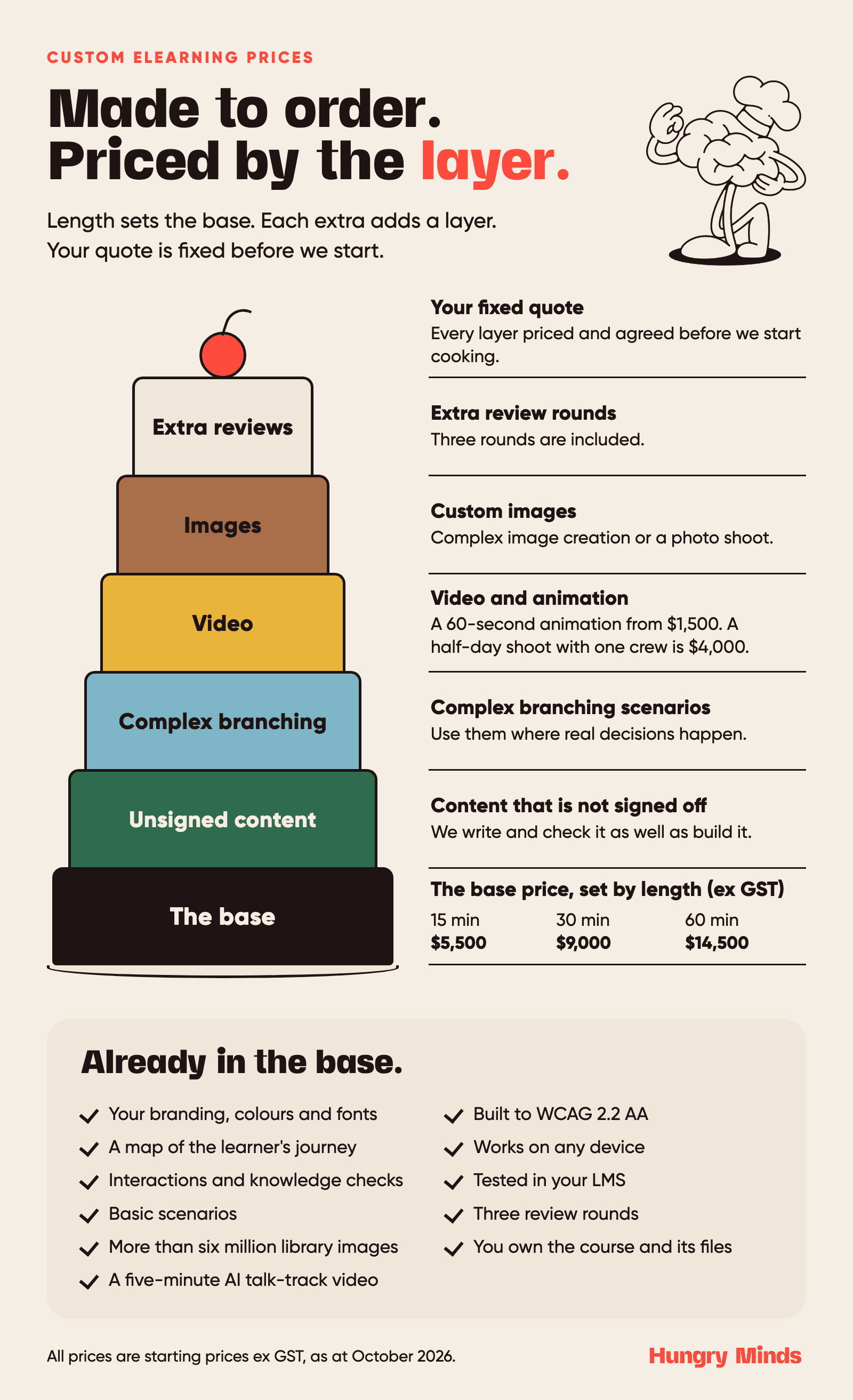
The base price gets you a finished module in your brand. It works on any device, it’s tested in your learning management system (LMS) and it’s built to WCAG 2.2 AA. You own it, source files and all.
- Your branding, a learning map and basic scenarios.
- Knowledge checks and interactions, from flip cards to timelines.
- Images from a library of more than six million, or your own.
- Your own videos, AI-generated images and an AI talk-track video of up to five minutes.
- Three review rounds.
A typical project takes 4 to 12 weeks, depending on how many modules you need and how ready your content is.
What makes eLearning development cost more?
Unsigned content, the extras you add and extra review rounds stack layers on top of the base price.
| What adds cost | Why it adds cost |
|---|---|
| Unsigned content | We write and check it as well as build it |
| Complex branching scenarios | Each branch is written, built and tested |
| Video and animation | Animation is priced by length, and filming by the half or full day |
| Custom images and photo shoots | Each image is made or shot for your course |
| Extra review rounds | Each round beyond the three included adds design and build time |
Every extra has a starting price in our price guide, so you can tick what your course needs and see the total before you talk to us.
Video has its own price list: a 60-second animation starts at $1,500 ex GST, and a half-day shoot with one crew is $4,000.
Watch out for the brief that says “we just want something engaging”. You can’t price that, so we go back a step and find the behaviour you want to change. The behaviour sets the length, and the length sets the base.
Why does an hour of eLearning take so long to build?
An hour of good eLearning takes weeks to design and build, and the more interactive it gets, the steeper the climb. Bryan Chapman’s 2010 study for the Chapman Alliance asked 249 organisations how long one finished hour took them.
| Type of learning | Typical hours to build one finished hour | Range of hours |
|---|---|---|
| Face-to-face training | 43 | 22 to 82 |
| Basic eLearning | 79 | 49 to 125 |
| Interactive eLearning | 184 | 127 to 267 |
| Advanced eLearning | 490 | 217 to 716 |
Those numbers predate Rise 360 and today’s AI tools, so use them to compare the four types. Robyn Defelice’s 2023 survey for ATD found a fully interactive piece took more than twice the hours of a passive one.
Her 2018 update for ATD revisits a 2009 study. It found that “subject matter experts and project scope appeared to have the largest effect” on the estimates. You control both of those, so that’s where the steps below start.
How do you get more course for your budget? Six steps
- Pick one behaviour. A course aimed at one decision is shorter and sharper, and length sets the price.
- Sign off your content first. Rewriting mid-build takes more hours than rewriting before it.
- Choose the size before the layers. Fix the minutes, then pick the extras that fit, and save custom images for the key moments.
- Branch where the decisions are. Save branching for the real calls people make on the job.
- Match the video to the job. Your own expert talking to camera often does more than a slick animation.
- Give feedback in one round. Put every reviewer’s comments in one document, with one person to settle clashes.
Should you build, buy off the shelf or commission?
Commission a custom course when your people need to see their own workplace, systems and decisions. Buy off the shelf when the topic is the same everywhere, and build in-house if you’ve got a learning designer and the tools.
| Option | What you pay | What you get |
|---|---|---|
| Off-the-shelf library | A licence, usually per learner or per year | Generic courses, ready now |
| Build it in-house | Your team’s time, plus authoring tool licences | Full control, if you have the skills |
| Commission a custom course | A fixed quote, from $8,000 for 15 minutes | Your content, your brand and your systems |
DIY looks cheapest on paper, until you count your team’s hours and the skills it takes. Ursula Benstead, who created The Shark Cage® framework, tried it first.

What happens before you get a quote?
We scope the course with you first, so you can see what’s in, what’s out and what each option adds. We go slow before we go fast, because changing the scope takes fewer hours than changing a built module. ADDIE (analyse, design, develop, implement, evaluate), the model behind our design, starts with that conversation.
You might take the first option as it stands, find more budget halfway through or save it for the next round. Two builds from our health and community eLearning work show how scope shapes a course.
The Shark Cage: two days cooked down to eight hours.
Ursula wanted her two-day Shark Cage® practitioner training on demand, anywhere in the world. We chose short direct-to-camera videos of Ursula over heavy production, to keep the warmth and clarity of her live sessions. Over four months, it became a self-paced course of about eight hours, on a LearnWorlds platform we set up for her.
The Kids Research Institute Australia: a town to explore.
For The Kids Research Institute Australia, we co-designed two modules on LGBTQIA+ inclusive healthcare for medical and psychology students over five months. The design had to create warmth, safety and curiosity. So we built in lived experience videos, custom illustrations and an illustrated town learners explore at their own pace. Here, the extra layers were the point.
Let us scope it with you.
Bring us in early, and we’ll send a fixed quote with options before any work starts.
Book a callWhen is eLearning the wrong solution?
eLearning is the wrong solution when the problem isn’t knowledge or skill. The first thing we ask is whether we’re solving a real problem or just delivering training.
If a clunky system or an unclear process stops people who know what to do, fix that first, because a course won’t solve it. It’s also the wrong fit in two other cases:
- The content changes every month. A job aid or a short video is quicker to update.
- The audience fits in one room. A well-run workshop can do the job for less.
FAQs
Get a number before the budget meeting.
Book a 45-minute discovery call and bring the problem. We’ll ask about the behaviour you want to change, then send a fixed quote with options. The oven stays off until you’ve agreed the scope.
Work out your price in our price guide, take a look at the full menu on our custom eLearning page, or try a working demo on our showcase.
References
- Chapman, B. (2010), How long does it take to create learning?, Chapman Alliance, archived copy.
- Defelice, R. A. (2018), How long does it take to develop one hour of training? Updated for 2017, ATD.
- Defelice, R. A. (2023), Want to speed up training development time?, TD magazine, ATD.

Michael Peart
Managing Partner, Hungry Minds
Michael Peart is Managing Partner and Senior Learning Designer at Hungry Minds, an Australian learning design consultancy. If you’ve asked us about a new program, you’ve met Michael. He turns your business goal into a sharp learning strategy, then drives it all the way to results.
