

Quick answer
To choose an eLearning development company, judge how they think before what they build. The right consultancy asks what your people need to do differently, and shows you drafts early. It focuses on bringing learning to life: what will it look like in action? Compare each proposal’s scope, inclusions and costs, so you’re comparing apples with apples.

What does an eLearning development company do?
An eLearning development company designs and builds online courses for your people. It usually delivers them as SCORM files, the standard format a learning management system (LMS) reads.
A build team makes what you ask for. A design team asks who the learning is for and what they need to do differently. Then it designs the learning before anyone builds a screen. If your content is written, signed off and learning design is already applied, a strong build team is enough. If you have a problem and a pile of policies, you need design first.
As a consultancy, we spend the majority of our thinking time (and a large part of our production time) in the first two steps of ADDIE: analyse and design. The full model runs analyse, design, develop, implement and evaluate, and the first two decide what gets built, for whom.

What should you ask an eLearning company before you sign?
A good eLearning company lets you see how it works well before anything is finished. You see who does the thinking, when the drafts come and how your people will practise. Ask these seven questions and you’ll soon know which kind of company you’re talking to.
Listen for names, dates and examples in the answers, because a vague answer at the pitch becomes a vague course at launch.
- What will our people do differently? A good company asks what your people need to do on the job before it asks how long the course should be. A course built for completions sees no change in skills, knowledge or behaviour.
- Who will design it, and who will build it? Meet the learning designer and the developer who’ll work on your course, not just the person who sells it to you.
- When will we see it? Ask for a date for each of three things: a prototype, a storyboard and a first draft. At Hungry Minds, we call it the ‘no surprises’ approach. Pre-socialising with the right people at the right time means that by the time we walk stakeholders through developed prototypes and drafts, nobody says, ‘This is missing critical content,’ or ‘We need to recast this whole thing.’
- How will people practise? Every learning outcome must have at least one application-based activity. It’s not simply, ‘Here’s a learning outcome, and it’s met because we have some content on a PowerPoint screen.’ The key is: So what? What are learners going to do with that content? Students taught by traditional lecturing failed 1.5 times as often as students in active learning (Freeman and colleagues, 2014). That review covered 225 studies of university science, engineering and maths courses. Ask a potential eLearning company to supply a demo, and count the decisions the demo asks you to make.
- Who steps in if someone’s away? Michael Peart, our Managing Partner, shares: “When we first sit down with a client, we go through our ways of working: when each person works, the best way to reach them, and who steps in if someone becomes unavailable.” Ask for the name of each person’s backup.
- Where will you test it? Ask them to test the course in your own LMS, and on the devices your people use, before launch. Every course we build is tested in your LMS.
- When would you tell us not to build a course? A consultancy that can’t name a case will sell you a course whatever the problem. We name ours further down this page.
Ask us all seven questions.
Book a 45-minute call and get our answers before we quote anything.
Book a callWhat should a good eLearning quote show?
A price on the back of an envelope can’t be compared with anything. A good quote names everything you’ll get, so you can lay two providers side by side for comparison.
| What the quote names | What good looks like |
|---|---|
| Course length and modules | The same minutes in every quote you compare |
| What’s included | Interactions, images, video and knowledge checks, clearly detailed |
| Review rounds | How many, and the cost of extra reviews |
| Accessibility | WCAG 2.2 AA, named in writing |
| What you receive | SCORM files for your LMS, and the source files, which you own |
| Timeline | Milestones, including the dates your reviews are due |
| Out of scope | Each option left out, with what it would add to include |
Why should accessibility be in the quote?
Name accessibility in the brief, because a standard that isn’t written down isn’t promised. In 2022, 5.5 million Australians, or 21.4%, had disability (ABS, 2024).
The standard to name is WCAG 2.2 at level AA, the World Wide Web Consortium’s current guidelines. It covers keyboard use, screen readers, captions and colour contrast.
Tim Berners-Lee, who invented the web, put it this way: “The power of the Web is in its universality. Access by everyone regardless of disability is an essential aspect.” We build every course to WCAG 2.2 AA.
What does a good partnership look like on a real project?
A couple of our government eLearning projects come to mind. City of Melton shows how people practise what they learn, and Multicultural NSW shows the tools that go with a course.
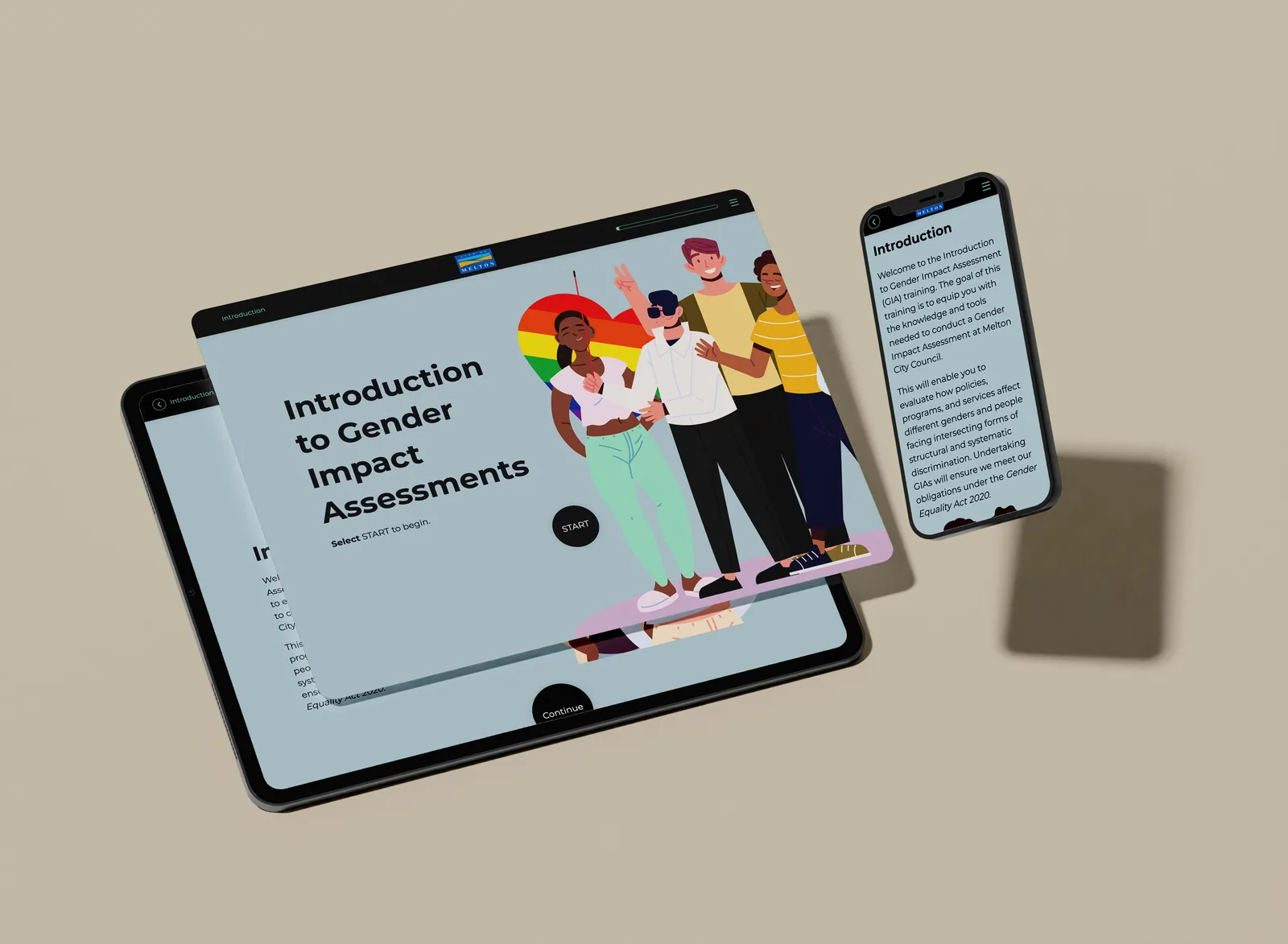
City of Melton: hard topics designed to feel safe.
We designed three modules on gender equality and family violence to feel approachable, trauma-informed and psychologically safe. We built the modules in Chameleon Creator, with scenario-based activities and reflective interactions that turn Council’s source content into practice.
More than 300 people leaders and staff in community-facing services have completed the City of Melton modules. Staff report greater confidence responding to disclosures of family violence.
Multicultural NSW: the course, plus the tools around it.
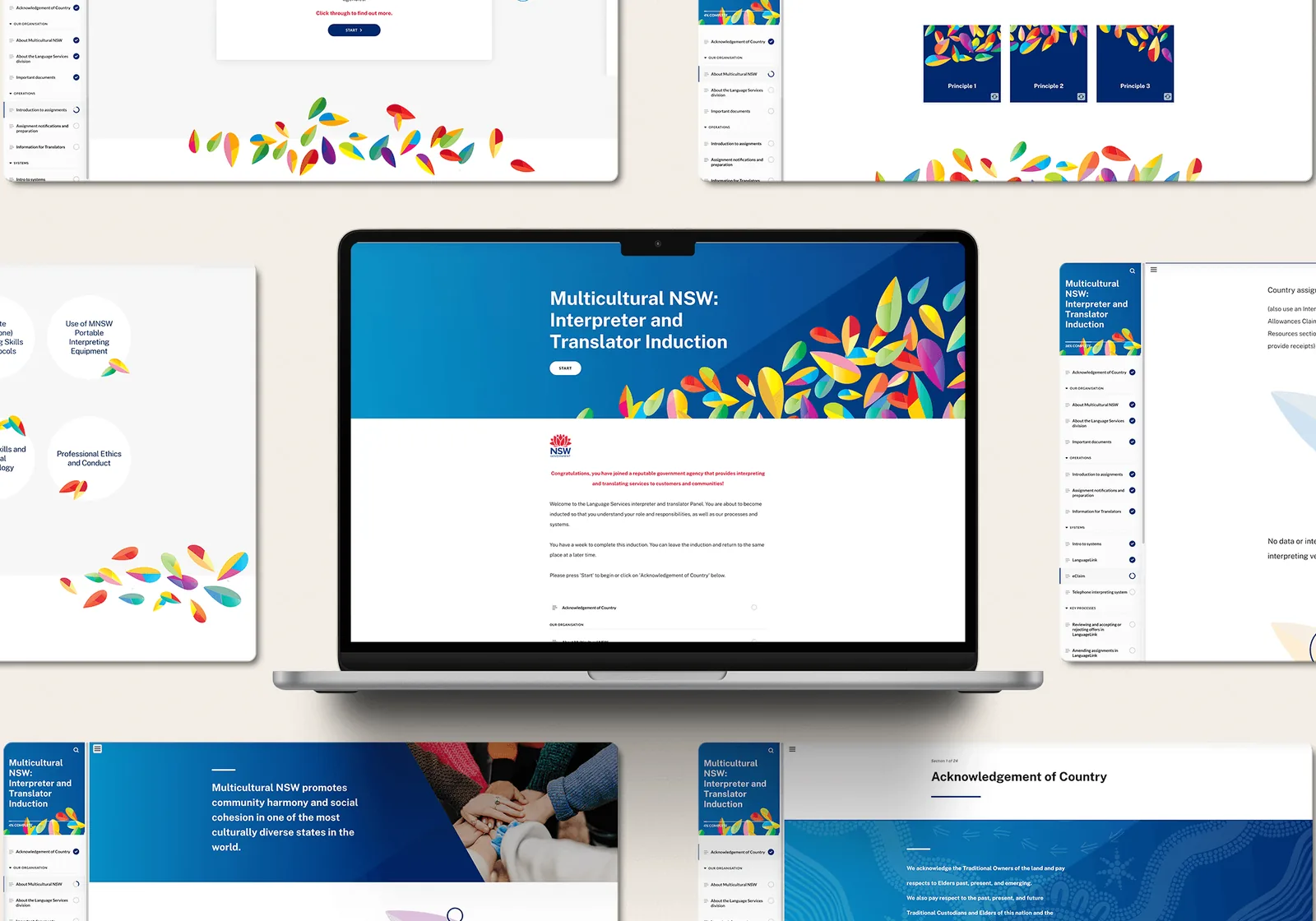
For Multicultural NSW‘s corporate induction, we paired the online course with a self-directed workbook for new employees and a guide for their managers. We also built a module with downloadable tools that help managers support newly arrived refugees joining their teams.
We’ve worked with Multicultural NSW over several years, including an induction for new translators and interpreters.
When should an eLearning company tell you not to build a course?
An eLearning company should tell you not to build a course when your people already know what to do. If they know and still don’t do it, look at their time, tools and managers before assuming that training is a solution. If you can’t yet say what the problem is, start with a learning needs analysis.
When the gap is knowledge or skill and a course is the wrong format, these may be a better fit:
- People need the answer mid-task. A job aid or quick reference guide puts the information in their hands at the point of need.
- The skill needs live practice and feedback. A facilitated workshop lets people practise with someone who can correct them on the spot.
We design programs that mix job aids, workshops and courses. We’ll help you decide which one fits the capability gap you need to close.
FAQs
See how a company works before you sign.
Book a 45-minute discovery call, bring us the problem and we’ll show you builds like yours.
To see our work before you book, open a working demo on our showcase or read how we design custom eLearning.
References
- Australian Bureau of Statistics (2024), Disability, Ageing and Carers, Australia: Summary of Findings, 2022, ABS.
- Freeman, S., Eddy, S. L., McDonough, M., Smith, M. K., Okoroafor, N., Jordt, H. and Wenderoth, M. P. (2014), Active learning increases student performance in science, engineering, and mathematics, Proceedings of the National Academy of Sciences, 111(23), 8410-8415.
- World Wide Web Consortium (2024), Web Content Accessibility Guidelines (WCAG) 2.2, W3C Recommendation, 12 December 2024.
- W3C Web Accessibility Initiative, Introduction to web accessibility, quoting Tim Berners-Lee.

Bianca Schimizzi
Director, Hungry Minds
Bianca Schimizzi is a Director and Senior Learning Designer at Hungry Minds, an Australian learning design consultancy. She’s our quality champion, making sure everything we deliver lives up to our promise of surprisingly good learning design. Bianca asks the sharp questions early, so your program solves the real problem from day one.