


Snapshot





Client
The Department of Jobs, Skills, Industry and Regions (DJSIR) is the Victorian Government department that grows the state’s economy for all Victorians.
It supports businesses and industries to invest and grow, including the tourism and creative sectors. It also builds skills for jobs across the economy and backs regional and community development.
Like every large employer, DJSIR is responsible for the psychological health and safety of its own people.
The need
Psychological risks leave no visible mark, and most of them come from how work is designed and led.
DJSIR wanted its managers to recognise three of them: unreasonable time pressure, low autonomy and low trust, and poor communication and lack of clarity. It also wanted managers to know what to change in their own teams straight away.
The main constraint was attention. Managers give a topic like this a few minutes between meetings, so a long compliance module on psychological safety was unlikely to be finished.
The learning solution
We designed three modules, one for each risk, on a shared structure. The design question was how to make a manager care about an invisible risk in the few minutes they have for it.
How we designed it
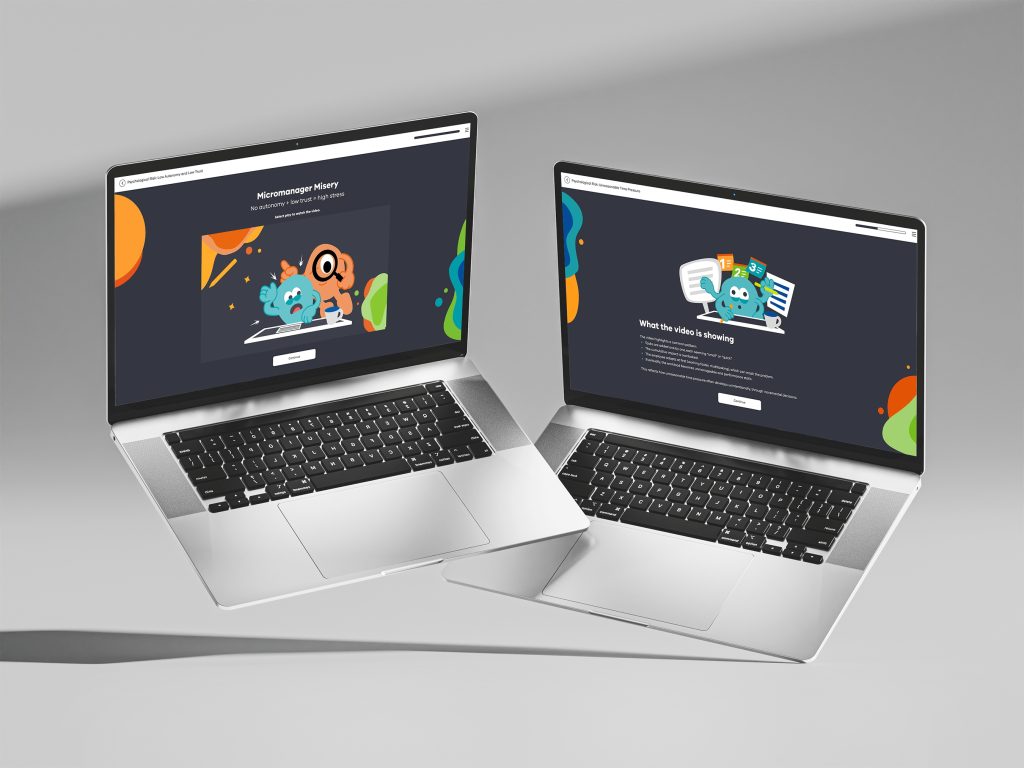
- An animation opens each module. Each module starts with a 20-second animated short. In Deadline Dropkick, a manager drops in one quick task after another while the clock speeds up. In Micromanager Misery, a manager never stops watching, just to be sure. In Mixed Messages, two managers point in different directions and the employee grows extra arms to cope. Learners see the risk happen before anything explains it.
- A screen decodes each animation. “What the video is showing” names the pattern the learner has just watched. For time pressure, that means tasks added one by one, each seeming small, until the combined load becomes unmanageable. The animation makes it funny, and the next screen makes it recognisable.
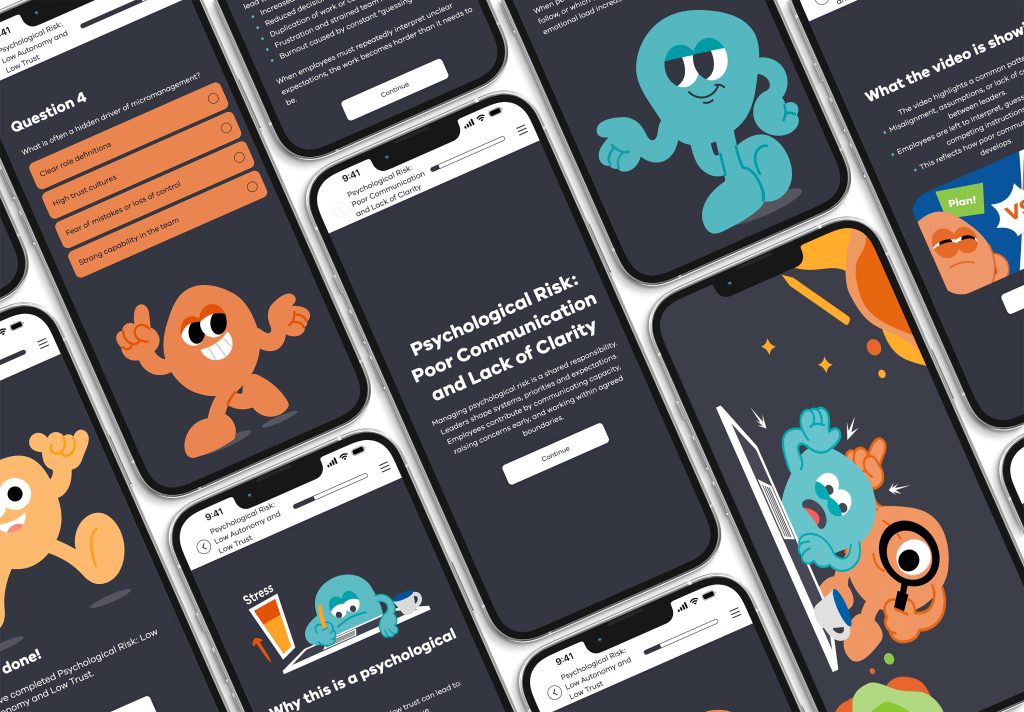
- Characters instead of actors. The cast is a set of bright, non-human characters on a dark stage. A manager watching a realistic actor micromanage someone can feel accused. A manager watching a character with a magnifying glass can laugh first, then decide whether the pattern is theirs. The humour makes a sensitive subject easier to approach.
- Written for the person who can change it. Every module puts manager actions first and speaks to leaders directly. Employee actions follow, and a closing line frames psychological safety as a shared responsibility. Psychological risk is reduced through workload, priorities and expectations, so the modules focus there.
- Reflection on the learner’s own behaviour. Two questions per module ask about the learner’s own leadership. For example: when workload pressure increases, how do you tend to respond as a leader?
- Mastery over a pass mark. Four scenario questions need 100% to pass, with unlimited attempts and feedback on every option. Managers finish knowing the right move for each situation.
- One structure for every risk. All three modules follow the same sequence, from the risk and the video through manager and employee actions to reflection, questions and resources. Each new module is quicker to build than the first.
What we built
- Three microlearns in Chameleon Creator, exported as SCORM 1.2: Unreasonable Time Pressure, Low Autonomy and Low Trust, and Poor Communication and Lack of Clarity.
- Three animated videos of around 20 seconds each, with SRT and VTT caption files. See more of our animation work.
- A bespoke character and background set, with icons and feedback states drawn in the department’s palette and handed over as source files.
- Launch images for hero, laptop and mobile, so the department could promote the modules internally.
- Three more scripts, Change Avalanche, Busy Bragger and Ghost Boss, written and ready to animate.
The outcome
DJSIR now has three microlearns that a manager can finish between meetings, running as SCORM in the department’s own LMS.
Each one ends on a resources screen that points to the department’s existing workload guides, tip sheets and support contacts. The modules lead managers into the support DJSIR already offers.
Three further scripts are written. Because every module follows the same structure, the department can add them without starting a new design.