

Snapshot



Client
TAFE NSW is Australia’s largest provider of vocational education and training, delivering practical, industry-aligned qualifications to hundreds of thousands of students each year across metropolitan, regional and remote New South Wales. Behind those courses sits a large instructional design community (Lead Instructional Designers, Instructional Designers and CQSAS teams) who design and quality-assure the learning experiences that students rely on. As TAFE NSW rolled out a new Course Development Framework, it wanted this community working from one clear, shared approach to design.
The need
TAFE NSW had recently launched a new Course Development Framework (CDF) and wanted its instructional designers working from a shared, consistent approach to design. Designers came from a range of backgrounds and had variable experience with the ADDIE model, there was no common language across teams, and ADDIE and the CDF were often seen as separate things. In a busy environment, process could also feel like a constraint on creativity rather than a support for it. TAFE NSW wanted to bring its people together around one practical approach that connects ADDIE to the CDF and shows that a strong process leads to better, more creative outcomes.
The learning solution
We designed and delivered a contextualised three-hour ADDIE workshop as the centrepiece of a broader capability program for TAFE NSW’s instructional design community. Rather than teaching ADDIE as theory, we built the workshop on discovery learning: participants co-construct the model from their own practice, then connect it directly to the TAFE NSW Course Development Framework. Every design choice was grounded in evidence-based learning principles: activating prior knowledge, learning by doing, spacing and reinforcement, and building in accountability so the learning transfers back to the job.
How we designed it
- Started with analysis and design. Ran a discovery and kick-off process with TAFE NSW and produced a high level design and learning architecture as a blueprint, agreed before build. This modelled the very Analyse and Design thinking the workshop teaches, so we solved the right problem before developing anything.
- Co-designed around their context. Mapped every ADDIE stage to the newly launched Course Development Framework (Scope, Design, Build Prep) so the model reinforced TAFE NSW’s ways of working rather than competing with them.
- Used discovery learning. Participants build the ADDIE model themselves through guided questions (recognition, not instruction), so they own the model rather than receive it.
- Learned through case studies. Anchored the session in six realistic case studies where projects failed for want of good Analyse and Design, making the cost of skipping a stage concrete and memorable.
- Made it collaborative and hands-on. Ran the whole workshop on a live Miro board with mixed breakout groups (each anchored by a Lead Instructional Designer) for hands-on, collaborative practice rather than passive listening.
- Taught for transfer. Introduced five “sticky learning levers” (spacing, application, social accountability, leader reinforcement and visible progress) so designers can build learning that changes behaviour, not just satisfaction scores.
- Built in accountability. Each participant leaves with a “Monday morning” commitment and a scheduled peer check-in two weeks later, turning intention into action.
- Planned evaluation from the start. Designed a two-part evaluation up front: an in-workshop pulse check against the learning outcomes, and a 30-day team huddle guide for Lead IDs, so impact is measured and acted on, not assumed.
What we built
- A contextualised three-hour ADDIE workshop: delivered virtually via Microsoft Teams and Miro across six cohorts of around 20 participants, giving the whole design community a shared language and a consistent, practical approach.
- A high level design and learning architecture: the agreed blueprint that gave TAFE NSW confidence in the approach before build and kept the program aligned to its objectives.
- A fully facilitated Miro board: with co-build activities, case studies, question canvases and a public commitment gallery, turning a virtual session into active, collaborative practice.
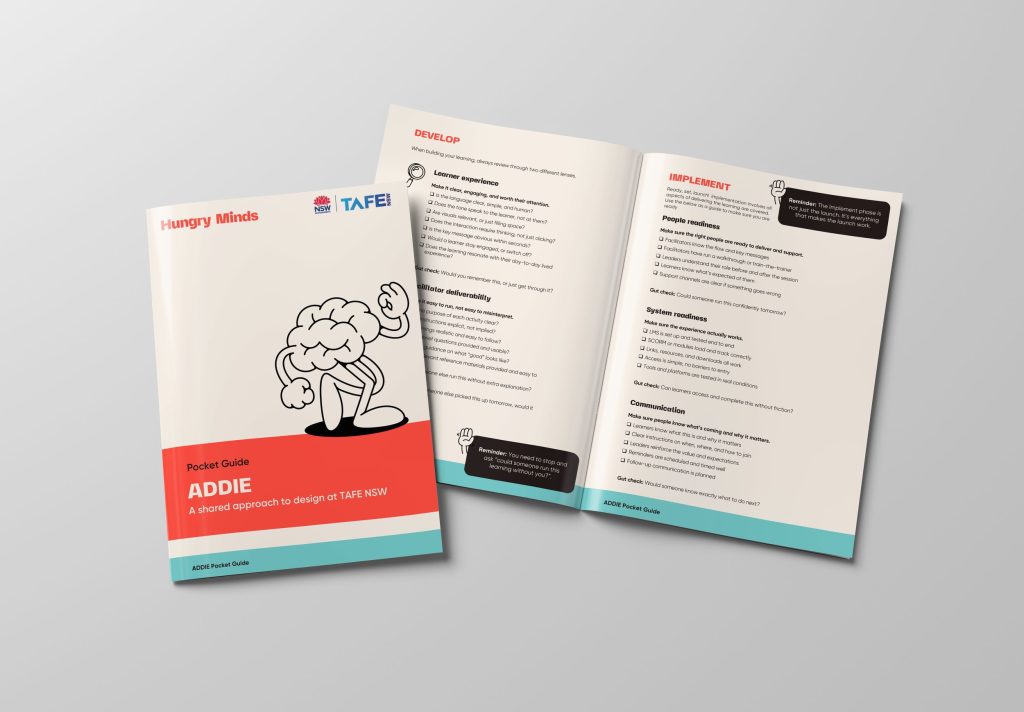
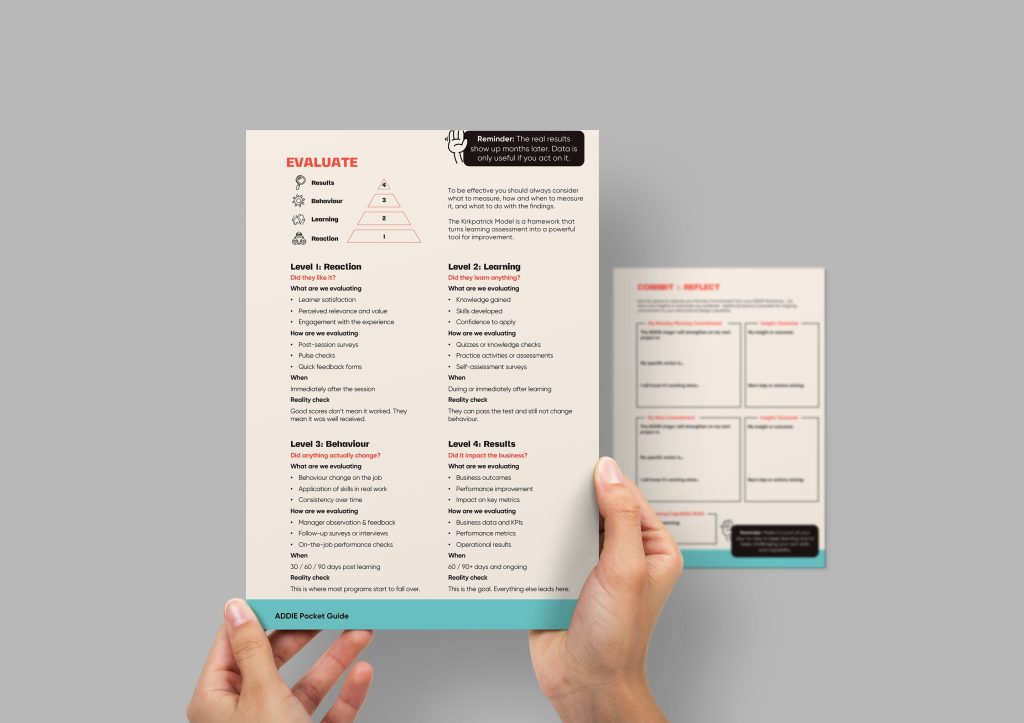
- A 10-page ADDIE pocket guide: covering what each stage is for, the Analyse question “buckets”, the sticky learning levers, the two Develop review lenses, the Implement readiness checklists, the Kirkpatrick evaluation model, and space for ongoing commitments. A lasting job aid so the learning lives on after the workshop.
- An evaluation strategy: an in-workshop pulse check plus a one-page 30-day team huddle guide, giving TAFE NSW a practical way to see ADDIE thinking showing up in real work and to address barriers as a team.
The outcome
The workshop gave TAFE NSW’s instructional designers a shared language and a consistent, practical approach to design, one that connects ADDIE directly to their Course Development Framework and reframes process as a design advantage rather than a constraint. Delivered across six cohorts, it reached the breadth of the design community, and the pocket guide and commitment cards keep the thinking active in day-to-day work well beyond the session. TAFE NSW is continuing to build on the program, with a follow-on Instructional Design for Teams course for its lead design group.
What this means for TAFE NSW
- A common ADDIE language across Lead IDs, IDs and CQSAS teams, supporting clearer collaboration and stronger design decisions.
- ADDIE and the Course Development Framework working as one connected system rather than two separate things.
- Sharper Analyse and Design practice, reducing costly rework and lifting the quality of learning for students.
- Practical job aids and peer accountability that embed the learning into everyday work.