

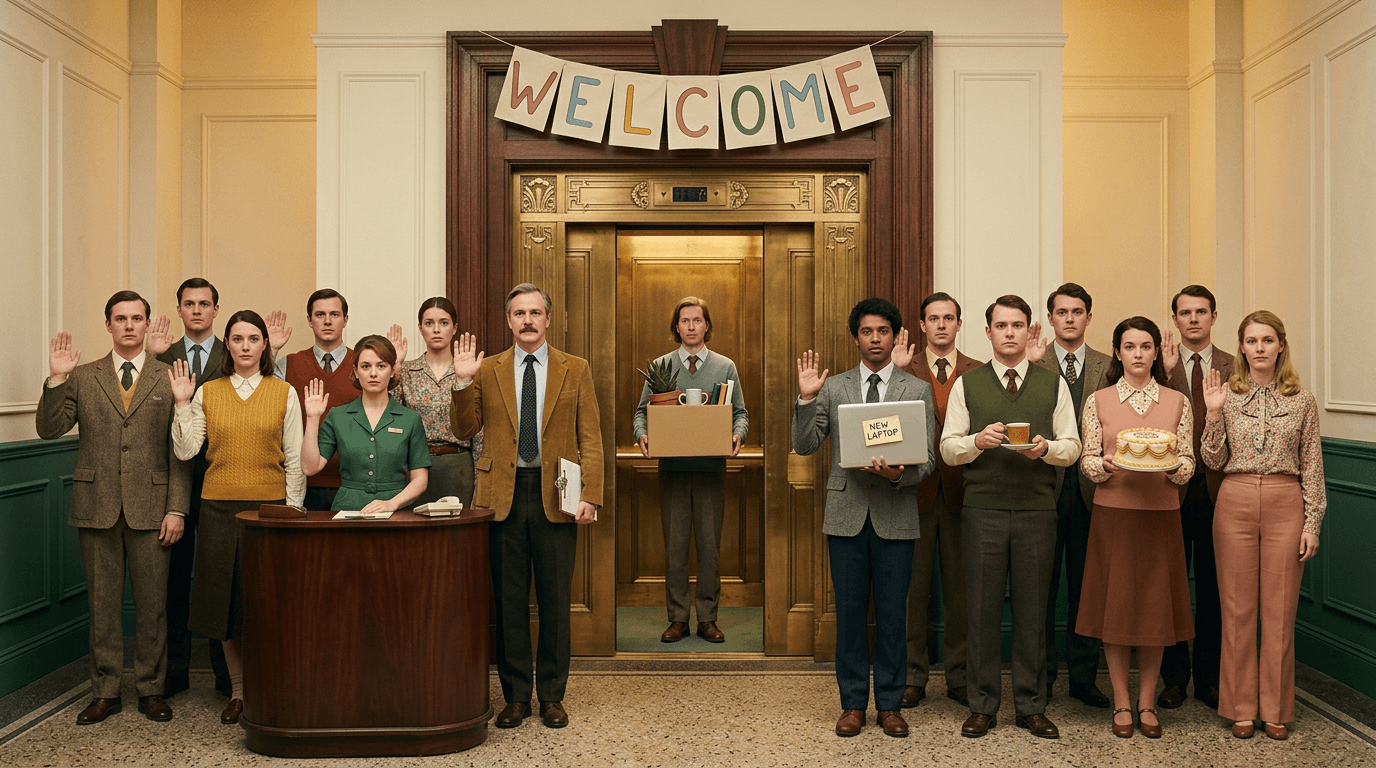
Most inductions are built to answer one question: has this person seen the policies? That is compliance, and it matters. But it is the smallest part of what an induction can do, and the research is unusually clear about what the rest looks like.
This article sets out the studies we trust, the numbers we do not, and how organisations with a strong sense of purpose turn their first weeks into something people remember.
What makes an induction stick?
The biggest measured effects in onboarding come from people, not content. Feeling accepted by colleagues predicts commitment more strongly than any amount of information. Stories told by frontline staff change how new starters behave more than stories told by executives. Five minutes with a real client changes effort for a month, and a written case study does not. One hour on day one spent on who the new starter is, rather than who the organisation is, cut turnover by a third in the one field experiment that tested it. And programs built only on online modules show no measurable benefit at all.
Four things an induction can do and where most stop
Talya Bauer’s framework for the SHRM Foundation splits onboarding into four Cs: compliance (rules and paperwork), clarification (what the job is), culture (how things work here) and connection (relationships). Her estimate is that around 30 per cent of organisations stop at compliance, half get as far as clarification, and only about one in five do all four systematically. That is an expert estimate rather than a survey, but it matches what we see. When a client tells us they already have twelve mandatory modules and their new starters still do not know what the organisation is for, they are describing an induction that stopped at the second C.
The 2025 meta-analysis by Bauer and colleagues in the Journal of Management, covering 183 samples, puts numbers on the other two. Social acceptance predicts job satisfaction at r = .42 and commitment at r = .40. The socialisation tactics with the largest effects are the social ones: role models, insiders, buddies. Content tactics matter, but less. So if the budget has to lean somewhere, it leans toward connection.
Stories: who tells them matters
Everyone agrees stories work in induction. The interesting finding is which stories. Sean Martin’s 2016 field experiment in the Academy of Management Journal followed 632 new hires at a large IT company. Stories about junior staff living the organisation’s values had a stronger effect on newcomers’ helping behaviour than the same stories told about senior leaders. Stories about senior leaders mattered most as cautionary tales: a leader breaching a value dampened behaviour more than a junior person doing the same.
The design consequence is simple. A CEO’s voice is for purpose, history and why the organisation exists. The frontline’s voice is for how we treat people here. Both belong in an induction, and they do different jobs. We saw this at Corrections Victoria, where a six-episode podcast series was opened by the Commissioner and carried by experienced officers talking about their first months and what they wished they had known. New staff listened on the drive in.
Clients and beneficiaries: live beats written
Adam Grant’s studies on task significance are the strongest evidence we have for “put yourself in the client’s shoes” activities, and they come with a warning. In the 2007 study, fundraisers who had a five-minute conversation with a scholarship recipient increased their weekly call time by 142 per cent and the money they raised by 171 per cent a month later. Fundraisers who only read a letter from a recipient showed no change at all. In the 2008 follow-up, new callers given a briefing on who their work helped earned 76 per cent more pledges in their first week, and lifeguards who read stories of rescues worked 43 per cent more voluntary hours. Stories about the personal benefits of the job made no difference.
So a client story in an induction should be a person: in the room, on a live call, or at minimum on film in their own words. A paragraph in a workbook is the weakest possible form of the same idea.
Day one: ask who they are before you tell them who you are
Cable, Gino and Staats ran a field experiment at Wipro with 605 new hires, published in Administrative Science Quarterly in 2013. One group spent an hour on day one reflecting on their own strengths and introducing their “best self” to the group, before any content about the company. Another spent the hour on the company’s values and star performers. A control group had the standard induction. Six months later, turnover in the control group was 47 per cent higher than in the best-self group, and the company rolled the exercise out everywhere.
It is a single study in a single company, so we cite it as a field experiment rather than a law. It is also cheap, one hour, and the effect is the largest single-intervention result in the onboarding literature.
Leaders on film
Klein and Weaver’s 2000 study in Personnel Psychology is the closest peer-reviewed support for a CEO video. New staff at Ohio State who attended a three-hour orientation covering history, values and mission, including a videotaped message from the president, knew more about the organisation’s goals and reported higher commitment one to two months later than those who did not. The study does not isolate the video’s effect, so nobody should claim it does. It does show that a short, well-built orientation with a leader’s voice in it moves commitment.
For organisations with a long-tenured or founding leader there is a second reason to record them. Spencer Stuart’s analysis of founder-led companies found founder CEOs serve 21 years on average and that 21 per cent of their successors are replaced within two years. Their advice is to capture the culture in the founder’s own words while you can. Ritz-Carlton still opens with Horst Schulze’s line about ladies and gentlemen serving ladies and gentlemen. Mayo Clinic still opens with the Mayo brothers. A film made now is a culture tool today and a succession asset later.

Learning the whole organisation: treasure hunts and teach-backs
Two activities keep coming up when clients describe what they want: sending new starters to find people across the organisation, and having them research a part of the business and present it. The evidence for each is different.
Gamified learning, which is what a treasure or scavenger hunt is, has a solid meta-analysis behind it. Sailer and Homner (2020) found a moderate effect on knowledge (g = 0.49) and smaller effects on motivation and behaviour that did not survive when only high-quality studies were included. So a treasure hunt is a good way to learn what fifty programs do and who runs them. It is not a motivation engine, and we do not sell it as one. Our own hunts at Multicultural NSW, VECCI and Metro Trains Sydney worked because each stop was a person with a story, which is Bauer’s connection effect doing the work under a game.
Teach-backs have stronger evidence than most people expect. Kobayashi’s 2019 meta-analysis of 28 studies found that preparing to teach something produces a learning effect of g = 0.35, and teaching it lifts that to g = 0.56, with interactive teaching (the audience asks questions) beating a straight presentation. “Research one program you do not work in and present it to your team” is well supported, provided the team is allowed to ask.
Past day one: spacing and practice
Cepeda and colleagues’ 2006 review of 317 experiments found that spaced learning beat one-off learning in 95 per cent of comparisons, with an average recall advantage of about 15 percentage points, and that the ideal gap grows with how long you need to remember. To hold something for six months, space it over weeks. A 30, 60 and 90-day campaign is the spacing effect applied to induction. A single induction day is the opposite, and the forgetting curve shows what happens next.
Frögéli, Jenner and Gustavsson’s 2023 systematic review in PLOS ONE is blunter. Across the controlled studies of formal onboarding, programs that relied solely on online modules showed no significant benefit. Structured, supported practice in the real work setting had large effects on role clarity and competence, and the most effective programs ran six to nine months. This is the research case against the thirteenth module, and the reason we design induction as a learning journey rather than an event.
Buddies and managers
Microsoft’s 2019 buddy pilot, reported in Harvard Business Review, tracked 600 new hires. Those with a buddy were 23 per cent more satisfied with onboarding at one week and 36 per cent at 90 days. Of those who met their buddy more than eight times in the first 90 days, 97 per cent said the buddy helped them become productive faster. These are self-reports from one company, and the “56 per cent faster” version that circulates online is a misreading. The real finding is about meeting frequency. Weekly, for 90 days, is the cadence to design for.
Gallup’s onboarding research adds the manager: when managers take an active role, new hires are 3.4 times as likely to say their onboarding was successful, and only 12 per cent of employees strongly agree their organisation does a great job of it. A manager conversation guide for the first fortnight is the cheapest intervention on this list.
Purpose as the retention lever
Gallup’s mission item (Q08) is the one to measure. Only about four in ten employees strongly agree that their organisation’s mission makes their job feel important, and Gallup’s models link a 10 per cent improvement on that item to an 8.1 per cent reduction in turnover. Deloitte’s 2014 survey found 73 per cent of employees at organisations with a strong sense of purpose said they were fully engaged, against 23 per cent elsewhere.
For a purpose-led organisation the lever already exists. The induction’s job is to make it explicit, personal and measured at 30 and 90 days rather than left on a slide.
Who does this well
Seven organisations with a strong sense of purpose, and what their first weeks look like.
| Organisation | What they do |
|---|---|
| Cleveland Clinic | Took all 43,000 staff offline for a day in mixed-role tables, a surgeon beside a housekeeper, to watch patient story films together and then talk. Every role was renamed “caregiver”, and every new hire now does the same program in orientation. Source |
| Mayo Clinic | Rebuilt orientation around a history film, a resource fair with twelve departments, a scavenger hunt across the campus and a bus tour led by retired employees. More than 900 staff rated it 88 to 95 per cent effective, and every site runs Heritage Days each October. Source |
| Ritz-Carlton | Starts every shift with a fifteen-minute line-up and a “wow story” about a colleague, read across the company the same day. Source |
| Zappos | Puts every hire, whatever their role, through the same four weeks: history, every department head presenting, and everyone learning to take a customer call. Source |
| Boots (UK) | Built its induction from the corporate archive, a 30-page illustrated history for every starter, and found it was also the best tool for bringing staff from acquired businesses into one story. Source |
| Canva | Runs a two-week onboarding with an office scavenger hunt and a mentor, and the co-founders still run the values session for every intake. Source |
| Teach For Australia | Runs a five-week national intensive so that a cohort becomes a community before anyone is placed. Source |
The pattern across all of them: everyone in the same room regardless of role, one shared identity, the founder or leader’s voice, the whole organisation learned by meeting it, the client at the centre, and reinforcement that runs well past day one.
The numbers we do not use
Some onboarding statistics are repeated so often they have become furniture. These are the four we leave out, and why.
- “Strong onboarding improves retention by 82 per cent and productivity by 70 per cent.” This traces to a 2015 Brandon Hall Group brief with no published method, sample or definition. Glassdoor cited it, and everyone else cites Glassdoor.
- “58 per cent more likely to stay three years.” An Aberdeen figure from 2007 that survives only in secondary sources.
- Oxytocin and storytelling. Paul Zak’s claims did not survive a 2015 critical review of the underlying trust studies.
- Stories are “22 times more memorable”. Attributed to Jerome Bruner, with no primary source anyone can find.
Stories, purpose and connection do not need these numbers. The studies above are enough.
FAQs
Frequently asked questions about induction programs
How we build inductions that stick
Our inductions for Corrections Victoria, Multicultural NSW, Marist180, Jewish Care, Southern Metropolitan Cemeteries Trust and Coongan each drew on some mix of the above. You can read more about that work on our onboarding and inductions page and in the Multicultural NSW case study.
If you are designing an induction and want to know which of these ideas fit your organisation before you spend anything on production, that is what a short Analyse and Design phase is for. Our learning strategy and learning design teams can map it with you, then build it.
Book a callReferences
- Bauer, T. N. (2010), Onboarding new employees: maximizing success, SHRM Foundation
- Bauer, T. N., Erdogan, B., Ellis, A. M., Truxillo, D. M., Brady, G. and Bodner, T. (2025), New horizons for newcomer organizational socialization: a review, meta-analysis, and future research directions, Journal of Management
- Cable, D. M., Gino, F. and Staats, B. R. (2013), Breaking them in or eliciting their best? Reframing socialization around newcomers’ authentic self-expression, Administrative Science Quarterly, 58(1), 1-36
- Cepeda, N. J., Pashler, H., Vul, E., Wixted, J. T. and Rohrer, D. (2006), Distributed practice in verbal recall tasks: a review and quantitative synthesis, Psychological Bulletin, 132(3), 354-380
- Deloitte (2014), Core beliefs and culture survey
- Frögéli, E., Jenner, B. and Gustavsson, P. (2023), Effectiveness of formal onboarding for facilitating organizational socialization: a systematic review, PLOS ONE
- Gallup (2021), 8 practical tips for leaders for a better onboarding process
- Gallup, Three ways mission-driven workplaces perform better
- Grant, A. M., Campbell, E. M., Chen, G., Cottone, K., Lapedis, D. and Lee, K. (2007), Impact and the art of motivation maintenance, Organizational Behavior and Human Decision Processes, 103, 53-67
- Grant, A. M. (2008), The significance of task significance, Journal of Applied Psychology, 93(1), 108-124
- Klein, H. J. and Weaver, N. A. (2000), The effectiveness of an organizational-level orientation training program in the socialization of new hires, Personnel Psychology, 53(1) (summary from The Ohio State University)
- Klinghoffer, D., Young, C. and Haspas, D. (2019), Every new employee needs an onboarding buddy, Harvard Business Review
- Kobayashi, K. (2019), Learning by preparing-to-teach and teaching: a meta-analysis, Japanese Psychological Research, 61(3)
- Martin, S. R. (2016), Stories about values and valuable stories: a field experiment of the power of narratives to shape newcomers’ actions, Academy of Management Journal, 59(5), 1707-1724
- Nave, G., Camerer, C. and McCullough, M. (2015), Does oxytocin increase trust in humans? A critical review of research, Perspectives on Psychological Science, 10(6), 772-789
- Sailer, M. and Homner, L. (2020), The gamification of learning: a meta-analysis, Educational Psychology Review, 32, 77-112
- Spencer Stuart, From founder-led to founder-inspired: advice for successor CEOs
- Cleveland Clinic, The power of purpose: a caregiver movement
- Association for Talent Development, Mayo Clinic orientation redesign
- Chief Executive, Ritz-Carlton founder Horst Schulze on the gold standard
- CustomerThink, Zappos new hire onboarding
- Managing Business Archives, Re-telling an old story (Boots)
- HRD Australia, Kudos: why belonging is key to wellness (Canva)
- Teach For Australia, What does the start of the journey look like?