
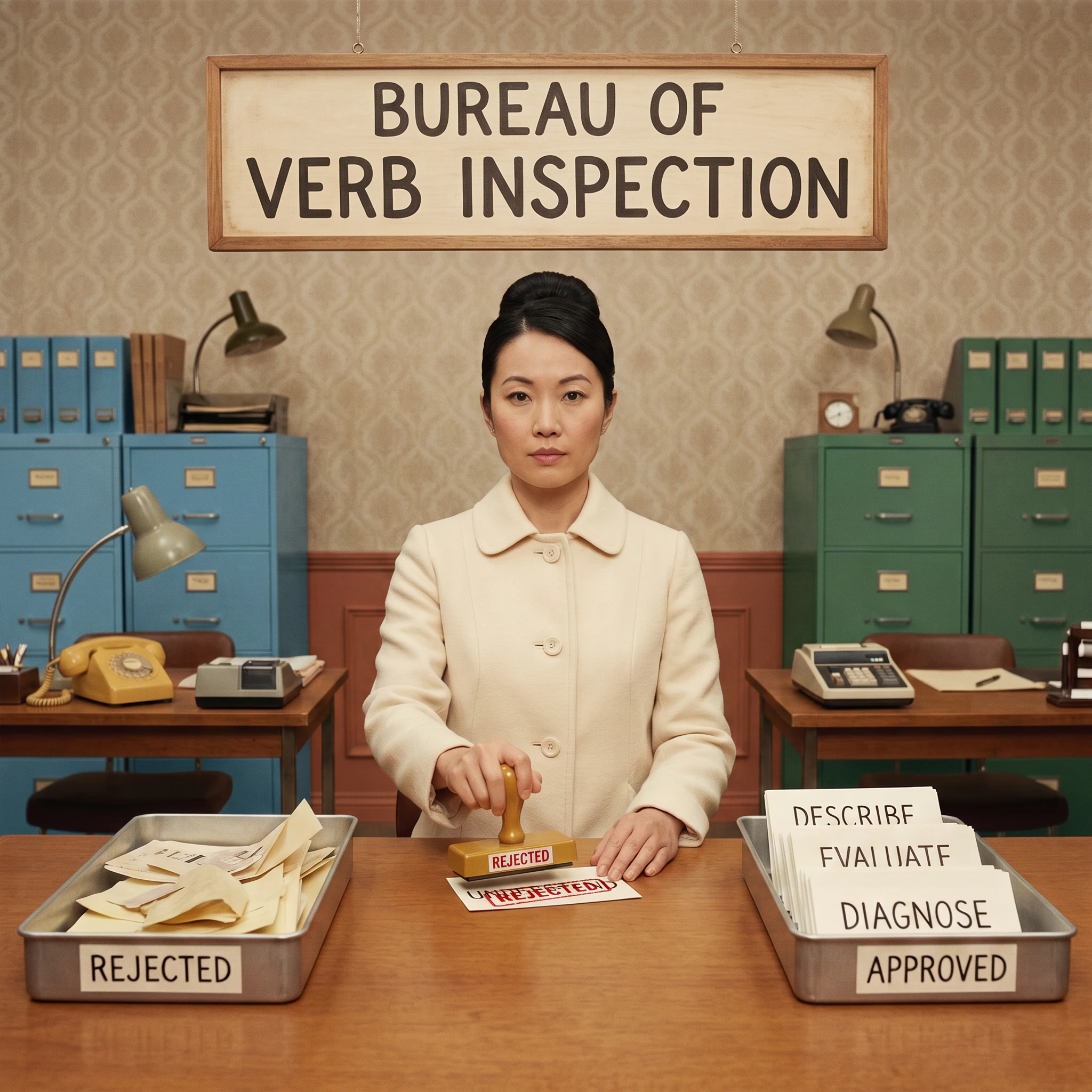
Bloom’s taxonomy turned 70 this year, and it is still one of the most quoted frameworks in learning design. It is also one of the least used. Plenty of training gets built with no real thought about what the learner needs to be able to do.
This guide covers what Bloom’s taxonomy is, how the revised version differs from the 1956 original, the knowledge dimension almost everyone skips, and how we use it on compliance, safety and leadership programs across Australia.
What is Bloom’s taxonomy?
Bloom’s taxonomy is a framework that classifies learning objectives by the level of thinking they require. The revised 2001 version sets out six cognitive levels: remember, understand, apply, analyse, evaluate and create. Learning designers use it to write objectives, sequence content and match assessment to the thinking a task demands.
Benjamin Bloom chaired the committee of educators that published Taxonomy of Educational Objectives in 1956. The purpose was practical rather than theoretical: give educators a shared vocabulary so that a “test of comprehension” meant roughly the same thing in two different institutions.
That original problem has not gone away. When a subject matter expert says a learner needs to “understand” a policy, that word could mean anything from reciting a definition to weighing up two competing obligations under pressure. Bloom’s taxonomy forces the conversation to get specific.
The six levels of Bloom’s revised taxonomy
The revised taxonomy runs from simpler cognitive work to more complex. Each level is expressed as a verb, because an objective describes something a learner does.
| Level | What the learner does | Workplace example |
|---|---|---|
| 1. Remember | Retrieves facts, terms, procedures from memory | Lists the four steps in the site lockout procedure |
| 2. Understand | Explains ideas in their own words | Explains why the lockout procedure exists |
| 3. Apply | Uses knowledge in a new but familiar situation | Completes a lockout on unfamiliar equipment |
| 4. Analyse | Breaks information apart and sees relationships | Identifies which step failed in an incident report |
| 5. Evaluate | Judges against criteria and defends the judgement | Decides whether a contractor’s method statement is adequate |
| 6. Create | Produces something new from the parts | Writes a lockout procedure for a new plant configuration |
The levels are useful as a rough progression, not a staircase everyone must climb one step at a time. Research on the revision notes that the 2001 update softened the strictness of the hierarchy without removing it entirely. In practice, an experienced operator might analyse a fault well before they can explain the underlying theory.
If you want a verb list to work from, Instructional Design Australia publishes a free quick reference guide for writing learning outcomes with Bloom’s revised taxonomy that maps suggested verbs to each level.
Bloom’s original taxonomy vs the revised (modified) taxonomy
In 2001, Lorin Anderson, a former student of Bloom, and David Krathwohl, a co-author of the 1956 original, published a revision. You will see it called Bloom’s revised taxonomy or Bloom’s modified taxonomy. They are the same thing.
| 1956 original | 2001 revision | What changed |
|---|---|---|
| Knowledge | Remember | Renamed and converted to a verb |
| Comprehension | Understand | Renamed and converted to a verb |
| Application | Apply | Converted to a verb |
| Analysis | Analyse | Converted to a verb |
| Synthesis | Evaluate | Order swapped with evaluation |
| Evaluation | Create | Synthesis renamed to create and moved to the top |
Three changes matter more than the renaming.
- Nouns became verbs. The original categories described types of knowledge. The revision describes cognitive processes, which is far more useful when you are writing something a learner has to demonstrate.
- Synthesis and evaluation swapped. Creating something original was judged to be more cognitively demanding than judging something against criteria, so create moved to the top.
- A second dimension was added. This is the part most summaries leave out, and it is the most useful change of the three.
The knowledge dimension: the half of Bloom’s taxonomy people skip
The revised taxonomy is a grid, not a ladder. The six cognitive processes run along one axis. Four types of knowledge run along the other.
| Knowledge type | What it covers | Example in a workplace program |
|---|---|---|
| Factual | Terminology, specific details, discrete facts | Hazard classification codes |
| Conceptual | Categories, principles, models, how parts relate | The hierarchy of control |
| Procedural | Methods, techniques, criteria for when to use them | How to run a risk assessment, and when |
| Metacognitive | Awareness of your own thinking and strategy | Recognising when you are out of your depth and escalating |
Unlike the six cognitive levels, these four are not a hierarchy. They are different kinds of content that each need different treatment.
Crossing the two dimensions gives you a much sharper objective. “Apply procedural knowledge” and “apply conceptual knowledge” produce completely different activities and completely different assessments. The first needs a simulation. The second needs a scenario with an ambiguous answer.
Metacognitive knowledge is the category we see neglected most often, and it is frequently the one that matters most. In high-risk work, the skill that prevents incidents is often not knowing the procedure. It is recognising that this situation is not the one the procedure was written for.
The three domains of learning
Bloom’s taxonomy is usually discussed as if the six cognitive levels are the whole thing. They are not. The original work identified three domains of learning: cognitive, affective and psychomotor.
Cognitive domain: thinking
The six levels above. Published in 1956 and by far the most widely used.
Affective domain: attitudes, values and buy-in
Krathwohl and colleagues published the affective taxonomy in 1964, with five levels running from receiving, through responding, valuing and organising, to characterisation, where a value becomes part of how someone consistently behaves.
This domain is where most culture, inclusion, safety leadership and wellbeing programs live. The training does not fail because people cannot recall the content. It fails because nothing shifted at the valuing level.
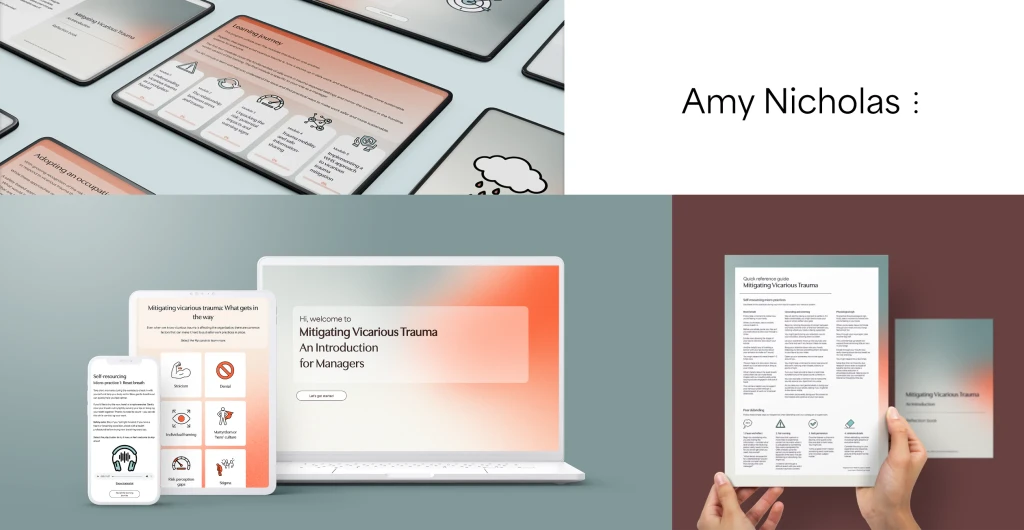
Mitigating Vicarious Trauma Frontline community services workers carry the weight of other people’s trauma, but martyrdom and other barriers have caused resistance to change. So, we designed for the affective domain first, naming the risk, normalising the response, and only then moving into practical strategies. Read the Mitigating Vicarious Trauma case study.
Psychomotor domain: physical skill
Bloom’s original group never completed a psychomotor taxonomy. Later researchers, including Simpson, Dave and Harrow, filled the gap with models running from imitation and guided practice through to precision and automaticity.
This domain governs equipment operation, clinical procedures, plant isolation and anything else where the hands have to be right. It is also the domain most badly served by eLearning built in isolation. You cannot assess a psychomotor objective with a multiple choice question, which is why these programs need a blended design with observed workplace assessment.
How to use Bloom’s taxonomy to write learning objectives
The taxonomy earns its keep at one specific moment: when you convert a vague request into something you can build and assess.
Here is what that looks like in practice.
| What the stakeholder asked for | Problem | Rewritten with Bloom’s |
|---|---|---|
| “Staff need to understand the new Code of Conduct” | Not observable, not assessable | Evaluate a workplace scenario against the Code and justify whether the conduct breached it |
| “Managers should be aware of psychosocial hazards” | Awareness is not a behaviour | Identify three psychosocial hazards in their own team and select an appropriate control for each |
| “Everyone needs training on the new CRM” | No level, no scope | Complete a standard customer record update in the CRM without reference to a job aid |
| “We want people to think more strategically” | Unbuildable as written | Analyse a business case and evaluate it against three stated investment criteria |
Three rules we hold to when writing objectives.
- One verb, one level, one observable behaviour. If an objective needs the word “and” twice, it is two objectives.
- Pick the level the job requires, not the highest one available. “Create” is not a badge of quality. For a lockout procedure, reliable recall and correct execution beat original thinking every time.
- Write the assessment at the same moment. If you cannot describe how you would check it, the objective is not finished. This is the step that keeps evaluation honest later.
Once objectives are set, they drive everything downstream: the high level design, the choice of learning methodologies and activities, and where the program sits in the broader learning architecture.
Bloom’s taxonomy in Australian workplace and compliance training
Two things make the taxonomy more than an academic exercise in an Australian workplace context.
Safety duties are written in behavioural terms. Under the model work health and safety laws, a business must provide information, training, instruction and supervision that is adequate and understandable. Safe Work Australia’s guidance on training and supporting your workers makes clear this is about what workers can do safely, not what was delivered to them. An objective pitched at “remember” when the job needs “apply” is a gap in a risk control.
Accredited training requires defensible assessment. Where a program leads to a nationally recognised outcome, the 2025 Standards for RTOs require assessment that genuinely evidences competence. Objectives written at the right cognitive level are what make that mapping hold up.
We use this thinking constantly. On biosecurity work with NSW DPI, the core objectives sat at analyse and evaluate, because inspectors need to weigh ambiguous evidence rather than recall a list. On equipment safety work with Southern Metropolitan Cemeteries Trust, the objectives were procedural and psychomotor, and the design had to include observed practice. Same framework, two very different builds.
Where Bloom’s taxonomy falls down
We use it constantly. We also do not treat it as scripture. Four honest limitations.
- Verb lists get used mechanically. The same verb can sit at different levels depending on the task. “Identify the correct form” is remembering. “Identify the root cause” is analysing. The verb alone tells you nothing without the object.
- Higher is not better. The taxonomy is often read as a quality ladder, where anything below “analyse” is lazy design. That misreads it. Plenty of critical workplace behaviour is pure recall and correct procedure, executed reliably under pressure.
- It classifies objectives, it does not design instruction. Bloom’s tells you what level you are aiming at. It does not tell you how to teach it. That is what Merrill’s first principles, adult learning theory and the 70:20:10 model are for.
- It says nothing about retention. You can write a perfect create-level objective and still have the whole thing evaporate in a fortnight. The Ebbinghaus forgetting curve is a separate problem requiring a separate solution, usually spaced reinforcement and microlearning.
Treat it as one instrument in the kit, sitting inside a full learning design process rather than standing in for one.
FAQs
Frequently asked questions about Bloom's taxonomy
Benjamin Bloom chaired the committee of educators who published Taxonomy of Educational Objectives in 1956, following a series of conferences that began in 1949. The affective domain was published in 1964. The cognitive domain was revised in 2001 by Lorin Anderson and David Krathwohl.
Getting the level right is most of the work
Bloom’s taxonomy will not write your program. What it will do is stop you building a knowledge check for a problem that needs judgement, or a three-day workshop for something that needs a job aid.
That decision happens early, in the analysis, which is where we spend most of our energy. If you are working out what your people need to be able to do, start with learning strategy. If the objectives are clear and you need it built well, our learning design and eLearning teams can take it from there. Send us the problem and we will tell you what level it sits at.
References
- Adams, N. E. (2015), Bloom’s taxonomy of cognitive learning objectives, Journal of the Medical Library Association, National Library of Medicine
- Orgill, B. D. and Nolin, J., Learning Taxonomies in Medical Simulation, StatPearls, National Library of Medicine
- The revised Bloom’s taxonomy dimensions, Education Resources Information Center (ERIC), US Department of Education
- Creating an empirically derived Bloom’s wheel, Education Resources Information Center (ERIC), US Department of Education
- Safe Work Australia, Training and supporting your workers to stay safe at work
- Australian Skills Quality Authority, About the 2025 Standards for RTOs
- ibstpi, Instructional Designer Competencies